What Does Iced Out Mean? The Term, the Culture, and the Stones
Learn what iced out means in jewelry and watches, how the stones differ, and what common price tiers really buy in 2026.
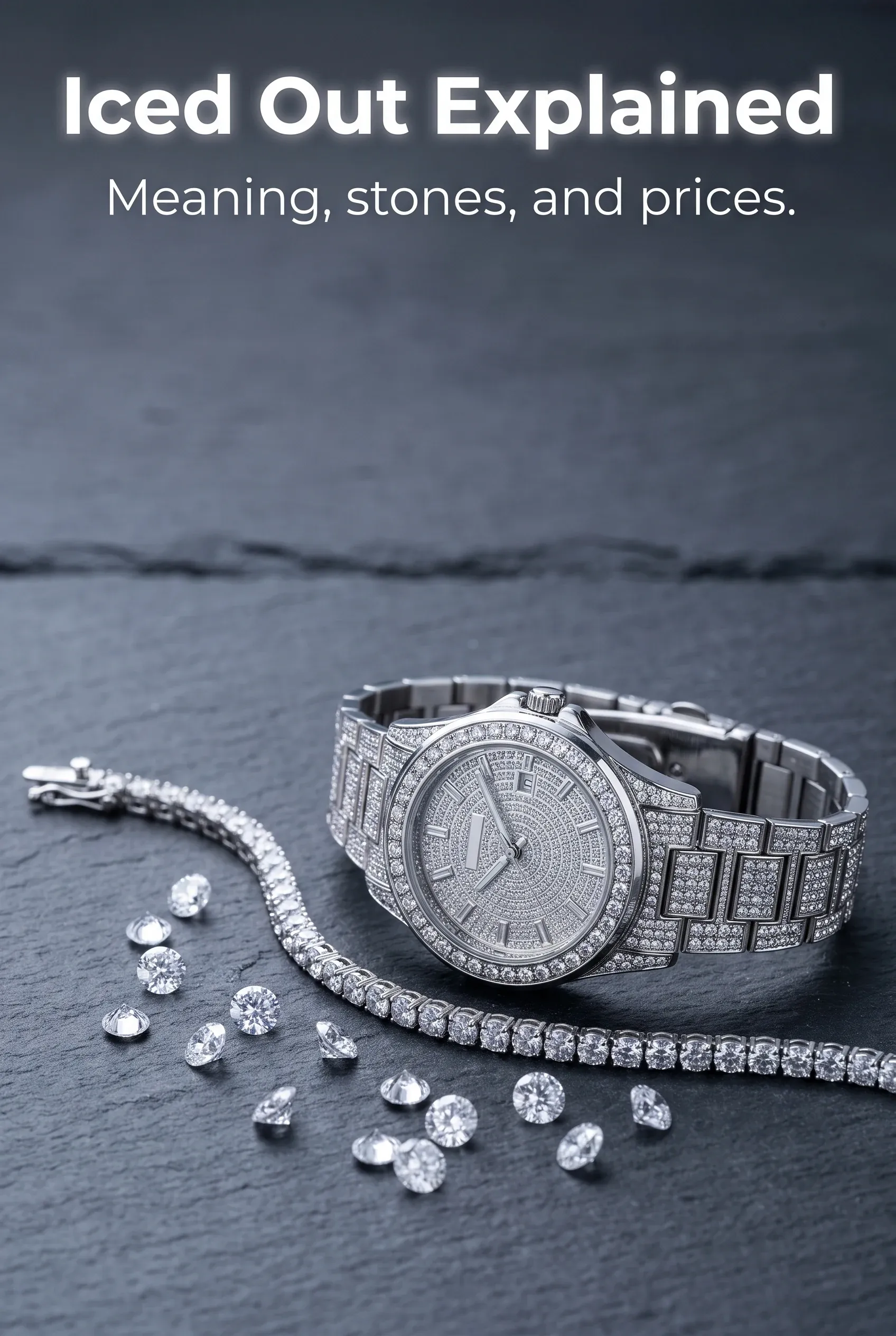
Iced out means a watch, chain, bracelet, or ring is heavily covered with bright stones. In jewelry talk, the phrase describes the look first, not the gem species, not the price, and not whether the stones are diamond, moissanite, cubic zirconia, or crystal. If you are shopping, that distinction matters because two pieces can look similar from across a room and sit in very different quality tiers.
What iced out means in jewelry
In the jewelry world, iced out usually means surface coverage. The piece is packed with clear stones so the metal almost disappears under sparkle. You will hear it most with watches, chains, bracelets, pendants, rings, and grill-style accessories.
The fastest way to understand the term is this, it tells you how much of the piece is set with stones, not how expensive it is. A bezel can be iced out. A dial can be iced out. A full bracelet, ring shoulder, or pendant face can be iced out too.
That is why the same phrase covers very different objects. One watch may have stones only on the bezel and hour markers. Another may have stones on the dial, case, lugs, crown guards, and every bracelet link. Both are iced out, but one is partial coverage and the other is fully iced.
Where the term sits in culture
The phrase grew through hip-hop jewelry language and then spread into mainstream fashion, sports, and social media. It became a way to describe pieces that are intentionally loud, visible, and hard to miss. The term now belongs to a much wider style audience than one scene.
That matters because people often attach assumptions to the look. Some see status and luxury. Others see costume, nightlife, or streetwear. Both readings can be true, because iced out is a styling category before it is a materials category.
Which stones create the look
Several materials can deliver the icy look. The main difference is how they hold up, how they handle light, and what they cost when you want lots of coverage.
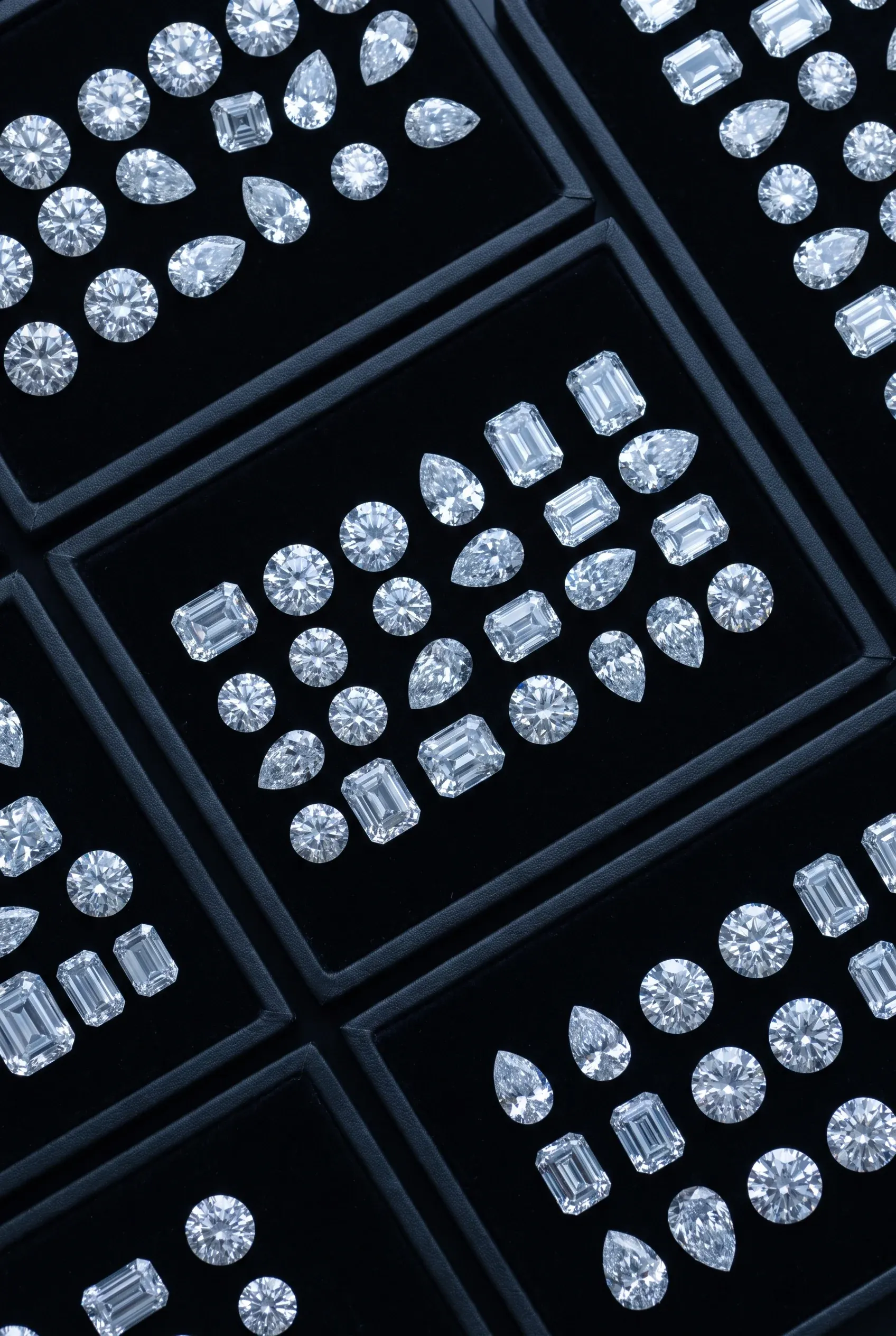
| Stone | Mohs hardness | Optical facts from market data | What it means in an iced out piece |
|---|---|---|---|
| Crystal or glass | About 5.5 to 6 | Lowest-cost shine, but scratches and dulls faster | |
| Cubic zirconia | About 8 to 8.5 | Refractive index 2.15 to 2.18, dispersion 0.060 | Bright and affordable, but softer than moissanite or diamond |
| Moissanite | 9.25 | Refractive index 2.65 to 2.69, dispersion 0.104 | Very hard, very fiery, and practical for heavy coverage |
| Diamond | 10 | Refractive index 2.42, dispersion 0.044 | Hardest option, with a tighter white sparkle than moissanite |
| White sapphire | 9 | Refractive index 1.76 to 1.77, dispersion 0.018 | Durable, but less fiery than the other common clear choices |
On the wrist, these differences show up in character more than in brightness alone. Moissanite throws more rainbow fire than diamond. Diamond looks cleaner and less disco-like to many eyes. CZ looks lively at first, while crystal is mostly about low upfront cost. White sapphire is durable, but usually reads calmer.
How moissanite changed iced out jewelry
Moissanite is silicon carbide, first identified in a meteor crater in 1893 by Henri Moissan. Gem-quality lab growth arrived in the late 1990s, and nearly all jewelry moissanite is lab grown. If you want a clear primer on what moissanite is, it helps before you compare stone-set watches.
For iced out jewelry, moissanite matters because it makes all-over coverage far more reachable than diamond. Loose retail for a 1 ct colorless moissanite is roughly $300 to $600, while a similar round diamond runs $4,000 to $7,000 if natural or $800 to $1,500 if lab grown. Moissanite pricing rises slowly with size, and diamond pricing climbs much faster. Also, VVS is the usual moissanite clarity grade, not a rare premium tier.
How watches differ from chains and rings
An iced out watch is not just a jewelry piece with a clasp. It has a movement, a crystal, a case shape, bracelet articulation, and water-resistance limits. Once stones cover the bezel, dial, and links, build quality matters more than it does on a plain watch.
Chains and pendants mostly ask the stones to survive body movement. Watches ask the stones to survive wrist movement, desk contact, bracelet flex, and daily handling around a crown and clasp. That is one reason watch pricing can vary sharply even when the overall look seems similar online.
What an iced out watch usually includes
When people say iced out watch, they usually mean stones on the bezel, dial, case, and bracelet, not just a shiny face. In 2026, a watch sold as moissanite for under about $300 is almost certainly crystal or CZ, not moissanite.
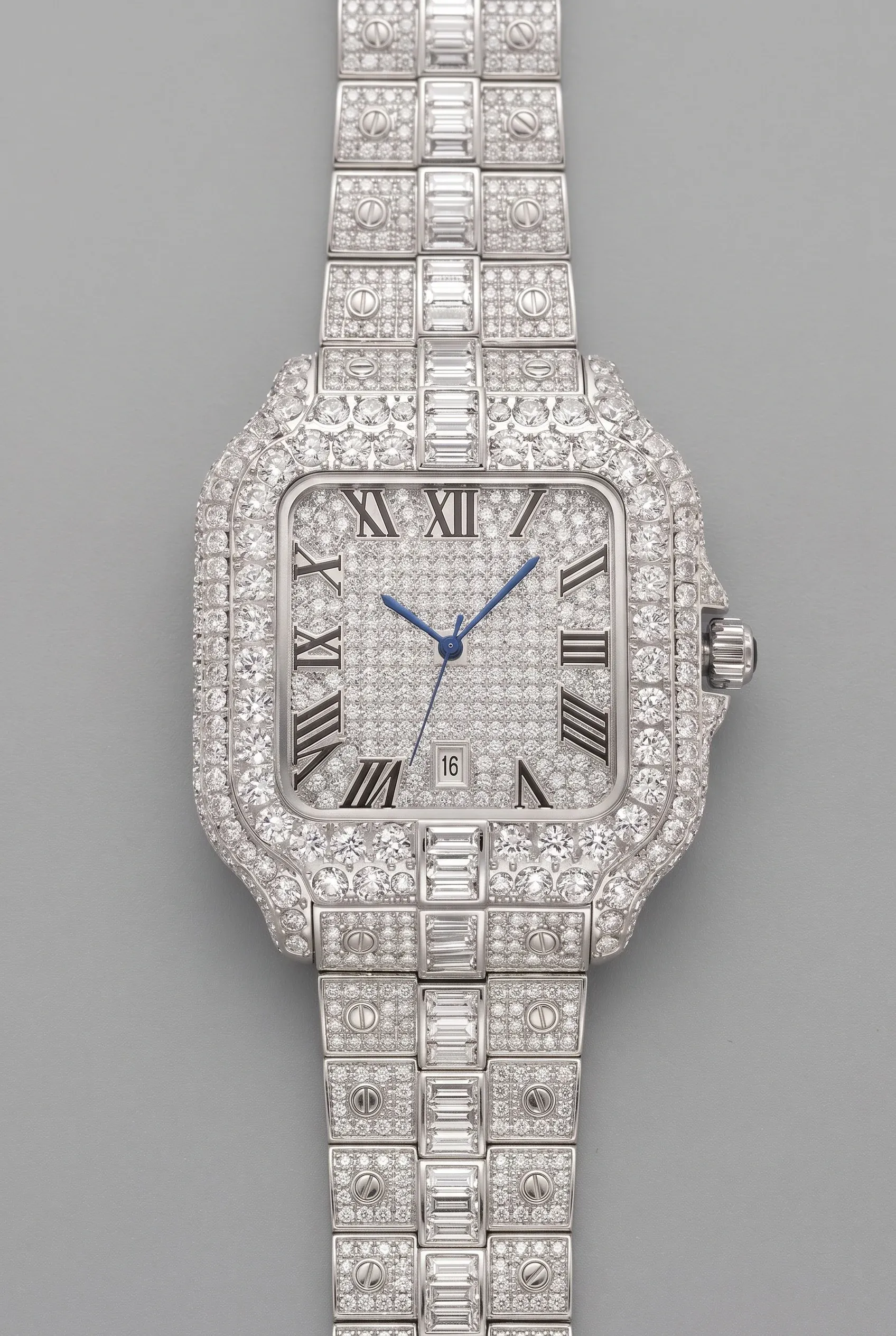
| Watch type | Usual price in 2026 | Typical stone reality | Build notes |
|---|---|---|---|
| Fashion iced watch | $100 to $400 | Usually crystal or CZ | Japanese quartz is common, hardened mineral glass is typical |
| Fully set moissanite watch | $900 to $2,700 | Moissanite across case, dial, or bracelet | Quartz is still common, sapphire crystal starts appearing above roughly $1,500 |
| Custom lab-diamond bust down | $5,000 to $15,000 | Lab-grown diamond | Movement, thickness, and service needs vary by base watch and setter |
| Custom natural-diamond set watch | $15,000 to $60,000 and up | Natural diamond | Quality depends on both the base watch and the stone setting work |
| Factory diamond-set piece from a major house | $40,000 to $250,000 and up | House-specified stones | Factory-finished, not later customization |
In the lower tiers, expect quartz because it keeps cost and thickness under control. Automatic movements can be attractive, but they usually add service cost and case height. Modest water resistance is also normal here, and 3 ATM means rain and hand-washing, not swimming.
How to spot quality in a stone-set watch
The first checkpoint is setting method. Hand-set stones, usually prong-set or bead-set, stay put far better than glued stones. Glue can look fine on day one and start shedding stones within months, especially on bracelets where links flex all day.
Then look at execution. Stones should sit level, spacing should look even, and the dial should not appear crowded or crooked. Ask whether the movement type is disclosed, whether the crystal is mineral or sapphire, and whether the case and bracelet are fully covered or only partly covered.
Clasp feel matters too. A bracelet can sparkle and still feel cheap if the links pinch, rattle, or leave sharp edges under the wrist. On a watch, finishing is not only visual. You interact with the clasp, crown, and bracelet every day, so rough hardware usually tells you where corners were cut.
How an iced out watch should fit your wrist
Fit comes before stone count. On a small wrist, a heavily set case wears larger than the same size plain watch because the sparkle expands the visual footprint. Women's classic sizing usually falls at 26 to 32 mm, women's contemporary at 34 to 36 mm, unisex at 38 to 40 mm, and men's at 40 to 44 mm.

If your wrist is under 6 inches, stay at or below 36 mm. Lug-to-lug length should not exceed your wrist width. The average US men's wrist is about 7 to 7.5 inches, so a 40 to 42 mm iced watch often sits in the safe middle. For smaller cases and proportion advice, see these notes on women's moissanite watch sizes.
Coverage changes fit perception too. A stone bezel on a plain bracelet reads neater than a fully flooded bracelet at the same diameter. If you are between sizes, the less covered version usually feels easier for daily wear, especially under cuffs.
How stones are identified and tested
Many buyers assume a pen tester settles everything. It does not. A standard thermal diamond tester will read moissanite as diamond, which is why so many videos create confusion. For the basic tester issue, read why a pen tester is not enough.
A dual thermal and electrical tester can separate moissanite from diamond. A loupe can help too, because moissanite is doubly refractive and can show facet doubling through the pavilion, while diamond is singly refractive. Usual moissanite paperwork is a GRA report. It confirms the stone is moissanite and lists basics like carat, cut, and color, but it is identification paperwork, not a GIA-style cut-quality guarantee. For visual checks, this guide on separating moissanite from diamond is the next step.
Does iced out mean factory set or customized
No. The term describes appearance, so it applies to both factory stone-set pieces and later custom work. From a buying point of view, that difference matters because a watch built as a factory diamond-set model is priced and finished very differently from a plain watch that was later covered by a setter.
Custom work can look good, but it depends on two separate things, the base watch and the setting job. A strong movement in a poorly executed case is still a poor finished product. A well-set bracelet on a weak base watch can still leave you with thin water resistance, thick case proportions, or future service complications.
If you care about watchmaking first, ask whether the piece was born that way or modified later. If you care about visual impact first, the answer may matter less than setting quality, coverage, and stone type. The key is not to compare a fashion iced watch, a custom piece, and a factory diamond-set piece as if they belong in the same category.
How to care for an iced out piece
Iced out jewelry traps lotion, skin oil, dust, and soap between stones faster than plain metal. That buildup makes any stone look dull, including moissanite and diamond. Regular gentle cleaning does more for sparkle than chasing a higher clarity label.
For home care, use mild soap, lukewarm water, a soft brush, and a lint-free cloth, then dry around the setting rather than rubbing hard across it. If you need a step-by-step method, these notes on cleaning moissanite safely cover the basics. Avoid impacts, gym use, and rough storage where a bracelet can scrape against keys or other metal.
Watches need one extra rule, respect the water rating. Splash resistance is not the same as swim proof, and soaked bracelets collect residue more quickly. Chains and rings are simpler, but they still last longer when stored separately, not tossed into one tray where stones and metal knock together.
When the style works best
Iced out works best when the rest of your look gives it room. A fully set watch reads strongest with simple clothing, clean colors, and one or two other pieces, not a stack of competing shine. If your wrist is slim, a bezel-set or dial-set watch usually feels easier than full bracelet coverage.
For daily wear, partial coverage is often the sweet spot. It still gives you the visual signal of an iced piece without turning every outfit into a special event outfit. Full coverage makes more sense if you want the watch to be the main point, not a background accessory.
Which version makes sense for your budget
Under $400
This is the fashion tier. It can be fun, especially if you want the look for occasional wear, photos, or nightlife. Just assume crystal or CZ unless proven otherwise, and treat very low moissanite claims with caution.
$900 to $2,700
This is where fully set moissanite watches usually live. For many shoppers, it is the practical balance between real stone hardness, strong light return, and a price that does not enter diamond territory. If the piece is well set, this tier makes the most sense for regular wear.
$5,000 and up
Once you move into lab-diamond custom work, natural-diamond custom work, or a factory diamond-set piece, you are paying for more than sparkle. The base watch, the setter’s labor, service obligations, and brand-level finishing all start to matter. At that point, you should ask whether you want jewelry first, watchmaking first, or both.
Common myths that confuse buyers
The biggest myth is that iced out means diamond. It does not. Another is that VVS moissanite is rare. It is not, because lab growth makes that clarity standard in the category. A third myth is that any certificate proves top quality. In moissanite, common paperwork mainly proves identity.
The last myth is that more sparkle always means better. Sometimes it only means a different optical profile. Moissanite has stronger fire than diamond, so it can look flashier. Some buyers want that. Others prefer diamond’s tighter look, or the low cost of crystal and CZ when the goal is style rather than long-term wear.
Frequently Asked Questions
Does iced out always mean real diamond?
No. Iced out describes the stone-covered look, not the material. A piece can be iced out with crystal, cubic zirconia, moissanite, lab-grown diamond, or natural diamond. You have to ask what stones are used, how they are set, and what price tier the piece sits in.
Is moissanite good for an iced out watch?
Yes, if you want a hard stone with strong sparkle without stepping into diamond pricing. Moissanite works especially well on fully covered watches because it handles wear better than crystal and most CZ pieces. Just remember that its rainbow fire is stronger than diamond, so the look is different.
Why do some iced out watches cost $299 and others $12,000?
The term covers very different products. At the low end, you are usually paying for a quartz watch with crystal or CZ and fashion-level finishing. At the high end, cost comes from moissanite or diamond, hand setting, the base watch itself, and the labor needed to cover a moving bracelet and detailed case parts.
Does an iced out watch need paperwork to prove the stones?
Only if you want confidence beyond price and photos. A GRA report identifies moissanite and lists carat, cut and color, but it does not grade cut quality like a diamond report does. For a watch already on your wrist, a jeweler's dual thermal and electrical tester settles material questions faster than paperwork alone.
Are GRA papers the same as diamond grading reports?
No. The usual GRA report for moissanite is best read as identification paperwork. It confirms that the stone is moissanite and lists basic details such as color and carat. It should not be treated as a full, independent guarantee of elite cut quality.
Is an iced out watch too flashy for daily wear?
Not necessarily. The easier daily option is partial coverage, such as a stone bezel or marker set, especially on a smaller case. A fully iced bracelet watch becomes the main visual point of your outfit, so it works best when the rest of your clothes and accessories stay simple.
What size iced out watch should I choose?
Start with your wrist, not the trend. If your wrist is under 6 inches, stay at or below 36 mm. Larger wrists can usually handle unisex and men's ranges more easily. Also check lug-to-lug length, because heavy sparkle makes a watch wear larger than a plain model of the same diameter.