Moissanite Watches for Women: Sizes, Dials, and Prices Explained
An independent guide to women’s moissanite watches with real 2026 price ranges, case sizes for small wrists, dial advice, and specs that matter.
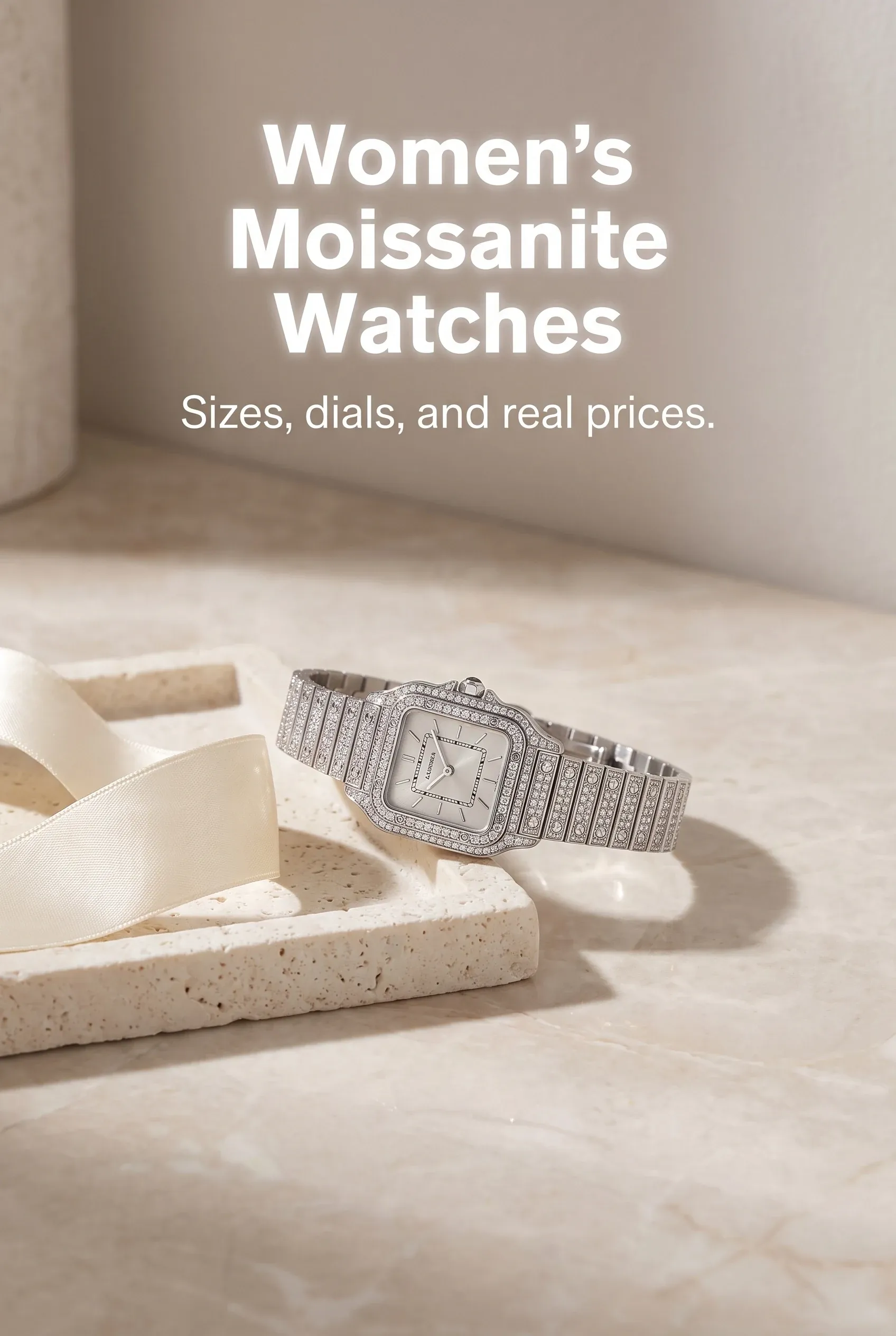
Moissanite watches for women make sense when you want real sparkle without factory diamond-set pricing. The good ones use hand-set lab-grown moissanite, sensible case sizes, and a quartz movement, usually from $900 to $2,700. The weak listings hide crystal or CZ behind vague wording, especially below about $300.
Start with your wrist and budget
Before you compare stones, decide how much watch you want on the wrist. On a smaller wrist, case diameter, lug-to-lug length, and bracelet weight change the look more than stone count does. If you already know you want a full bracelet of stones, plan for more heft and a higher price than a strap-based dress watch.
If your wrist is under 6 inches, stay at or below 36 mm. A slim 26–32 mm case reads classic, a 34–36 mm case looks current, and 38–40 mm starts to feel unisex. For broader browsing, see the site’s women’s watch coverage.
What you are actually buying
Moissanite is silicon carbide, not a diamond coating and not a lab-grown diamond. It was identified in 1893 by Henri Moissan in a meteor crater, and gem-quality lab growth became common in the late 1990s. Nearly all jewelry stones today are lab grown, as explained in this guide to what moissanite is.
For watches, that matters because the stone is tough enough for regular wear. It ranks 9.25 on the Mohs scale, above white sapphire at 9 and far above crystal or glass at about 5.5–6. Its refractive index of 2.65–2.69 and dispersion of 0.104 give it strong white return and more rainbow fire than diamond.
Moissanite is also slightly lighter than diamond, with a density of 3.21 versus 3.52. You will not feel that difference on the wrist, but it is one more reminder that the two stones are not the same material.
Sizes that work on smaller wrists
Women’s watch sizing is simpler when you separate diameter from presence. A square or fully paved case usually wears larger than a plain round case with the same millimeter number. A bright bracelet also makes a watch feel bigger because the shine continues beyond the case.
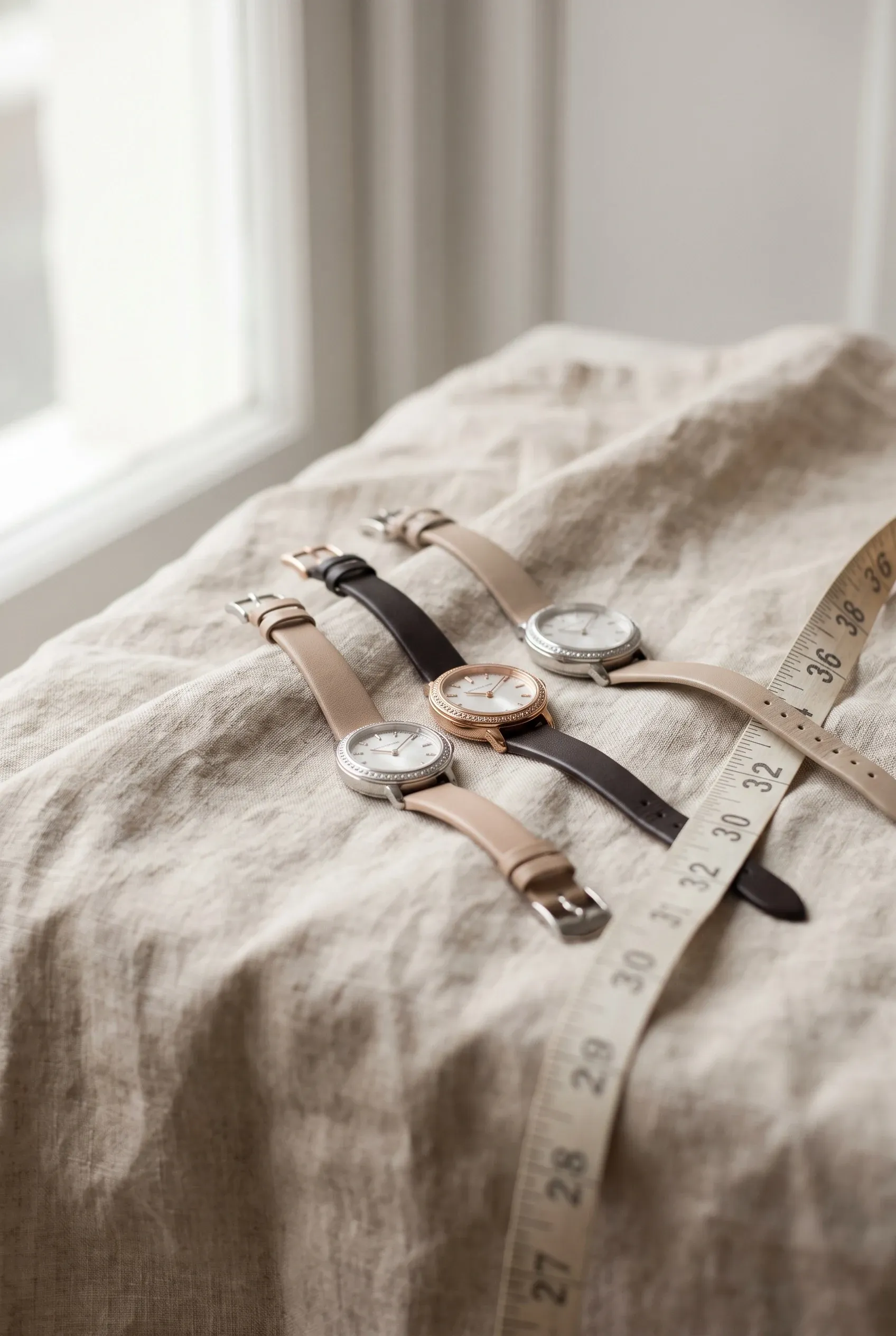
| Size group | Case size | How it wears | Best note |
|---|---|---|---|
| Women’s classic | 26–32 mm | Small, dressy, easy under sleeves | Strong choice for slim wrists and formal wear |
| Women’s contemporary | 34–36 mm | More presence without looking oversized | Usually the upper limit for wrists under 6 inches |
| Unisex | 38–40 mm | Bold and jewelry forward | Works if you want a statement fit |
| Men’s | 40–44 mm | Large on most smaller wrists | Best only for a deliberate oversized look |
Do not treat diameter as the only fit number. Square cases wear broader across the wrist, and thick fully set bezels look larger than thin polished ones. When two watches share the same diameter, the one with a brighter bracelet and dial will usually read larger from across the room.
Use the table as a starting point, then check the side profile. Lug-to-lug should not exceed your wrist width, or the watch will overhang and feel top heavy. If you want a glitter-heavy look without the bulk, a 30–34 mm case on a leather strap is usually the safest balance.
Dial styles and how they wear
The dial decides whether the watch reads refined, playful, or full nightlife. This matters more on women’s pieces because smaller cases leave less room for hands, markers, and contrast.
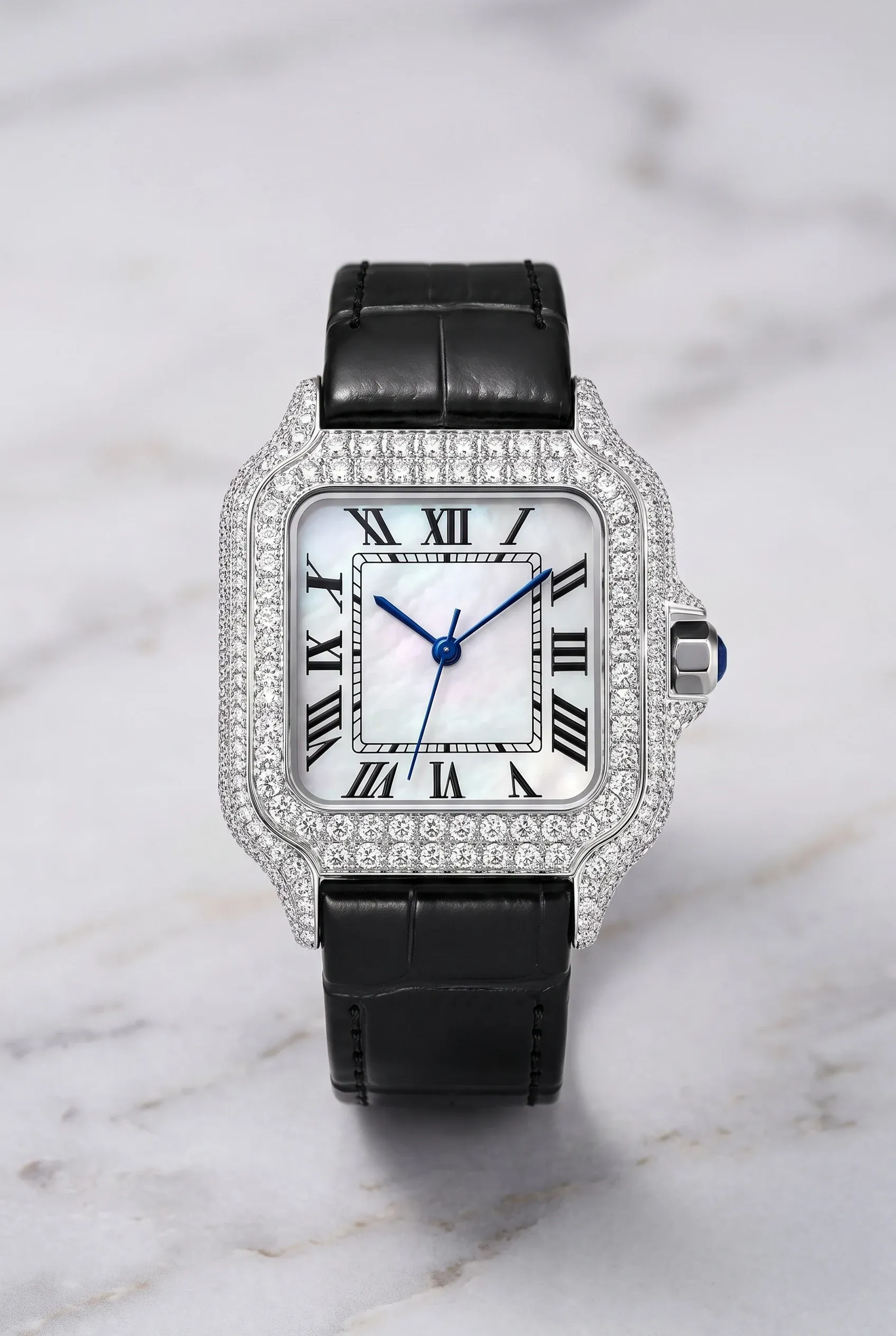
A clean dial with a stone bezel is the easiest everyday choice. You keep the sparkle around the case, but the center stays readable in office light and daylight. Mother-of-pearl adds softness, while deep green, burgundy, black, or pink dials give stronger contrast against silver-toned hands.
A fully paved dial looks brightest at night and in direct sun, but legibility drops. If you like that effect, choose larger hands or a case no smaller than the low 30s. For more outfit-focused ideas, browse the site’s style coverage.
Baguette-style layouts look sharper and more architectural. Round pave looks softer and throws more scattered fire. If you wear knitwear or soft tailoring, round pave and mother-of-pearl blend easily. If your wardrobe is sharper, a colored dial or baguette chapter ring gives cleaner lines.
Real price ranges in 2026
Price is the fastest way to separate real moissanite from imitation. In 2026, fully set moissanite watches usually sit between $900 and $2,700. Crystal or CZ stone-set watches live around $100 to $400, and anything sold as moissanite under about $300 is almost certainly not moissanite.
| Category | Usual price | What you are getting |
|---|---|---|
| Crystal or CZ stone-set watch | $100 to $400 | Fashion watch shine, lower stone durability, usually quartz |
| Fully set moissanite watch | $900 to $2,700 | Hand-set moissanite jewelry effect without diamond pricing |
| Custom lab-diamond set watch | $5,000 to $15,000 | Higher stone cost, more labor, still custom territory |
| Custom natural-diamond set watch | $15,000 to $60,000 and up | Traditional diamond prestige with steep material cost |
| Factory diamond-set watch from a major house | $40,000 to $250,000 and up | Luxury watchmaking plus factory stone setting |
Moissanite stays affordable because the underlying stone is much cheaper than diamond. A loose 1 ct colorless moissanite usually retails around $300 to $600 per carat, while a similar 1 ct round diamond is about $4,000 to $7,000 if natural or $800 to $1,500 if lab grown. Watch stones are much smaller, but the same cost gap explains why moissanite can cover a whole case and bracelet without entering diamond territory.
The main cost drivers are the number of hand-set stones, metal coverage, and bracelet labor. Dial color, by contrast, usually changes the look more than the price. Women’s watches with leather straps or partial stone coverage often land nearer the low end of the moissanite band.
Moissanite, CZ and crystal are not the same
Many women’s watches use the word iced to describe shine, not the actual stone. Moissanite, cubic zirconia, and crystal can look similar in a tiny product photo, but they behave differently after months of wear.
CZ usually measures about 8–8.5 on the Mohs scale, with a refractive index of 2.15–2.18 and dispersion of 0.060. It can look bright at first, but it abrades sooner than moissanite and loses crisp facet edges faster. Crystal or glass is softer still, around 5.5–6, so it is the first to show scratches.
White sapphire is a calmer alternative at 9 on the Mohs scale, but its fire is much lower, with 0.018 dispersion. If you want the most sparkle for the money, moissanite wins that trade-off. If you want a quieter look or a very low price, compare how moissanite compares with CZ before you shop.
What movement, crystal and water resistance to expect
Under $3,000, Japanese quartz is the normal movement in a stone-set watch. That is not a flaw. Quartz keeps the case slimmer, lowers service cost, and makes more sense when most of the budget goes into hand setting and metal finishing.
Automatic movements exist, but they add thickness and cost. On a small wrist, that extra height can make a watch feel more like jewelry than like a balanced everyday watch. If you plan to wear the watch under sleeves, total thickness matters almost as much as diameter.
For the front crystal, hardened mineral glass is common, while sapphire crystal usually appears above roughly $1,500. Water resistance matters too. A 3 ATM rating means rain and hand-washing, not swimming, showering, or beach days.
How stone setting affects durability
The setting method matters more than the stone count. Hand-set stones, usually with prongs or bead setting, stay put far better than glued stones. If a listing only shows sparkle and never explains the setting, be careful.
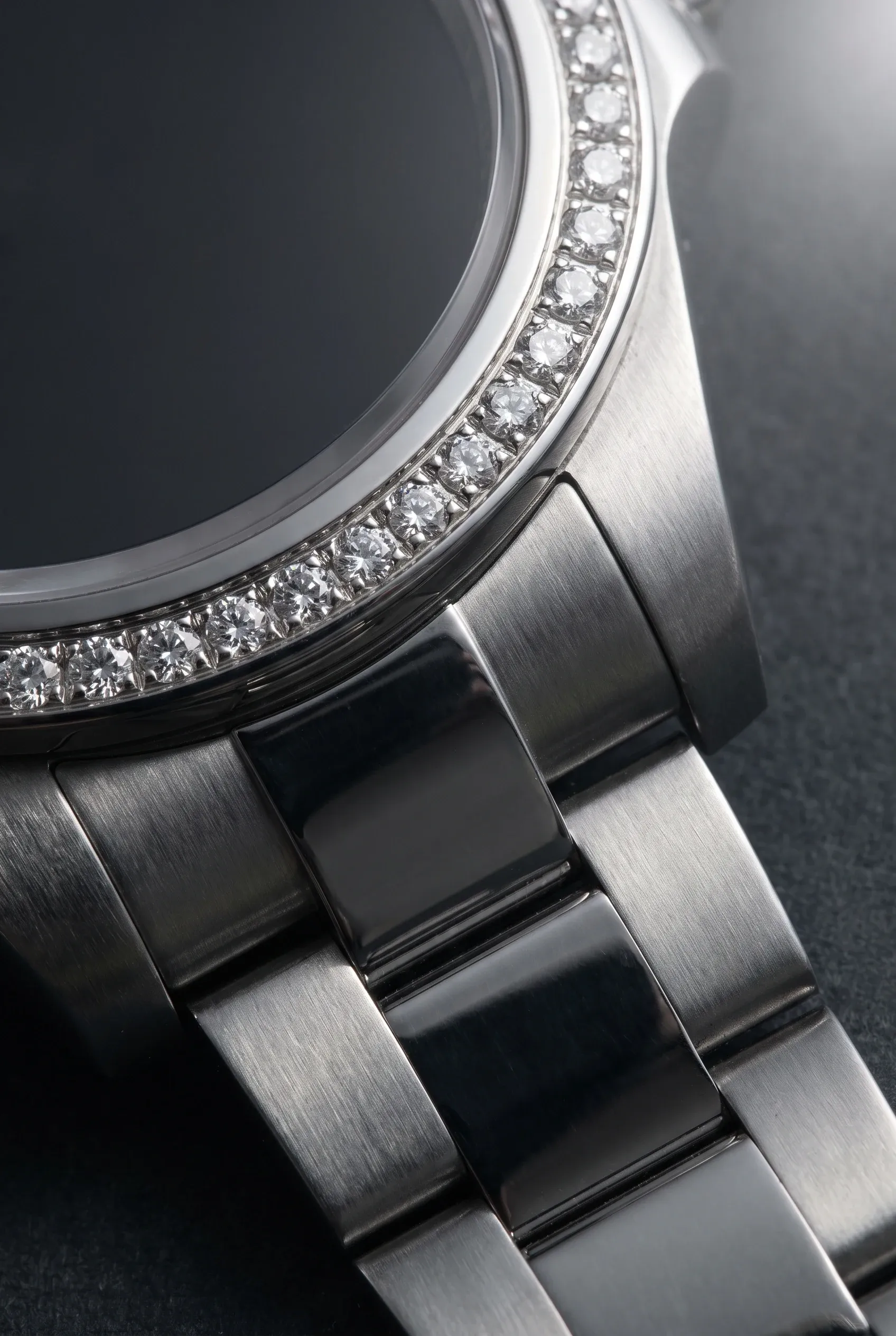
On a women’s watch, the riskiest areas are the outer bracelet links and the bezel corners. Those parts rub against desks, sleeves, and bags. A smaller case with stones focused on the bezel often wears longer than a fully covered bracelet, simply because fewer exposed edges take daily knocks.
Bracelet articulation matters too. A stiff bracelet concentrates impact at the first few links, while a flexible strap removes stones from the most mobile part of the wrist. That is one reason many smaller women’s designs age better on leather or on a simpler bracelet.
Paperwork, testers and color grades
Most moissanite paperwork in this market is a GRA report. It confirms that the stone is moissanite and lists basics such as carat, cut, and color. Read it as identification, not as a GIA-style promise that the watch has elite cut quality.
Color labels follow the usual jewelry shorthand. D-E-F means colorless, and G-H-I means near-colorless. You will also see VVS often, but on moissanite that is usually the norm from lab growth, not a rare premium feature.
Do not rely on a simple diamond pen tester. Thermal testers often read moissanite as diamond, while dual thermal and electrical testers separate them. Through a loupe, moissanite can also show facet doubling through the pavilion because it is doubly refractive, unlike diamond. The site’s diamond tester guide explains that difference in plain terms.
Who a ladies moissanite watch suits best
A ladies moissanite watch makes the most sense when you want serious sparkle below lab-diamond pricing. It is especially strong for dress wear, dinners, events, and gift buying where the visual effect matters more than mechanical watch pedigree.
It is less ideal if you want a quiet everyday office piece, a swim watch, or a slim heirloom-style watch with movement prestige as the main story. Some readers also prefer diamond’s calmer fire. Moissanite throws more color, which looks lively to some eyes and too flashy to others.
For many women, the sweet spot is a 28–34 mm watch with a readable dial, a stone-set bezel, and a strap or lighter bracelet. That gives you the point of moissanite, visible sparkle, without forcing a 40 mm unisex look.
It also makes sense as an anniversary gift. In the US, watches are the modern 15th anniversary gift, and diamond is the modern 10th or 30th anniversary gift. A moissanite watch can nod to both ideas without moving into custom diamond budgets.
How to shop without getting misled
Most bad purchases come from ignoring the basic watch specs. Use this short checklist before you pay.
- Confirm the case size. Ask for the millimeter diameter and a side view, not just a wrist shot.
- Confirm the stone. The listing should say moissanite clearly, not simulated, crystal, or diamond look.
- Confirm the setting. Hand-set prong or bead settings are safer than glue.
- Confirm the watch build. Check movement type, front crystal material, and water resistance.
- Confirm the paperwork claim. A GRA card identifies moissanite, but it does not prove luxury-level finishing.
If the price, specs, and photos do not line up, walk away. In this category, clear numbers are usually a better sign than dramatic marketing words.
If you are buying for Christmas, timing matters because stone setting and sizing can add handling days. In 2026, standard ground orders generally need to leave by Dec 15–17, expedited by Dec 20–21, and overnight by Dec 22–23, but always check the retailer’s own cutoff page.
Frequently Asked Questions
Are moissanite watches for women worth the money?
They can be, if your goal is visible sparkle and better stone durability than crystal or CZ without paying diamond-set prices. The strongest value is usually a smaller, hand-set watch in the $900 to $2,700 range with clear specs on size, movement, crystal, and water resistance.
How much should moissanite watches for women cost?
In 2026, a real fully set moissanite watch usually costs about $900 to $2,700. Listings around $100 to $400 are the normal range for crystal or CZ stone-set watches. If a watch is labeled moissanite under about $300, treat that as a major warning sign.
What size works best on a small wrist?
For a wrist under 6 inches, stay at or below 36 mm. A 26–32 mm case looks classic, while 34–36 mm feels more modern. Also check lug-to-lug length, because the lugs should not extend past your wrist width, even if the diameter looks fine.
Do the stones fall out over time?
They can, but the risk depends more on setting method than on moissanite itself. Hand-set prong or bead settings hold much better than glue. Bezel corners and outer bracelet links take the most daily abrasion, so smaller cases or strap models usually have fewer vulnerable stone positions.
Can you swim with a women’s moissanite watch?
Not unless the specific watch is rated for it. In this category, 3 ATM is common, and that only covers rain and hand-washing. It does not mean swimming, showering, or beach use. Water and repeated knocks are two of the quickest ways to shorten a stone-set watch’s life.
How can I verify a secondhand moissanite watch is genuine?
Ask for a GRA report if one exists, since it confirms the stone material and lists carat, cut and color. Beyond paperwork, a jeweler can use a dual thermal and electrical tester rather than a basic pen, and a loupe can reveal moissanite’s facet doubling through the pavilion.
Is quartz a drawback on a dressy stone-set watch?
Not usually. Under $3,000, Japanese quartz is the normal movement and often the practical choice. It keeps the case thinner, reduces service cost, and leaves more of the budget for stone setting. An automatic can be nice, but it usually adds thickness and expense.