Diamond Watch Alternatives: 5 Stones Compared on Price and Sparkle
Compare lab diamond, moissanite, white sapphire, CZ, and crystal watches with real 2026 prices, sparkle data, and practical buying trade-offs.
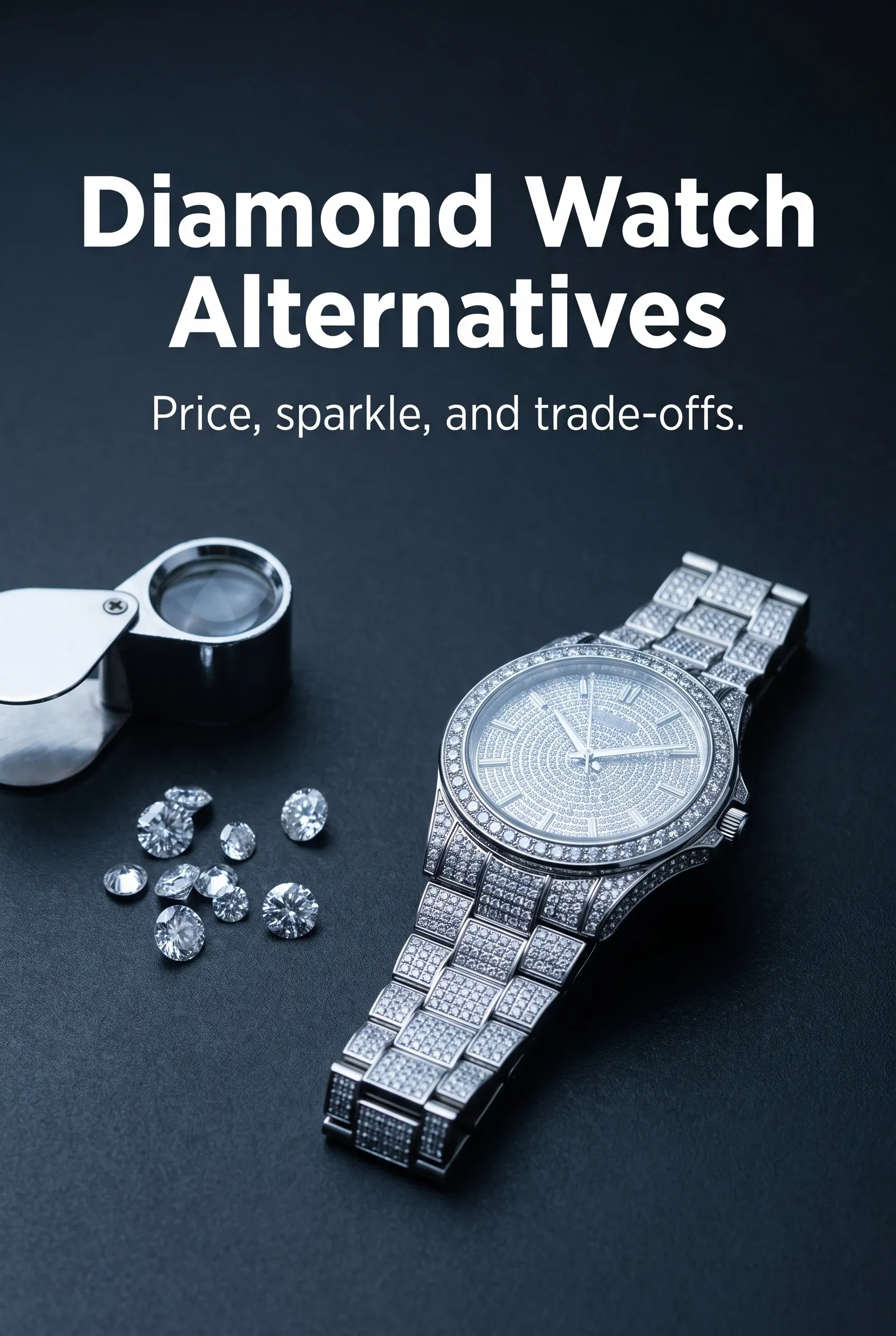
Diamond watch alternatives fall into five real categories: lab-grown diamond, moissanite, white sapphire, cubic zirconia, and crystal. If you want the closest diamond look for much less money, moissanite is usually the best value, while lab-grown diamond is the premium substitute and CZ or crystal handle fashion budgets. The right pick depends on whether you care most about sparkle, durability, or the total watch price.
The five real alternatives
Most shoppers start with the wrong question. They ask which stone is the cheapest, when the better question is which stone gives the look and lifespan they actually want on a wristwatch.
- Lab-grown diamond. This is still diamond, just grown in a lab. It gives you the exact diamond material, but finished watches still land in custom pricing territory.
- Moissanite. Silicon carbide, and nearly all jewelry moissanite is lab grown. It is the closest visual substitute for diamond in the mainstream watch market, especially when you want strong sparkle without diamond pricing.
- White sapphire. A durable white gem with a calmer, less fiery look. It works for buyers who want a cleaner and quieter watch face.
- Cubic zirconia. The classic budget substitute. It can look bright at first, but it sits in a lower durability tier than moissanite, sapphire, or diamond.
- Crystal or glass. This is the fashion-watch end of the market. It gives surface glitter from a distance, but it is not a fine-gem solution.
If you want broader stone context beyond watches, our stone comparison guides cover the same trade-offs in jewelry categories too.
Sparkle and durability at a glance
The numbers below explain why these materials look different even when a watch is fully covered in stones. Refractive index tells you how strongly light bends in the stone, while dispersion tells you how much rainbow fire it throws.
| Stone or material | Mohs hardness | Refractive index | Dispersion | What it usually looks like on a watch |
|---|---|---|---|---|
| Lab-grown diamond | 10 | 2.42 | 0.044 | Balanced white sparkle, high crispness, the classic diamond look |
| Moissanite | 9.25 | 2.65 to 2.69 | 0.104 | Very bright, more rainbow fire than diamond, strong performance in small stones |
| White sapphire | 9 | 1.76 to 1.77 | 0.018 | Cleaner and quieter, less flash, more understated than diamond |
| Cubic zirconia | About 8 to 8.5 | 2.15 to 2.18 | 0.060 | Bright budget sparkle, often convincing in photos and short wear |
| Crystal or glass | About 5.5 to 6 | Varies | Varies | Surface glitter more than deep return, mainly a fashion effect |
Those figures matter more on a watch than many people expect. Stone-set watches use dozens, sometimes thousands, of small stones, so slight differences in fire and clarity stack up fast across the bezel, dial, and bracelet.
What finished watches cost in 2026
Finished watch prices are where the gap becomes obvious. Diamond material is only part of the bill, because setting labor, the base watch, and after-sales service also change the total.
| Watch category | Typical US price | What you are usually paying for |
|---|---|---|
| Crystal or CZ iced out watch | $100 to $400 | Fashion watch styling, entry-level stone coverage, usually quartz |
| Moissanite iced out watch | $900 to $2,700 | Real moissanite setting work on the case, bezel, dial, or bracelet, usually quartz |
| White sapphire stone-set watch | Varies by maker | A less standardized category, with fewer published market benchmarks |
| Custom lab-grown diamond set watch | $5,000 to $15,000 | Diamond material plus custom setting labor on an existing watch |
| Custom natural-diamond set watch | $15,000 to $60,000 and up | Higher stone cost plus custom labor and risk |
| Factory diamond-set watch from a major house | $40,000 to $250,000 and up | Factory setting, luxury watch pricing, and original brand positioning |
The blunt market reality is useful here. A watch sold as moissanite for under about $300 is almost certainly using crystal or CZ instead.
How the stones look in daylight and flash
Lab-grown diamond gives the most familiar diamond presentation. The sparkle is bright and crisp, but it stays relatively controlled, which is why it still reads expensive even on a full pave watch.
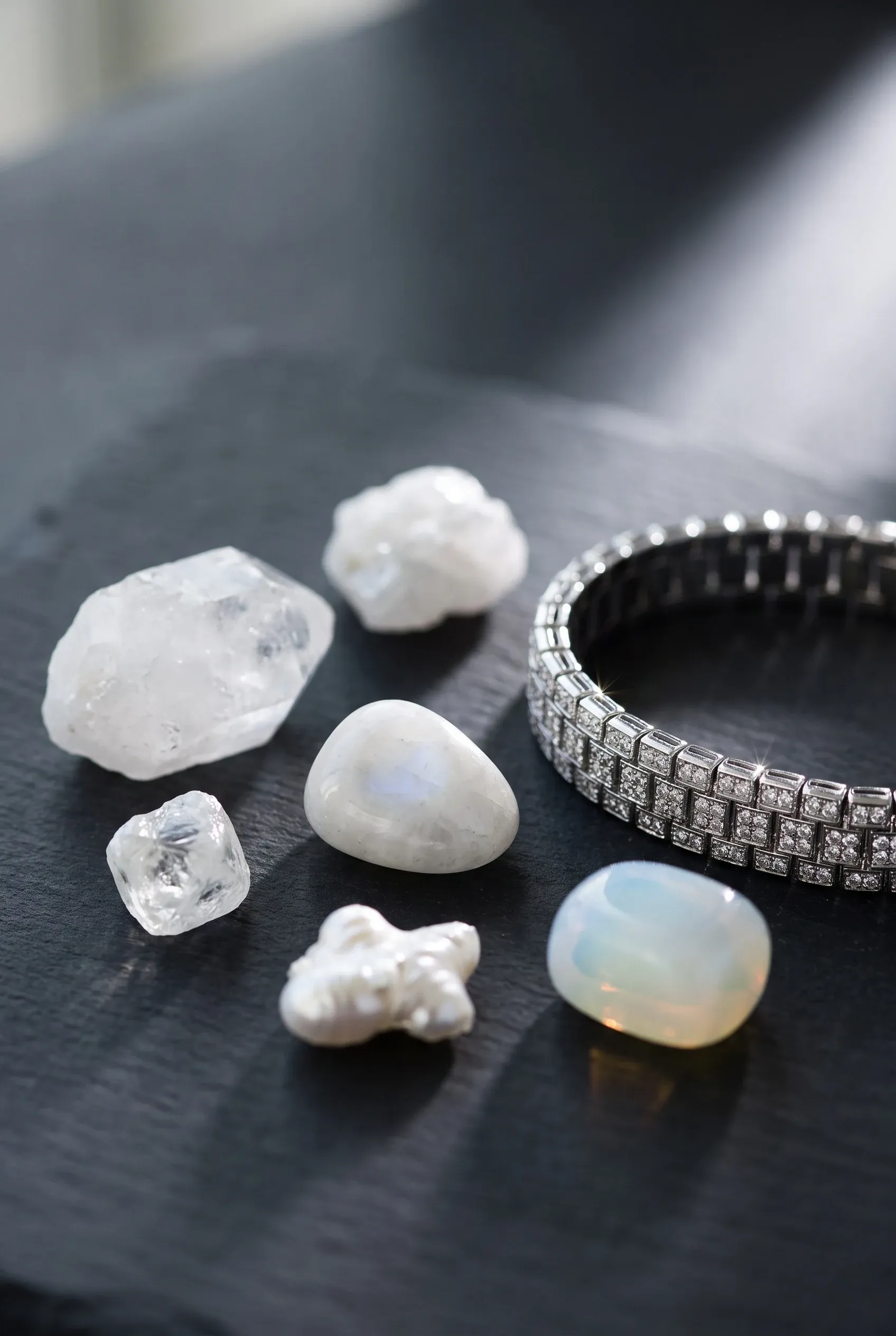
Moissanite is brighter and more colorful. Its fire is much stronger than diamond, so in direct sun, club lighting, or phone flash, it throws more rainbow return. Some buyers love that bigger effect. Others think it looks less subtle on a watch covered in many small stones.
White sapphire is the quiet option. You get more white reflection than rainbow flash, which can be useful if you want an iced out watch that still fits tailoring or daily office wear.
CZ is often lively under hard light, especially in online product photos. Crystal tends to look more like glitter than gemstone light return. From a few feet away, both can still give the iced out effect, which is why they remain common in low-cost watches.
Moissanite for the closest look at a sane price
For most readers, moissanite is the real answer. It sits far closer to diamond than CZ or crystal in both durability and optical performance, but it stays in a finished watch price tier that normal shoppers can actually reach.
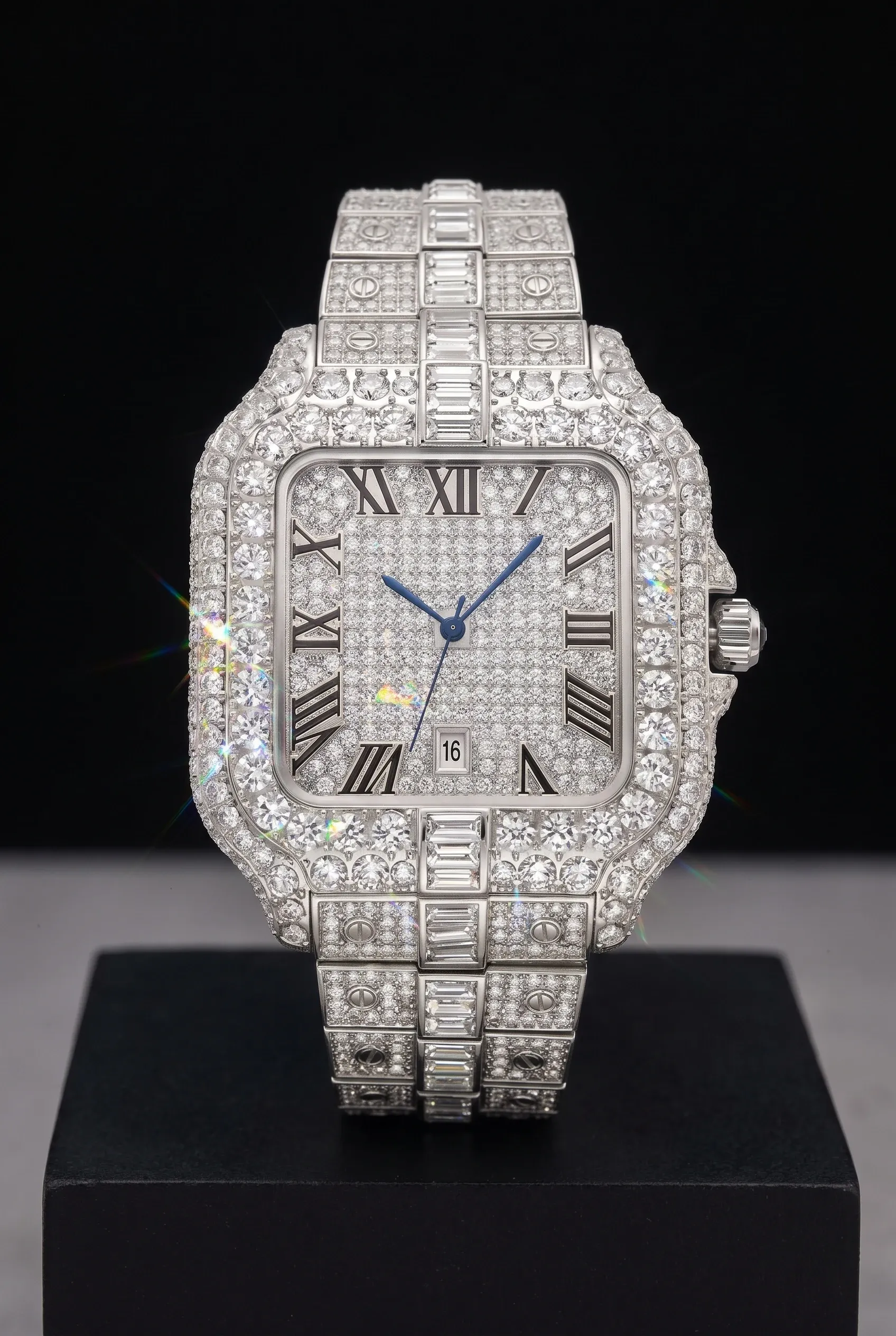
The stone itself helps explain that gap. A loose 1 ct colorless moissanite typically retails for about $300 to $600, while a similar 1 ct diamond runs about $4,000 to $7,000 if natural or about $800 to $1,500 if lab grown. That flatter moissanite price curve is why larger fully set watches do not explode in cost the way diamond projects do.
There are a few details worth knowing before you buy. Moissanite is doubly refractive, so facet doubling can be visible under a loupe through the pavilion. A basic thermal pen also reads moissanite as diamond, which is why tester clips alone prove very little, as we explain in this guide to diamond testers. A dual thermal and electrical tester can separate the two.
Paperwork should also be read correctly. GRA reports are the common moissanite documents in this category. They identify the stone as moissanite and list carat, cut, and color, but they are not a GIA-style guarantee of top cut quality. You will also see VVS constantly. In moissanite, VVS is standard, not a rare upgrade.
Lab-grown diamond when you want actual diamond
If your priority is owning diamond rather than imitating it, lab-grown diamond is the cleanest path. It avoids moissanite’s extra rainbow fire and its loupe-visible doubling, so the look stays squarely in diamond territory.
The catch is that a lab-grown diamond watch is not a cheap watch. Even though lab diamond stone prices are far below natural diamond, a finished stone-set watch still involves diamond setting labor, more expensive material, and usually a custom process rather than a mass-produced one.
That makes lab-grown diamond the right choice for a buyer who wants the word diamond to be literally true, not just visually close. It is a good lab diamond watch alternative to natural diamond, but not a casual step down in cost the way many shoppers first assume.
White sapphire for a quieter watch
White sapphire makes sense when you want a bright watch without the extra color flashes that come with moissanite. On wrist, it reads cleaner and calmer, especially indoors.
It is also a serious gemstone rather than a fashion substitute. The durability is strong enough for regular wear, but the optical profile is much softer than either diamond or moissanite. That means less drama across a fully set bezel or bracelet.
This is the option for someone who likes an iced out silhouette but not an attention-seeking light show. The trade-off is simple. You are choosing restraint over maximum sparkle.
Cubic zirconia for entry-level shine
Cubic zirconia sits in the practical budget lane. It has enough brightness to look good across a dial, bezel, or link bracelet, and it gives more pop than white sapphire for the money.
The reason it costs so much less is not mysterious. It is softer than the higher-end options, and that matters on a watch that hits desks, door frames, and countertops. Daily wear is harder on a watch than occasional wear in earrings or a pendant.
CZ works best when the goal is style rather than longevity. If you want to test whether you even like an iced out watch on your wrist, CZ is a reasonable starting point. If you already know you want the look long term, most shoppers end up wanting moissanite instead.
Crystal and glass for fashion-first pieces
Crystal and glass belong to the lowest price band, and there is nothing wrong with that if you buy them for what they are. They create a bright fashion effect, especially from a distance, and they let you try a fully covered watch without a major spend.
The issue is durability, not style. This material sits well below the gemstone options, so it is the least suitable for hard daily wear. It is also common to see this category mixed with glued settings, which is where a lot of disappointment starts. If you are comparing low-cost pieces, read our guide to glued versus hand-set stones before you buy.
If a listing makes big claims but stays in the low hundreds, assume you are shopping in the crystal or CZ zone until proven otherwise. That mindset saves more money than any tester trick.
What matters more than the stone
The stone is not the only thing that decides whether an iced out watch feels worth it. Setting method, movement, water resistance, and the watch crystal all affect how it wears after the first week.
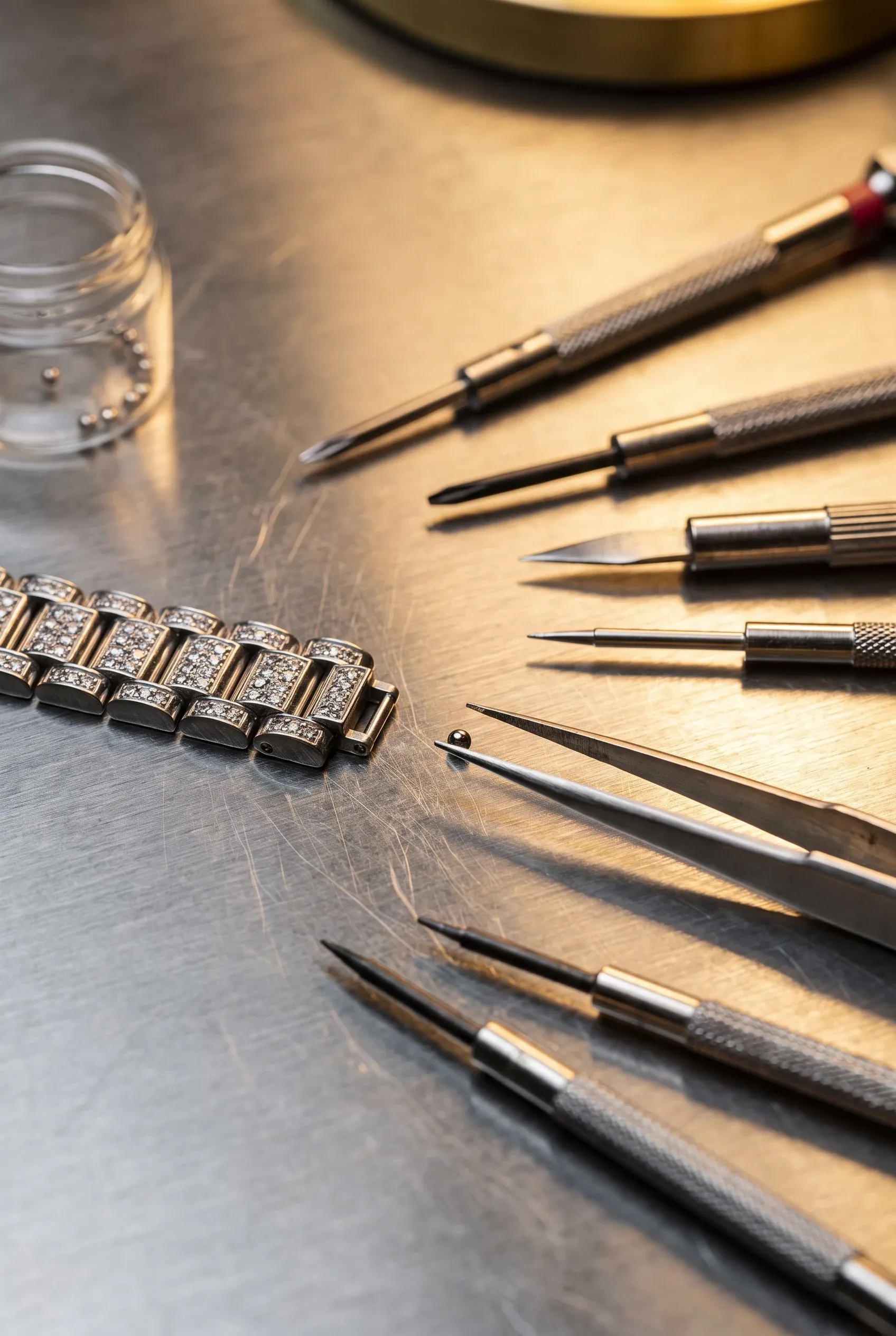
Hand-set stones, whether by prong or bead, stay put far better than glued stones. Under $3,000, Japanese quartz is the normal movement in stone-set watches, and that is usually a feature, not a flaw. Quartz keeps cost, thickness, and maintenance in check. If you are deciding between movement types, our breakdown of quartz versus automatic explains the trade-off in this category.
Water resistance claims also need translation. A 3 ATM watch is fine for rain and hand-washing, but not for swimming. Hardened mineral glass is common, while sapphire crystal usually appears once you move into the higher four-figure bracket.
How to choose by budget and wrist
Start with the budget, then shrink the field by wrist size. If your cap is only a few hundred dollars, buy crystal or CZ as a style piece and judge it on design, not on gem value. If your budget reaches the mid-tier stone-set market, moissanite is usually the sweet spot. If actual diamond matters, expect a custom project rather than an impulse purchase.
Wrist size matters just as much. On a wrist under 6 inches, stay at or below 36 mm. Women’s classic sizes usually sit in the 26 to 32 mm range, women’s contemporary sizes in the 34 to 36 mm range, unisex in the 38 to 40 mm range, and men’s in the 40 to 44 mm range. Lug-to-lug should not exceed your wrist width, and fully set watches often wear larger than a plain steel watch of the same diameter.
For reference, the average US men’s wrist is about 7 to 7.5 inches. If you want a deeper look at the moissanite middle tier, see our guide on how much a moissanite watch costs.
Who each option is best for
Choose lab-grown diamond if the actual material matters, you want the classic diamond look, and you accept custom-watch pricing. Choose moissanite if you want the strongest mix of realism, durability, and cost control. For most readers searching diamond watch alternatives, that is the best balance.
Choose white sapphire if you want a more reserved watch that still uses a real gemstone. Choose CZ if you want a cheaper alternative to a diamond watch for occasional wear, trend testing, or gift shopping at a lower budget. Choose crystal if you simply want the iced out look for the least money and you do not expect fine-jewelry durability.
There is no single winner for everyone. The honest ranking depends on your budget ceiling, your tolerance for upkeep, and whether you want a watch that reads like diamond from across the room or one that literally uses diamond under inspection.
Frequently Asked Questions
What are the best diamond watch alternatives?
The best options are lab-grown diamond, moissanite, white sapphire, cubic zirconia, and crystal. For most shoppers, moissanite is the best balance of price, sparkle, and durability. Lab-grown diamond is best when you want actual diamond, while CZ and crystal are budget style choices rather than long-term gemstone solutions.
Which diamond alternative holds up best in daily wear?
Moissanite and white sapphire hold up best over years of wear, at 9.25 and 9 on the Mohs scale. Cubic zirconia is softer at 8 to 8.5 and shows wear sooner. Crystal or glass settings scratch fastest, around 5.5 to 6. Hardness helps, but secure setting still matters just as much.
What is the cheapest stone used on iced out watches?
Crystal and cubic zirconia are the lowest-cost options in this market, and finished watches using them usually sit around $100 to $400. If a watch is advertised as moissanite but priced under about $300, it is very likely using crystal or CZ instead.
Are lab-grown diamond watches much cheaper than natural diamond watches?
They are cheaper, but they are not cheap. In 2026, custom lab-grown diamond set watches commonly sit around $5,000 to $15,000, while custom natural-diamond versions start much higher. The setting labor still keeps lab-grown diamond well above moissanite, CZ, or crystal.
Is white sapphire better than cubic zirconia for a watch?
It depends on what you mean by better. White sapphire is the harder and more durable option, so it suits regular wear better. CZ usually gives more immediate sparkle for less money. If you want quiet refinement, pick sapphire. If you want budget flash, pick CZ.
How can I avoid buying a glued stone-set watch?
Read the product description carefully and look for explicit wording such as hand-set, prong set, or bead set. In this category, glued stones are the weak point because they tend to shed within months. If the listing is vague, assume the setting quality is also vague.
What watch size works best on a small wrist?
If your wrist is under 6 inches, stay at or below 36 mm. Women’s classic sizing usually falls between 26 and 32 mm, while 34 to 36 mm is a more contemporary look. With stone-set watches, check lug-to-lug too, because sparkle-heavy cases often wear larger than expected.