How Much Does a Moissanite Watch Cost? 2026 Prices by Stone Count
See real 2026 moissanite watch prices by stone count, size, movement and setting quality, plus the warning signs that usually mean crystal or CZ.
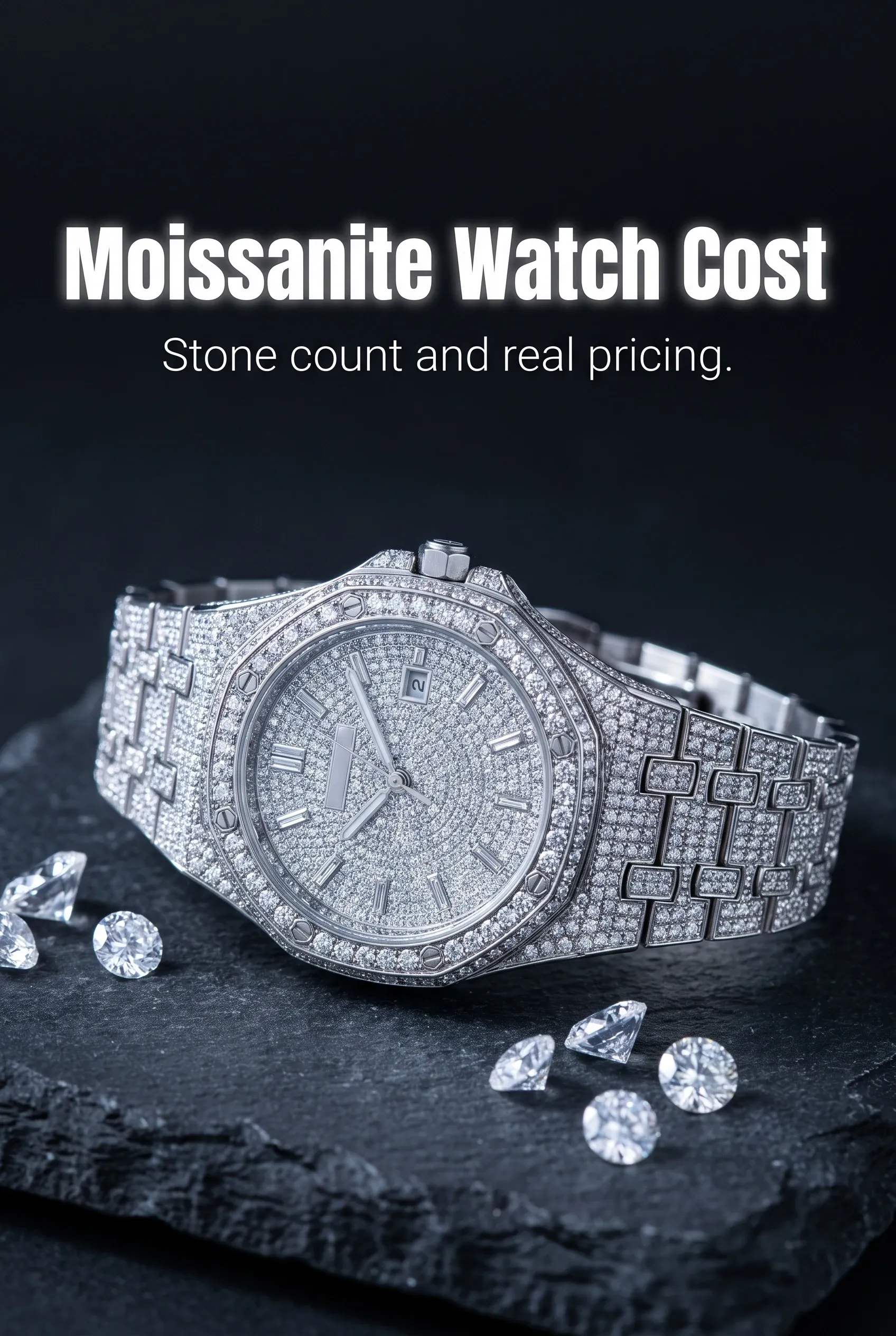
A real moissanite watch usually costs $900 to $2,700 in 2026. If you are asking how much a moissanite watch costs, the honest answer is that stone count matters, but setting quality, case size, movement and whether the stones are actually moissanite matter just as much. Anything sold as a moissanite watch for under about $300 is almost certainly crystal or cubic zirconia.
That wide range makes sense once you know what iced out actually covers. Some watches use moissanite only on the bezel or dial. Others cover the bezel, lugs, case flanks, bracelet and even the dial, which can push stone counts into the thousands.
The real 2026 price ranges
The cleanest way to price this market is by watch type first, then by stone coverage. A true moissanite piece sits far above imitation iced watches, but far below diamond-set customs. That middle position is why moissanite has become the value option for people who want real gem sparkle without five-figure diamond money.
| Watch category | What you are usually getting | Common 2026 price |
|---|---|---|
| Crystal or CZ iced watch | Imitation stones, often glued, basic quartz movement | $100 to $400 |
| Entry real moissanite watch | Smaller case or partial coverage, usually quartz | $900 to $1,100 |
| Mid-range moissanite watch | Heavier stone coverage on case, dial and bracelet | $1,100 to $1,800 |
| Fully set moissanite watch | Dense coverage, often 40–42 mm cases, better finishing | $1,800 to $2,700 |
| Custom lab-diamond bust down | Lab diamonds, custom setting work | $5,000 to $15,000 |
| Custom natural-diamond set watch | Natural diamonds, custom setting work | $15,000 to $60,000 and up |
The most important line in that table is the jump from $400 to $900. That gap is where most confusion lives. Plenty of listings use the word moissanite loosely, but the actual market for hand-set moissanite watches starts around the $900 mark, not the $200 mark.
Stone count helps, but it is not the whole price
Stone count sounds precise, but it is only one part of the bill. A watch with 3,000 tiny pave stones can cost less than a watch with 700 larger stones if those larger stones need deeper seats, cleaner alignment and more metal removed by hand. Count tells you coverage. It does not tell you stone size, total carat weight or setting difficulty.
That matters because shoppers often compare listings by one big number. Sellers know this, so a very high count can look impressive even when the stones are tiny and the watch uses basic parts elsewhere. The better habit is to read count as a coverage clue, then check the movement, crystal, water resistance and whether the stones are hand set.
Stone count also interacts with case size. A 42 mm watch simply has more surface area than a 30 mm watch. More surface area usually means more stones, more labor and a higher total price, even before you get into the bracelet.
Price bands by stone count
There is no universal price chart that every seller follows, so the honest approach is to use broad market bands. These bands work best when the watch is actually set with moissanite, not imitation stones. They also assume a standard stone-set watch build, usually with Japanese quartz inside.
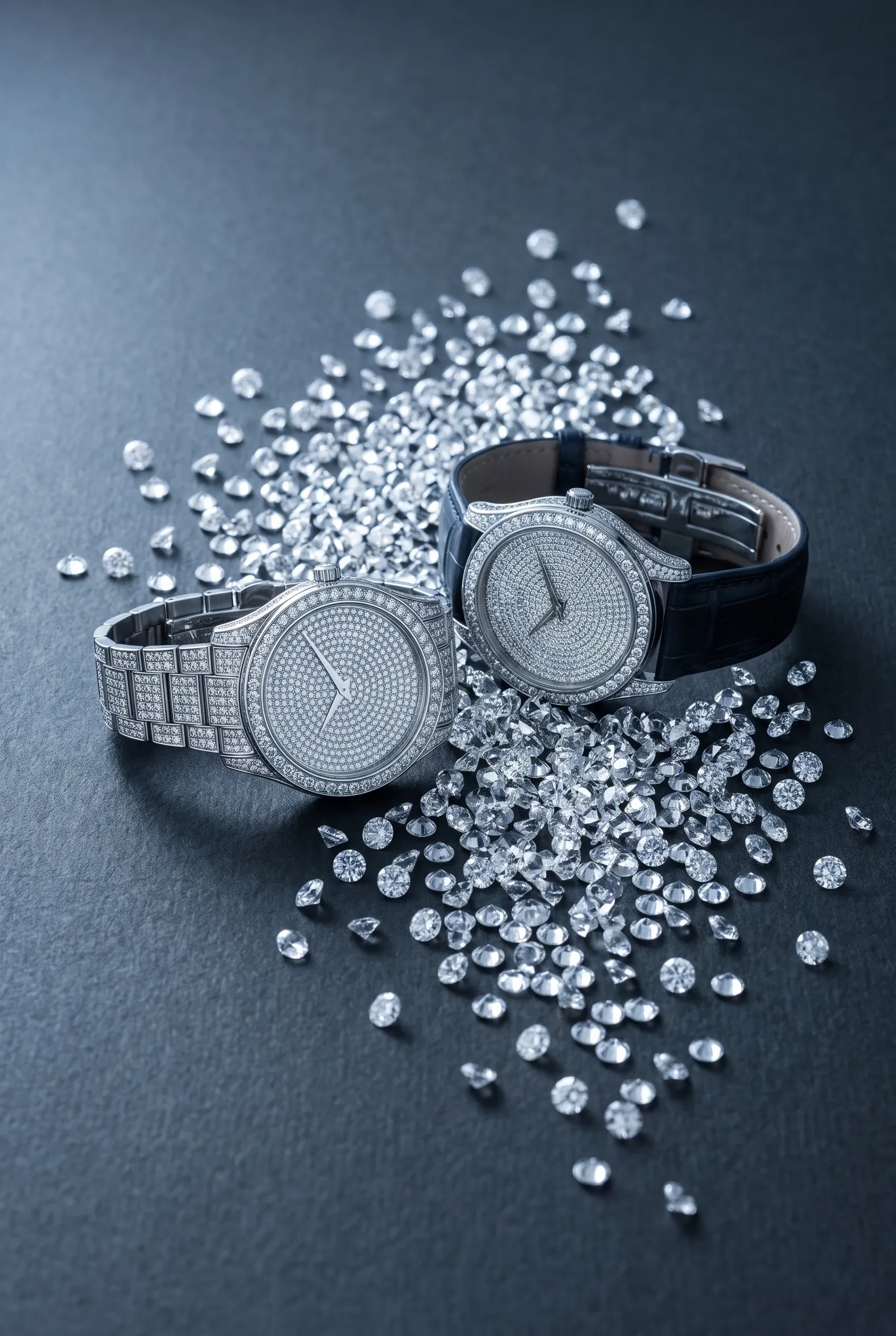
| Approximate stone count | What that usually means | Fair 2026 price if real moissanite |
|---|---|---|
| 200 to 500 stones | Bezel, dial markers or a smaller women’s case with moderate coverage | About $900 to $1,100 |
| 500 to 1,000 stones | Heavier bezel and case coverage, sometimes bracelet links too | About $950 to $1,400 |
| 1,000 to 2,000 stones | Strong coverage across case and bracelet on a mid-size or men’s watch | About $1,100 to $1,900 |
| 2,000 to 3,500 or more | Fully flooded case, dial and bracelet, usually 40–42 mm | About $1,200 to $2,700 |
Notice how the price does not rise in a straight line with count. That is because watches are not priced like loose stones. Once a watch is already fully covered, adding more tiny stones may not change the total as much as upgrading the crystal to sapphire, improving the case finishing or paying for cleaner setting work.
Why two watches with the same count can cost very different amounts
If two watches both say 1,500 stones, four things can explain a large price gap. First, the layout may be different. Round pave is common, while baguette-style layouts usually take more planning and cleaner channels, which can raise labor.
Second, the count may sit on different watch sizes. A dense 36 mm watch with 1,500 stones is a different build from a more open 42 mm watch with the same number. Third, one seller may include moissanite on the dial and crown, while another limits the stones to the bezel and first bracelet links.
Fourth, the underlying watch can be better or worse. A thicker case, tighter bracelet tolerances, higher grade clasp and a sapphire crystal can move the price up even if the visible stone count stays similar. That is why count is useful, but never enough on its own.
What you are actually paying for
A moissanite watch price combines gem material, labor and base watch parts. The stone itself is silicon carbide, nearly always lab grown for jewelry use, and it is not especially expensive compared with diamond. Loose colorless moissanite around 1 carat typically retails for about $300 to $600, while a similar 1 carat round diamond runs about $4,000 to $7,000 if natural, or about $800 to $1,500 if lab grown.
Watch stones are much smaller than a 1 carat center stone, so the per-carat comparison is only a rough guide. Still, it explains the bigger picture. Moissanite is far more expensive than crystal or CZ, but nowhere near diamond pricing, which is why fully set moissanite watches can exist in the low four figures.
You are also paying for setting labor. Hundreds or thousands of small seats must be cut, aligned and secured. Then you pay for the base watch, which usually means a metal case and bracelet, a quartz movement, a crystal and finishing work. When one of those parts improves, the final price moves.
How to tell whether a watch is really moissanite
The easiest first screen is price. Below about $300, the market is overwhelmingly crystal or CZ. That does not automatically make those watches bad for fashion use, but it does mean you should not pay moissanite money for imitation stones.
After that, ask what test was used. Standard thermal pens often read moissanite as diamond, so passing a basic tester proves very little. A dual thermal and electrical tester separates the two. We explain that in more detail in this guide to a diamond tester.
Paperwork needs context too. GRA reports are common with moissanite watches and loose stones. They identify the stone as moissanite and list basics like carat, cut and color, but they are not a GIA-style quality guarantee. Treat that paperwork as identification, not proof that the setting is clean or the watch is worth the asking price.
If you have the watch in hand, a loupe can help. Moissanite is doubly refractive, so facet doubling can appear through the pavilion. Diamond is singly refractive. That is not always easy to use on a set watch, but it is a real gemological difference.
Setting quality is where cheap watches fail
For stone-set watches, setting method matters as much as stone type. Hand-set stones, usually secured by prongs or bead setting, are the durable standard. Glued stones may look fine at first, but they commonly start shedding within months. This is the single most common reason cheap iced watches disappoint.
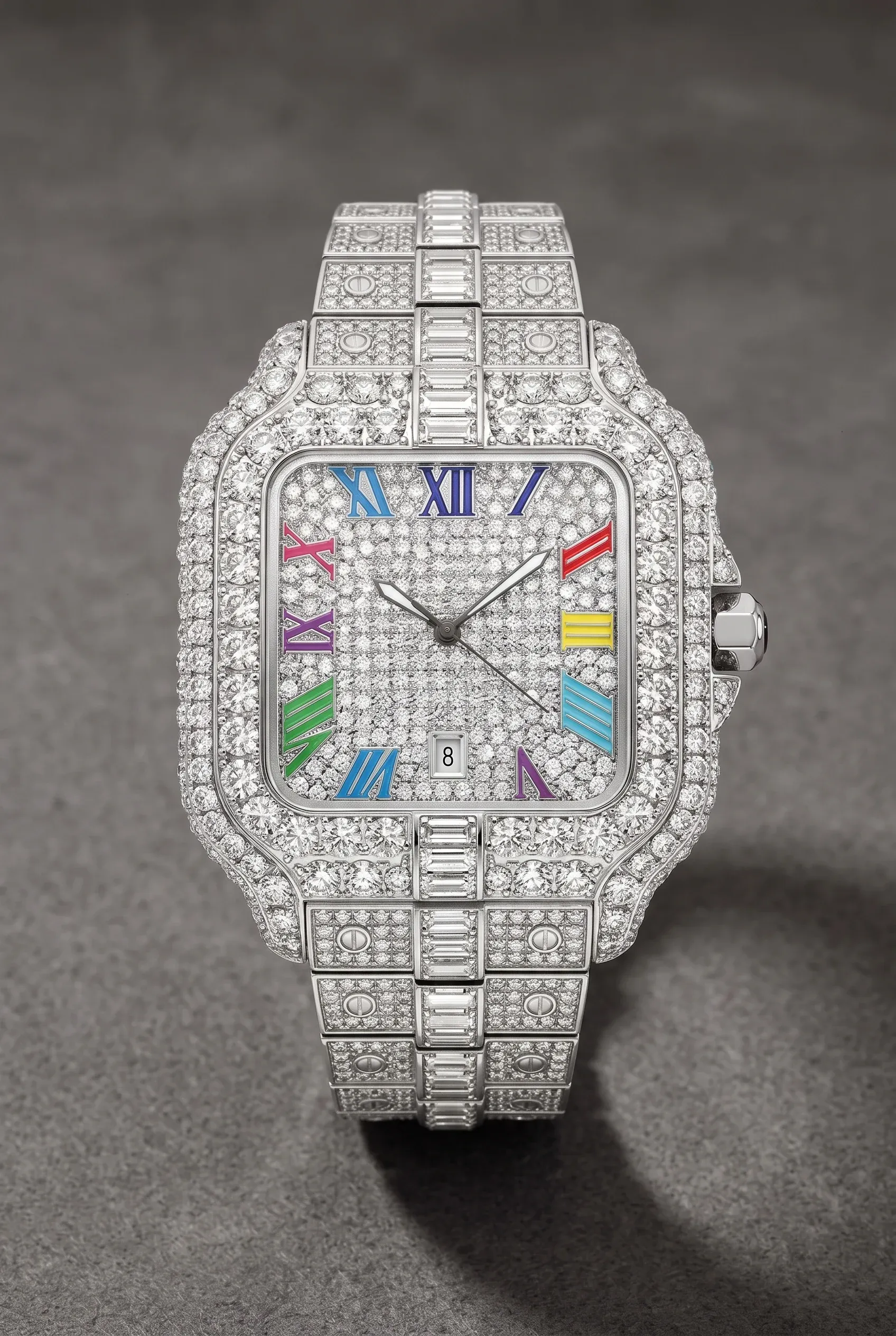
If a seller does not clearly say the stones are hand set, ask. If the answer is vague, assume the setting is not a strength. We break down the failure points in this guide to hand-set stones and glued stones.
This is also why some real moissanite watches look more expensive than their raw stone cost suggests. Labor is slow, and good labor shows up in even rows, level tables, consistent spacing and stones that stay put. For an iced watch, those basics matter more than a flashy stone count headline.
Movement, crystal and water resistance
Under $3,000, most moissanite watches use Japanese quartz movements. That is normal, not a flaw. Quartz keeps cost down, keeps the case slimmer and avoids the added service needs that come with an automatic movement. If you are deciding between the two, start with how you will wear the watch, then read more about quartz or automatic for stone-set pieces.
The crystal is another price lever. Hardened mineral glass is common. Sapphire crystal usually appears above roughly $1,500. Sapphire resists scratches better, so it can be worth paying for on a daily watch, but it is not the first upgrade we would prioritize over secure setting work.
Water resistance claims also need plain reading. A 3 ATM rating means rain and hand-washing, not swimming. That number will not make a watch cost much more, but it should shape expectations. A heavily stone-set watch is usually bought for looks first, not for sports use.
Size changes both look and cost
Case size affects comfort, style and price. Women’s classic sizes usually land at 26–32 mm, women’s contemporary at 34–36 mm, unisex at 38–40 mm and men’s at 40–44 mm. More millimeters usually mean more metal surface to cover and, therefore, more stones and labor.
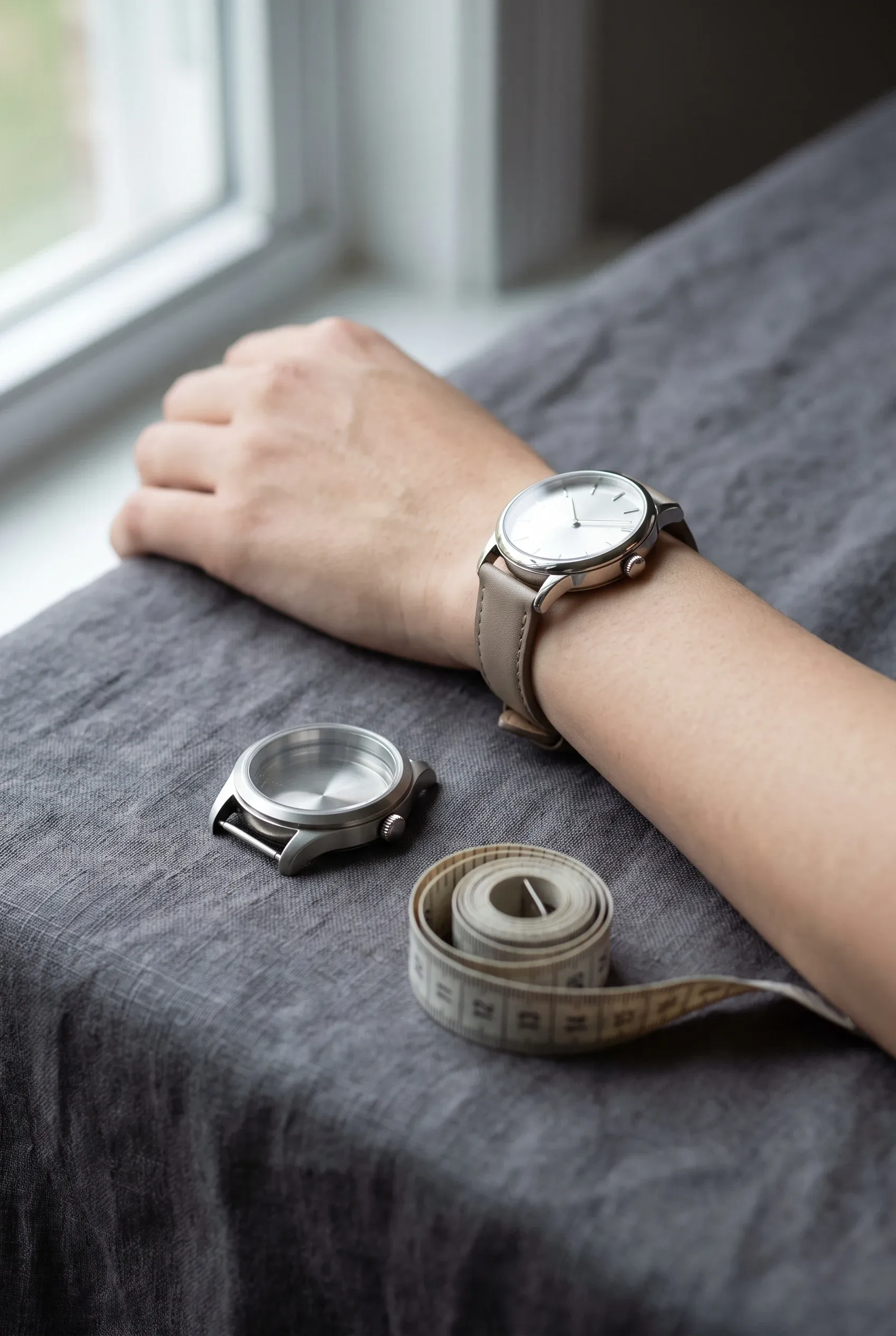
For small wrists, cost control often starts with size discipline. If your wrist is under 6 inches, staying at or below 36 mm usually looks better and avoids paying for coverage you do not need. A compact watch with well-placed moissanite can feel more expensive than an oversized case drowning a small wrist.
If you are shopping a smaller case, this guide to women’s sizes and dials can help you match coverage to wrist size. The same principle applies on the men’s side. Lug-to-lug length should not exceed your wrist width, no matter how tempting the bigger stone count looks.
Women’s and men’s price patterns
Women’s moissanite watches often start at the low end of the real market, roughly around $900, because the cases are smaller and the total stone use is lower. That does not mean they look less substantial. A square or rectangular case with dense coverage can still deliver a very full iced look without climbing to the top of the price range.
Men’s watches tend to cluster higher because 40–44 mm cases and broader bracelets need more coverage. A fully set men’s watch commonly lands from about $1,100 upward, and the dense, full-bracelet versions are the ones most likely to approach $2,700. The average US men’s wrist is about 7 to 7.5 inches, which helps explain why 40–42 mm cases dominate this category.
The main mistake is buying size for image instead of fit. A better-fitting watch often costs less and looks more convincing. Bigger is not automatically better when stones, dial and bracelet are already competing for attention.
When moissanite makes the most sense
Moissanite is the middle-ground stone for people who want real gem performance on a watch without diamond pricing. On the Mohs scale it sits at 9.25, compared with diamond at 10 and CZ at about 8 to 8.5. It also has a higher refractive index than diamond, 2.65 to 2.69 versus 2.42, and more dispersion, 0.104 versus 0.044, so it throws stronger rainbow fire.
That makes moissanite a better long-term stone choice than crystal or CZ for buyers who care about sparkle and durability. It also keeps the total watch price in a zone that many shoppers can actually reach. The jump from moissanite to lab-diamond custom work is large, and the jump to natural diamond is larger still.
Moissanite is least sensible if you simply want the iced look for occasional wear and have a hard cap below $400. In that case, an imitation stone watch may be the honest answer. It will not be moissanite, but it may match your budget better than stretching for a real stone category you do not need.
A fair-price checklist before you buy
Before paying, run through a short checklist. It will catch most overpriced or mislabeled listings faster than stone count alone.
- Check the price floor. Under about $300, assume crystal or CZ unless there is unusually strong proof otherwise.
- Ask how the stones are set. Hand-set is the standard you want. Glued stones belong in the cheap fashion tier.
- Read the movement line. Japanese quartz is normal in this market. Do not pay an automatic premium unless you specifically want that trade-off.
- Check the crystal. Hardened mineral glass is common, sapphire is a meaningful upgrade above the entry level.
- Treat GRA paperwork correctly. It identifies moissanite, but it does not certify superior watchmaking or cut quality.
- Match size to wrist. Paying for a bigger case usually means paying for more stones. Make sure that extra cost also improves the fit.
If a watch clears those checks and lands inside the normal range for its size and coverage, the price is probably realistic. If the listing leans hard on a giant stone count but hides the movement, crystal and setting method, be cautious. In this category, the missing details are often the expensive ones later.
Frequently Asked Questions
How much does a moissanite watch cost if it has over 3,000 stones?
In 2026, a real moissanite watch with 3,000 or more stones usually lands around $1,200 to $2,700. The lower end tends to be quartz with standard mineral glass, while the upper end usually reflects denser coverage, better finishing, sapphire crystal or stronger setting work.
Is a $299 moissanite watch real?
Usually no. In the current US market, a watch sold as moissanite for under about $300 is almost always crystal or cubic zirconia. That price tier can still be fine for fashion use, but it does not line up with normal hand-set moissanite watch costs.
Does a GRA certificate prove the watch is high quality?
No. A GRA report is common moissanite paperwork, and it mainly identifies the stone as moissanite while listing basic details such as carat, cut and color. It is not a full watch-quality guarantee, and it does not prove strong setting work, finishing or long-term durability.
Does passing a diamond tester affect a moissanite watch’s price?
No, and it should not be used to justify one. A basic thermal pen often reads moissanite as diamond regardless of the watch’s real price or quality, so a passed test says nothing about value. Price should be judged by stone count, setting method, movement and crystal, not tester results.
Are automatic moissanite watches worth more than quartz ones?
They can be, but not always in a way that helps the buyer. Automatics add thickness and service cost, while Japanese quartz is the normal, practical movement in stone-set watches under $3,000. If the watch is mainly a style piece, quartz often makes better financial sense.
Do more stones always mean more carats?
No. A higher count often means smaller stones, not more total carat weight. A watch with fewer but larger stones can carry more carat weight and cost more to set. That is why stone count is useful for judging coverage, but not enough for valuing a watch on its own.
What is the best price tier for a first moissanite watch?
For most buyers, the sweet spot is around $1,000 to $1,500. That range is where real moissanite, hand setting and solid everyday specs most often meet. It also gives you enough budget to avoid the imitation-stone tier without pushing into custom diamond territory.