Does Moissanite Pass a Diamond Tester?
Yes, usually — and that says more about the tester than the stone. What thermal testers measure and what they cannot tell you.
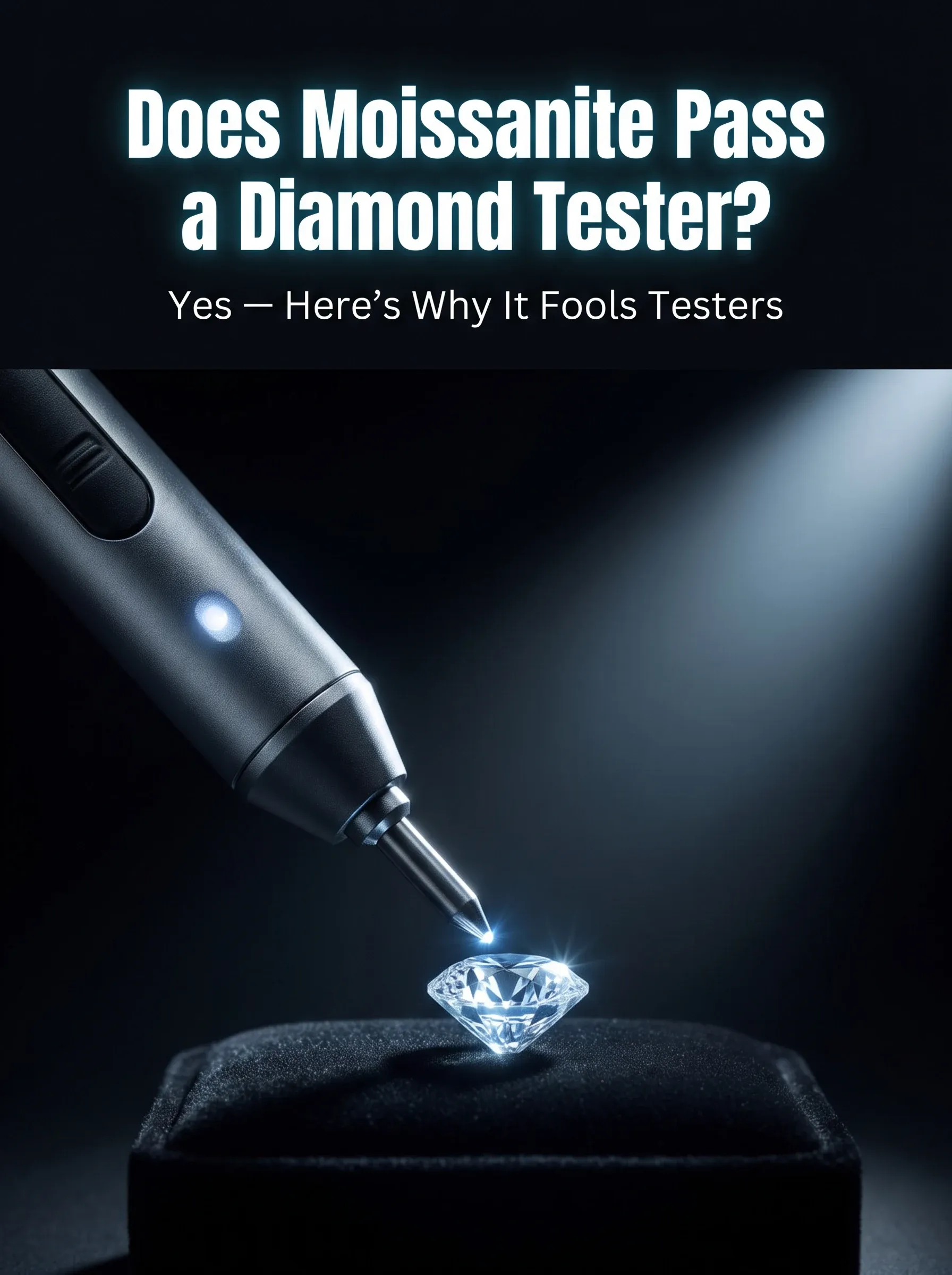
Yes—moissanite can pass a diamond tester, especially a standard handheld tester that measures thermal conductivity. That does not make moissanite a diamond; it means the tester is reading one shared physical behavior rather than proving the stone’s identity.
If you want the short version, here it is: a basic diamond tester is useful for separating diamond or moissanite from stones like cubic zirconia, but it is not enough on its own to tell diamond from moissanite with confidence. For that, you need additional testing, usually electrical conductivity, magnification, or professional lab verification.
Introduction to Moissanite and Diamond Testers
Moissanite is a gemstone in its own right, made of silicon carbide. The trade also classifies it as a diamond simulant, because it resembles diamond closely enough at a glance to be mistaken for one. Both descriptions are accurate, and the second is the reason testers exist. It offers strong durability and produces intense sparkle and fire, which is why many buyers choose it for engagement rings and fine jewelry on purpose rather than as a substitute.
A diamond tester is a tool used to identify whether a stone behaves like diamond under a specific test. Most consumer diamond testers are pen-style devices. They touch the stone with a small probe and measure how quickly heat moves through it.
That detail matters because the phrase diamond tester sounds more definitive than it really is. A tester does not automatically confirm that a stone is a natural diamond, a lab diamond, or not a diamond at all. It only reports the result of the property it measures.
Understanding Moissanite: Composition and Key Properties
Moissanite is silicon carbide, not carbon crystal like diamond. The material has a different crystal structure, different optical behavior, and different electrical behavior, even though it can look very close to diamond in jewelry.
GIA identifies synthetic moissanite as a common diamond simulant and states that it is not a diamond, even though it is easy to confuse with diamond by appearance alone. That distinction is the foundation of the entire testing question: appearance and identity are not the same thing.
Moissanite is also extremely hard. On the Mohs scale, it ranks about 9.25, which makes it suitable for everyday wear. It is slightly lighter than diamond as well, with a specific gravity of 3.22 compared with diamond’s 3.52.
Lab Creation and Formation Process
Natural moissanite is extremely rare. Henri Moissan first identified it in 1893, and the material found in nature became famous for its connection to meteorites. The moissanite used in jewelry today is lab created.
Modern jewelry-grade moissanite entered the market in the late 1990s. That timing matters because the rise of colorless lab-created moissanite pushed the jewelry trade to improve testing methods beyond older thermal-only testers.
Because jewelry moissanite is lab created, buyers often consider it for ethical and sustainability reasons. It also costs far less than a comparable diamond; one common market comparison puts moissanite at roughly 90% less than a diamond of similar size and quality.
Optical Characteristics: Sparkle, Fire, and Refractive Qualities
Moissanite has a higher refractive index than diamond, so it throws off more intense sparkle and stronger rainbow fire. In practical terms, when you look at the stone under direct light, moissanite often shows more colorful flashes, while diamond tends to show a more balanced mix of white light and colored fire.
This is one of the easiest visual clues for you to notice. If a stone looks especially fiery and rainbow-heavy, moissanite becomes more likely. That is still not a final test, because lighting, cut quality, and cleanliness all affect how a stone looks.
Under magnification, moissanite also shows double refraction. Jewelers often call this “doubling.” When viewed through certain facets, the facet junctions or culet can appear doubled or slightly fuzzy. A diamond is singly refractive, so it does not show that same doubled look.
Exploring Diamonds: Natural and Lab-Grown Differences
Diamonds come in two main categories: natural and lab grown. Both are real diamonds. Both are made of carbon and share the same basic physical and chemical identity, which is why both will generally register as diamond on standard diamond testers.
The difference is origin. Natural diamonds form in the earth. Lab-grown diamonds are produced through technological methods such as CVD and HPHT. Those growth methods do not make them fake; they make them man-made diamonds.
That said, testing gets more complicated with some lab stones. A standard pen tester may read a lab diamond as diamond, but unusual conductivity patterns in some stones—especially some HPHT material—can create confusing results and require more advanced confirmation.
Fundamental Physical Properties of Diamonds
Diamond is prized for exceptional hardness, high thermal conductivity, and strong brilliance. It ranks 10 on the Mohs scale, making it harder than moissanite, although both are durable enough for daily jewelry wear.
Diamonds also conduct heat extremely well. That property is the reason thermal diamond testers exist in the first place. When the tester probe touches the stone, diamond disperses heat quickly, and the device interprets that response as a diamond-like result.
Many diamonds also carry a microscopic inscription on the girdle tied to a grading report. If you are trying to verify whether a mounted stone is a diamond, that inscription can be far more useful than a quick pen test.
Comparison of Hardness and Brilliance with Moissanite
Diamond and moissanite overlap in the exact areas that confuse shoppers most: both are hard, both are bright, and both can pass visual inspection when set in jewelry. Their differences show up in the details.
| Property | Diamond | Moissanite |
|---|---|---|
| Composition | Carbon | Silicon carbide |
| Mohs hardness | 10 | 9.25 |
| Specific gravity | 3.52 | 3.22 |
| Sparkle pattern | Balanced white light and fire | Stronger rainbow fire |
| Refraction | Single | Double |
| Standard thermal tester result | Usually passes as diamond | Often passes as diamond |
If you are choosing between them, the practical takeaway is simple: diamond gives you the traditional benchmark, while moissanite gives you a lower-cost stone with more dramatic fire. The tester issue matters most when you are verifying authenticity, resale value, or disclosure.
How Diamond Testers Operate
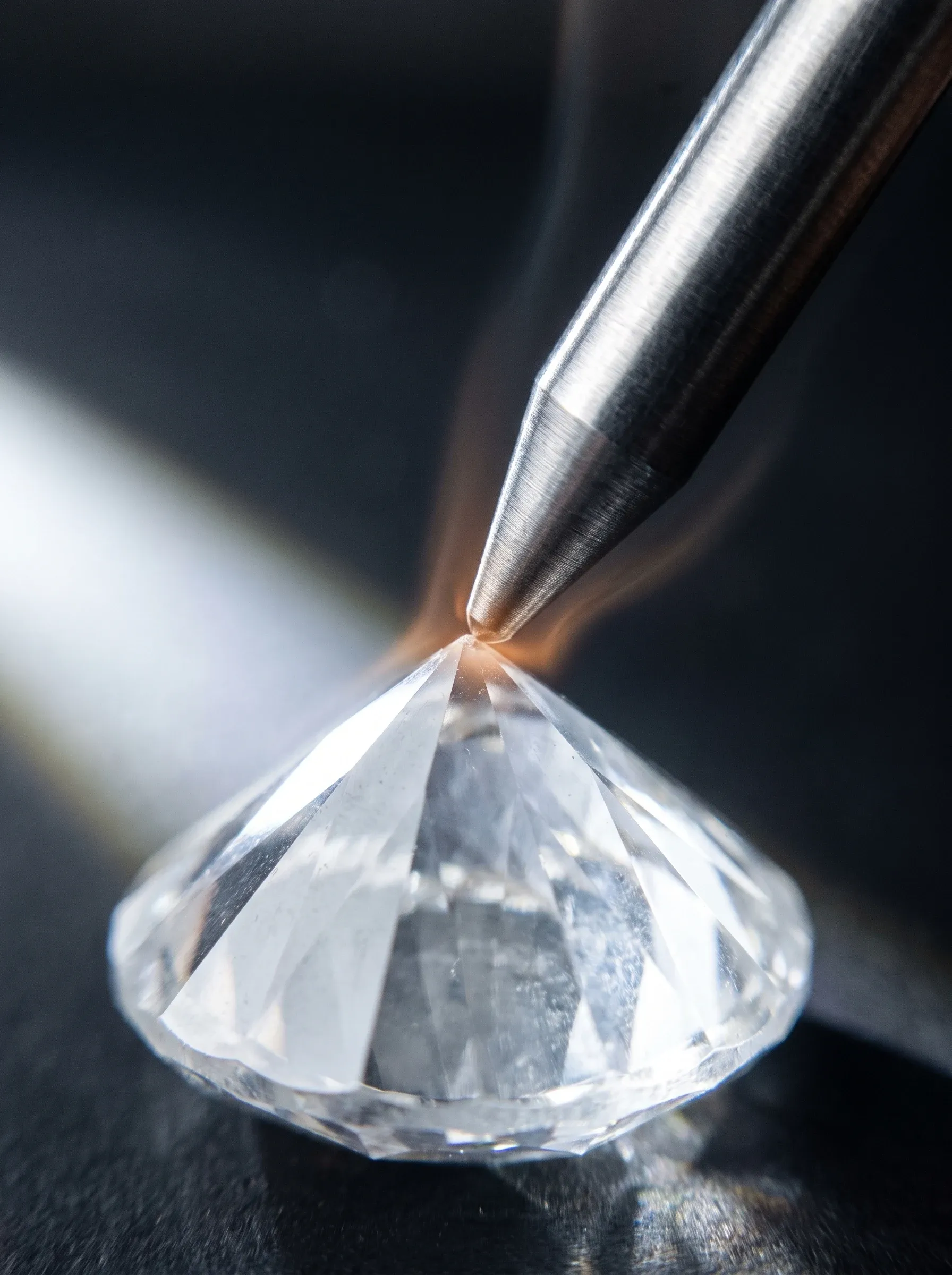
Most handheld diamond testers are built around one core idea: diamonds move heat quickly. The tester places a heated probe on the stone and measures how fast that heat is conducted away.
If the response falls within the expected range, the tester signals “diamond.” That is why these tools work well for eliminating low-conductivity simulants like cubic zirconia. CZ does not mimic diamond’s thermal behavior, so it fails this kind of test — one of several ways moissanite and cubic zirconia part company.
The problem is that moissanite also has high thermal conductivity. A thermal tester cannot always separate two different materials if both materials handle heat in a similar way.
Thermal Conductivity: The Science Behind the Test
Thermal conductivity measures how efficiently a material transfers heat. Diamond is exceptionally strong in this area. Standard diamond testers were designed around that fact.
Moissanite also conducts heat very effectively. GIA documented this issue in 1997, noting that the thermal probes then on the market reacted to synthetic moissanite as if it were diamond. That is the technical reason moissanite can pass a diamond tester: the device is reading heat transfer, not chemical identity.
In plain language, the tester is not “fooled” because the stone looks convincing. It is “fooled” because the measurement itself is limited. If the only question the tool asks is “Does this stone conduct heat like diamond?” moissanite can answer yes strongly enough to trigger a diamond reading.
Electrical Conductivity and Other Testing Principles
More advanced testers go beyond thermal conductivity. Some combine thermal and electrical conductivity, which helps distinguish moissanite from diamond because moissanite shows electrical behavior that diamond generally does not.
Professional instruments go further still. GIA states that its iD100 distinguishes natural diamonds from laboratory-grown diamonds and diamond simulants using advanced spectroscopic technology, rather than UV light alone, which helps reduce false readings. Screening systems in the trade also separate out simulants for further testing instead of treating one quick result as final proof.
That layered approach is the right one. A reliable identification process does not rely on one pen, one touch, or one beep.
Moissanite on the Diamond Tester: Testing Outcomes
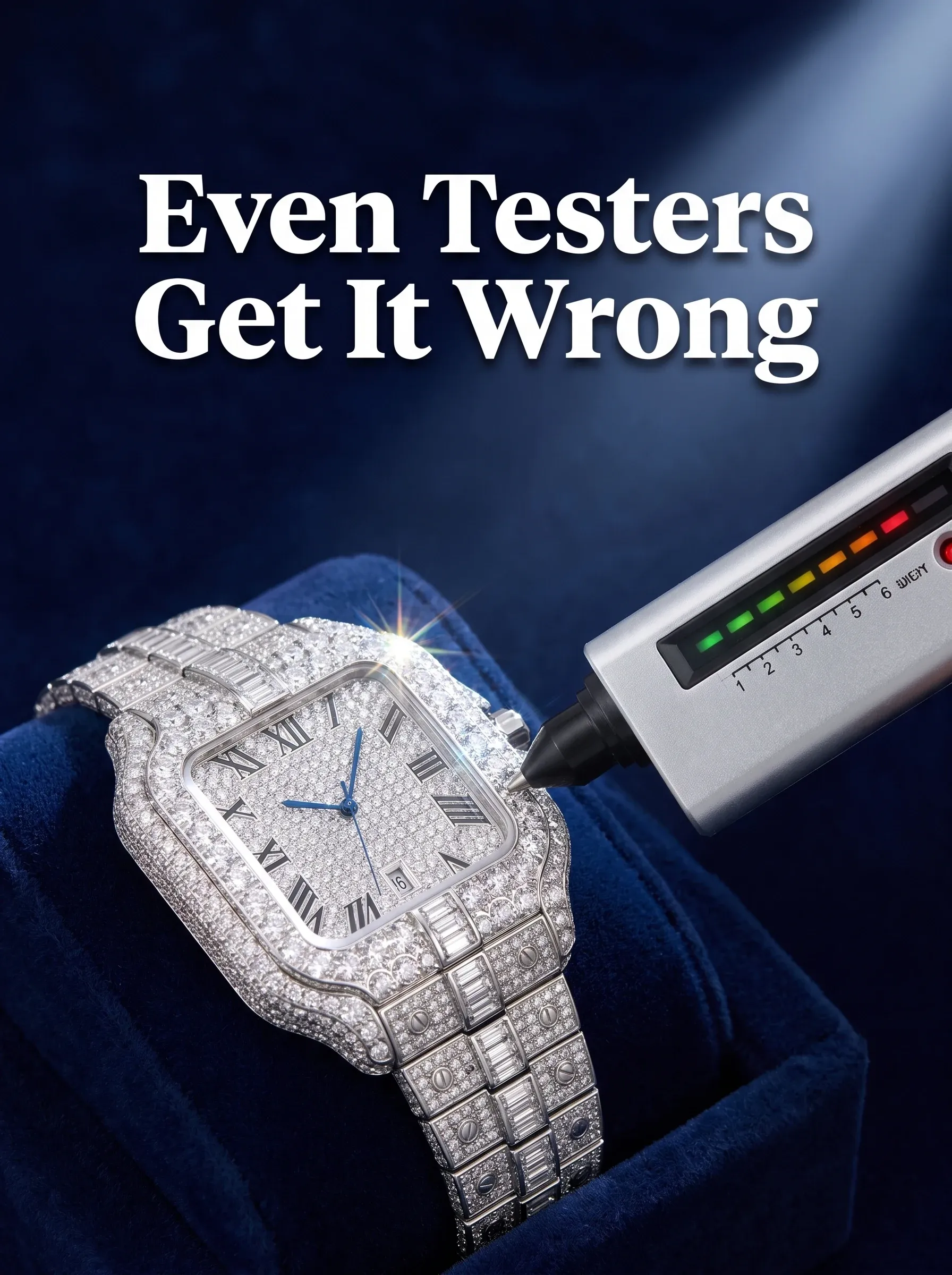
When moissanite goes on a standard diamond tester, three outcomes are possible: it reads as diamond, it reads as moissanite on a dual-function tester, or it triggers an uncertain result that needs more testing. The exact outcome depends on the tester design and the quality of the test conditions.
This is why two people can test the same stone and report different results. One may be using a basic thermal pen. Another may be using a multi-tester. A third may be using professional screening equipment and magnification afterward.
A single result without context does not tell you enough about the stone’s true identity or value.
Can Moissanite Pass the Diamond Tester?
Yes. On a standard thermal diamond tester, moissanite often passes as diamond.
GIA discussed this problem in 1997, when it addressed the need for a dedicated colorless moissanite/diamond tester, and again in 1998 when it explicitly noted moissanite testing as diamond on a standard tester. That is not a fringe exception; it is a recognized limitation of the tool.
At the same time, moissanite is still identifiable. GIA states that synthetic moissanite is easily distinguished from diamond by optical and physical characteristics. So the right conclusion is not “testers are useless.” The right conclusion is “basic testers are incomplete.”
Factors Influencing Test Results and Misidentification
Test results change based on the device and on how the test is performed. The most common reasons for misleading readings are:
- Thermal-only testers: These are the most likely to read moissanite as diamond.
- Probe touching metal: If the tester tip contacts the setting instead of only the stone, the reading can be wrong.
- Low battery or worn device: Older or poorly maintained testers produce unreliable results.
- Stone size and mounting: Small stones and tightly set stones are harder to test cleanly.
- Lab-grown diamond overlap: Some lab diamonds, especially some HPHT stones, may produce confusing readings that resemble moissanite on certain testers.
There is also a more subtle issue: people treat a “diamond” result as proof of value. It is not. A stone that passes a tester could be a natural diamond, a lab-grown diamond, or moissanite. Those three outcomes have very different market values.
A GIA laboratory note showed the importance of follow-up analysis. Standard testing showed a submitted stone was not a diamond, and later examination proved it was synthetic moissanite. The lesson is straightforward: when the answer matters, screening is just the first step.
Jewelry Buying Considerations: Verifying Authenticity and Value
If you are buying jewelry, the testing question is really about disclosure, authenticity, and price. A moissanite stone is not inferior simply because it is not diamond. The problem starts only when a seller represents one as the other or prices the stone as though the distinction does not matter.
Moissanite has real advantages. It is durable, bright, and much more affordable than diamond. It is also commonly chosen by buyers who want a lab-created stone instead of a mined gem.
Diamonds have their own advantages. They carry stronger traditional resale recognition, established grading systems, and the status of being the benchmark stone that diamond testers were originally meant to detect. Your decision depends on whether you value identity, budget, appearance, or long-term market perception most.
The Role of Lab Certification and Professional Appraisal
A grading report or lab certificate is far more valuable than a casual tester result. If a diamond has a report number inscribed on the girdle, a jeweler can inspect that inscription under magnification and match it to the paperwork.
For lab-grown diamonds, inscriptions may also include wording such as “lab grown” or “LG.” That helps separate lab diamonds from natural diamonds, though it does not replace full gemological testing when paperwork is missing.
Professional appraisal adds another layer. A trained jeweler or gemologist can combine microscope work, conductivity testing, and document review. That is the right path when you are insuring jewelry, reselling it, settling an estate, or confirming a high-value purchase.
Tips for Consumers and Jewelers in Choosing Quality Stones
If you want to avoid confusion, use a simple verification process instead of relying on one test.
- Start with the seller’s disclosure: ask whether the stone is natural diamond, lab diamond, or moissanite.
- Check for grading paperwork or an inscription if the stone is sold as diamond.
- Use a multi-tester rather than a thermal-only tester when possible.
- Inspect the stone under magnification for doubling if moissanite is suspected. Our identification guide ranks each method by how much you can trust it.
- Have a jeweler confirm the result if the stone’s value matters.
If you are a jeweler, the same rule applies: do not represent a stone based on a single pen reading. Use the tester as a screening tool, not as the final word.
Conclusion: Insights on the Intersection of Moissanite, Diamonds, and Tester Technology
Moissanite does pass a diamond tester in many cases, especially when the tester measures only thermal conductivity. That result happens because moissanite and diamond share high heat conductivity, not because moissanite is a diamond.
The most accurate way to identify a stone is to combine methods: conductivity testing, magnification, inscription checks, and professional lab or jeweler review. If you remember one thing, make it this: a diamond tester tells you how a stone behaves under a narrow test, not what the stone is worth or what it truly is.
Frequently Asked Questions
Does all moissanite pass a diamond tester?
Most moissanite will pass a standard thermal diamond tester, but the exact result depends on the tester model, stone size, and testing conditions.
Can a diamond tester tell moissanite from diamond?
A basic thermal tester often cannot. A multi-tester that measures thermal and electrical conductivity does a much better job of separating moissanite from diamond.
Do lab-grown diamonds pass diamond testers?
Yes. Lab-grown diamonds are real diamonds, so they generally pass diamond testers. Some stones, especially some HPHT material, may need additional testing if the reading is unclear.
What is the easiest visual way to spot moissanite?
Look for stronger rainbow fire and check for doubling under magnification. Moissanite often shows more colorful sparkle than diamond and can display double refraction through the facets.
Will cubic zirconia pass a diamond tester?
No. Cubic zirconia does not have the high thermal conductivity needed to pass a standard diamond tester.
Does passing a diamond tester prove a stone is valuable?
No. A passing result only shows that the stone behaves like diamond under that test. It does not prove whether the stone is a natural diamond, a lab-grown diamond, or moissanite.
Should you buy moissanite if you want a diamond look for less?
If you want strong sparkle, durability, and a much lower price, moissanite is a solid choice. If you want the identity, grading tradition, and market recognition of diamond, choose diamond instead.
What is the best way to verify a stone before buying?
Ask for full disclosure, review any grading report, check for an inscription if the stone is sold as diamond, and have a qualified jeweler verify it rather than relying on a quick tester reading alone.