Is Moissanite a Lab Grown Diamond?
No — and the difference is not a technicality. One is carbon, the other is silicon carbide, and only one gets a diamond grading report.
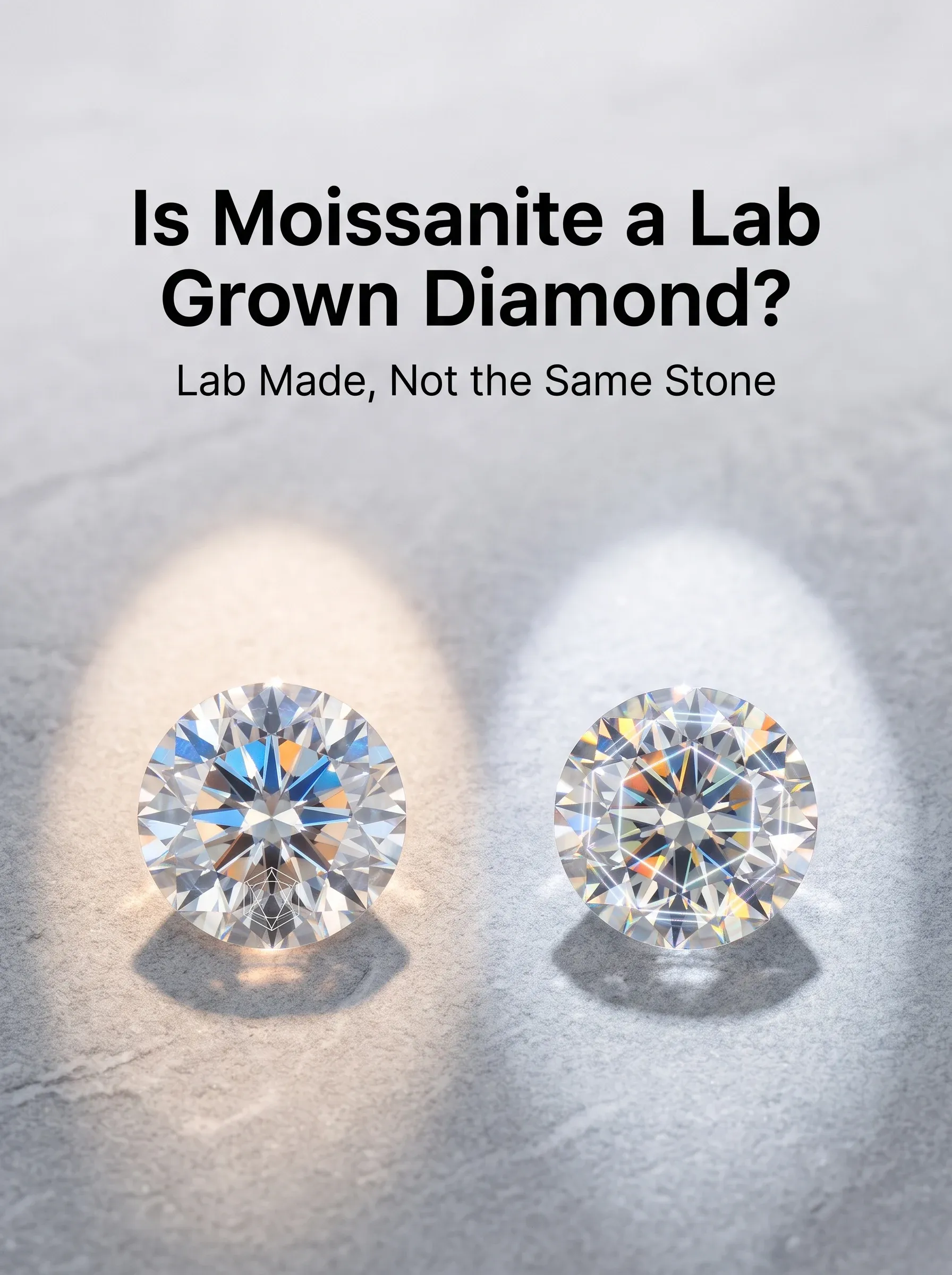
No. Moissanite is not a lab grown diamond. It is a different gemstone made of silicon carbide, while a lab grown diamond is a real diamond made of carbon with the same chemical, physical, and optical identity as a mined diamond.
The confusion happens because both stones are made in a lab and both are popular in engagement ring jewelry. If you are choosing between them, the key difference is simple: one is a diamond, and the other is a diamond simulant with its own look, hardness, sparkle, and price point.
Introduction: Unraveling the Debate – Is Moissanite a Lab Grown Diamond?
If you want the direct answer before anything else, here it is: moissanite is not a diamond of any kind. It is lab created in most modern jewelry, but “lab created” does not mean “lab grown diamond.” Those terms describe two different gemstones.
The FTC draws that line clearly. “Laboratory-grown” or similar diamond terms apply when a stone has essentially the same optical, physical, and chemical properties as a mined stone. Moissanite resembles a diamond, but it does not share the same composition or structure, so it stands in a separate category.
That distinction matters when you compare sparkle, certification, durability, and resale expectations. If you buy based only on appearance, you may end up with a stone that looks different from what you expected once you see it in daylight, office lighting, or side-by-side next to diamonds.
What Is Moissanite? Exploring Its Composition, Origins, and Unique Properties
The short version is below. For the full picture — how the stone was discovered, why it throws rainbow flashes, and how it behaves in daily wear — read What Is Moissanite?.
Moissanite is a gemstone made from silicon carbide. In jewelry, it serves as a durable, bright, diamond-like stone, but it is not carbon crystal and it is not a diamond.
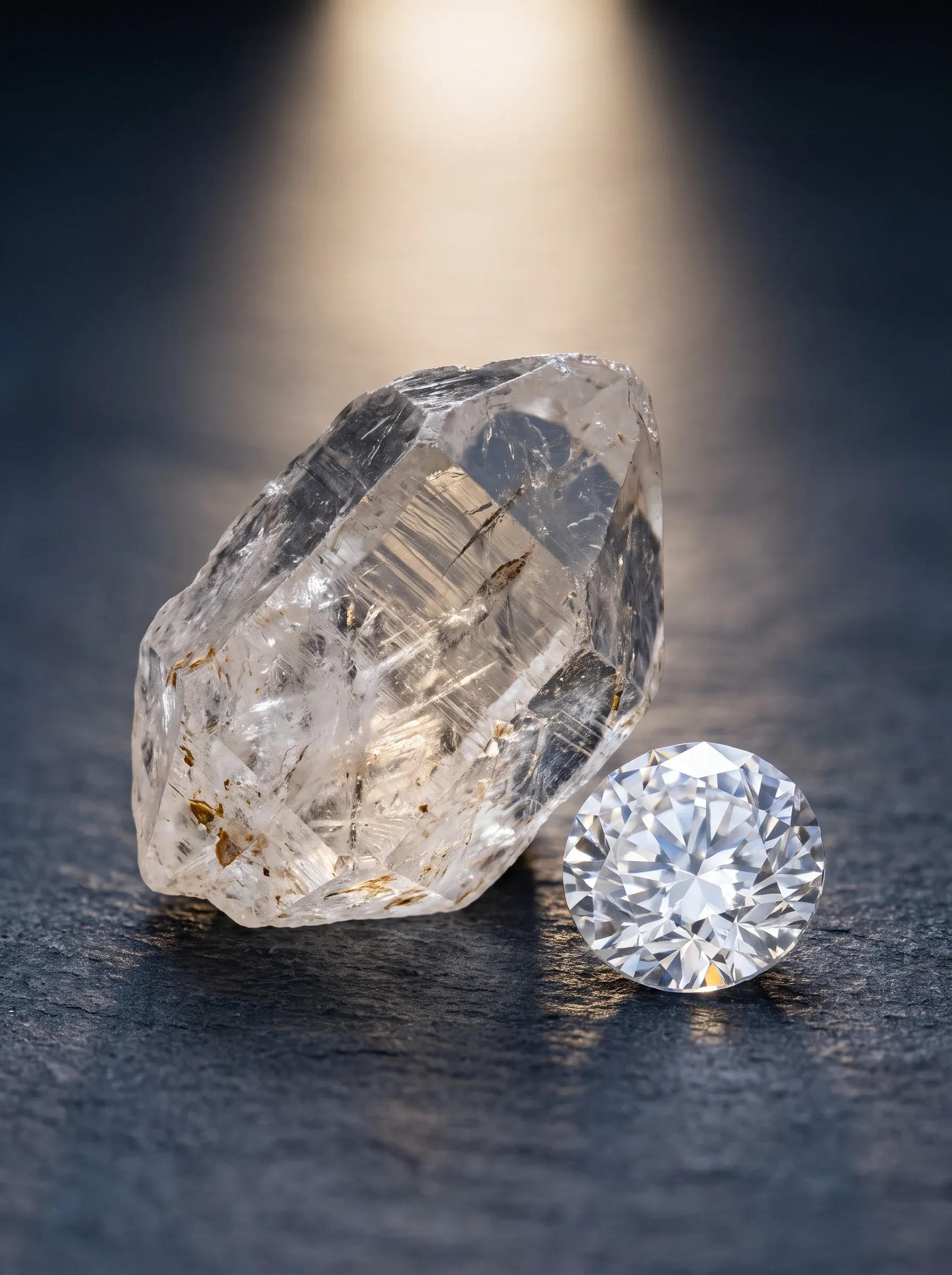
Natural moissanite exists, but it is extraordinarily rare and was first identified in 1893 by Henri Moissan in material from a meteorite crater in Arizona. Because natural crystals are too rare and too small for mainstream jewelry use, the moissanite you see in rings today is made in a lab.
That makes moissanite a real gemstone in its own right, not fake glass and not cubic zirconia. It simply belongs to a different mineral category than diamond.
Chemical Makeup and Formation Process
The chemical difference is the foundation of the whole debate. Moissanite is silicon carbide, often written as SiC. A diamond, whether mined or lab grown, is crystallized carbon.
Because the materials are different, their crystal structures are different too. That affects how each stone handles light, how it looks under magnification, and how gemological tools identify it. GIA separates moissanite, simulants, and lab grown diamonds for exactly this reason: they may look similar at first glance, but they are not the same material.
Modern moissanite entered the jewelry market as a lab-created silicon carbide gemstone and gained traction as a diamond alternative in 1998. That commercial history helped cement its place as a standalone option rather than a substitute pretending to be a diamond.
Key Attributes: Hardness, Colorless Appearance, and Sparkle
Moissanite is hard enough for everyday wear. On the Mohs scale, GIA puts it at 9.25, which makes it highly resistant to scratching in normal jewelry use, though still softer than diamond at 10.
Its appearance is one reason people love it and one reason others avoid it. Moissanite can look very colorless, especially in higher-quality stones, but larger stones may show warmth under certain lighting. Its sparkle is also more intense and more colorful than diamond sparkle.
That colorful effect comes from higher dispersion. Moissanite’s dispersion is about 0.104, while diamond’s is about 0.044. In plain English, moissanite throws more rainbow fire, while diamond returns a more balanced mix of white brilliance and colored flashes.
Understanding Lab Grown Diamonds
A lab grown diamond is a diamond. It is not a lookalike and not a simulant. It has the same carbon composition and crystal structure as a mined diamond.
That means a lab diamond shares the same hardness, the same fundamental optics, and the same grading framework used for mined diamonds. If your goal is the exact diamond category rather than a diamond-like gemstone, lab grown diamonds meet that standard.
The Laboratory Process: Transforming Carbon into Diamonds
Lab grown diamonds are made by transforming carbon into diamond crystal in a controlled laboratory environment. The setting is different from the Earth, but the end material is still diamond.
This is why the terminology matters so much. CIBJO adopted “laboratory-grown diamond” and “laboratory-created diamond” for non-natural diamond in 2010, reinforcing that the term applies to diamond material itself, not to every gemstone made in a lab.
When you buy a lab diamond, you are buying carbon crystal with diamond properties. You are not buying a diamond substitute.
Lab Diamond vs. Mined Diamond: Production and Quality Differences
The biggest production difference is origin: one is grown in a lab and one is mined from the earth. Chemically and physically, both are diamond.
A lab grown diamond is graded by independent diamond labs. IGI and GCAL issue full 4C reports for lab grown diamonds, and GIA grades them under its current lab-grown reporting framework. Moissanite does not receive a diamond grading report because it is not a diamond.
From a visual standpoint, a jeweler cannot identify a lab diamond versus a mined diamond by eye alone. Confirming origin requires documentation or specialized testing. That is very different from moissanite, which has optical traits that a trained jeweler can often spot.
Moissanite in the Laboratory: Myths, Facts, and Manufacturing Insights
The biggest myth is that moissanite becomes a lab diamond just because it is grown in a laboratory. It does not. The lab is the place of manufacture, not the identity of the stone.
Another common misunderstanding is that moissanite is “basically the same” as a lab diamond. That shortcut causes bad buying decisions. The stones are different in composition, refraction, certification, and market position.
CIBJO classifies imitation diamond products by whether they mimic a diamond without sharing its chemical composition, physical properties, or structure. In that framework, synthetic moissanite sits with diamond simulants, not with laboratory-grown diamonds.
The Role of the Moissanite Lab in Gem Creation
A moissanite lab creates silicon carbide gemstones for jewelry use. Its job is not to grow diamond crystal from carbon, but to manufacture a different gemstone with its own optical signature.
That distinction is useful when you read product descriptions. “Lab created moissanite” is accurate because the stone is made in a lab. “Lab grown diamond” is accurate only for diamond material. Mixing the two creates confusion and risks deceptive labeling, which is exactly why the FTC’s jewelry guidance focuses on precise terminology.
Comparing Traditional Lab Grown Diamonds with Moissanite Variants
Traditional lab grown diamonds are diamonds first and foremost. Their benchmark is mined diamond performance and grading. Moissanite variants aim for a different balance: lower price, strong durability, and a more vivid sparkle.
If you compare them side by side, the most visible difference is light performance. Moissanite produces more rainbow flashes and can show doubled facet lines because it is doubly refractive. Diamond is singly refractive, so its facet pattern looks cleaner and more familiar to people who picture a classic diamond look.
That is why two buyers can see the same stones and reach opposite conclusions. One sees extra sparkle and loves it. The other sees a look that is too flashy and prefers the calmer brilliance of a diamond.
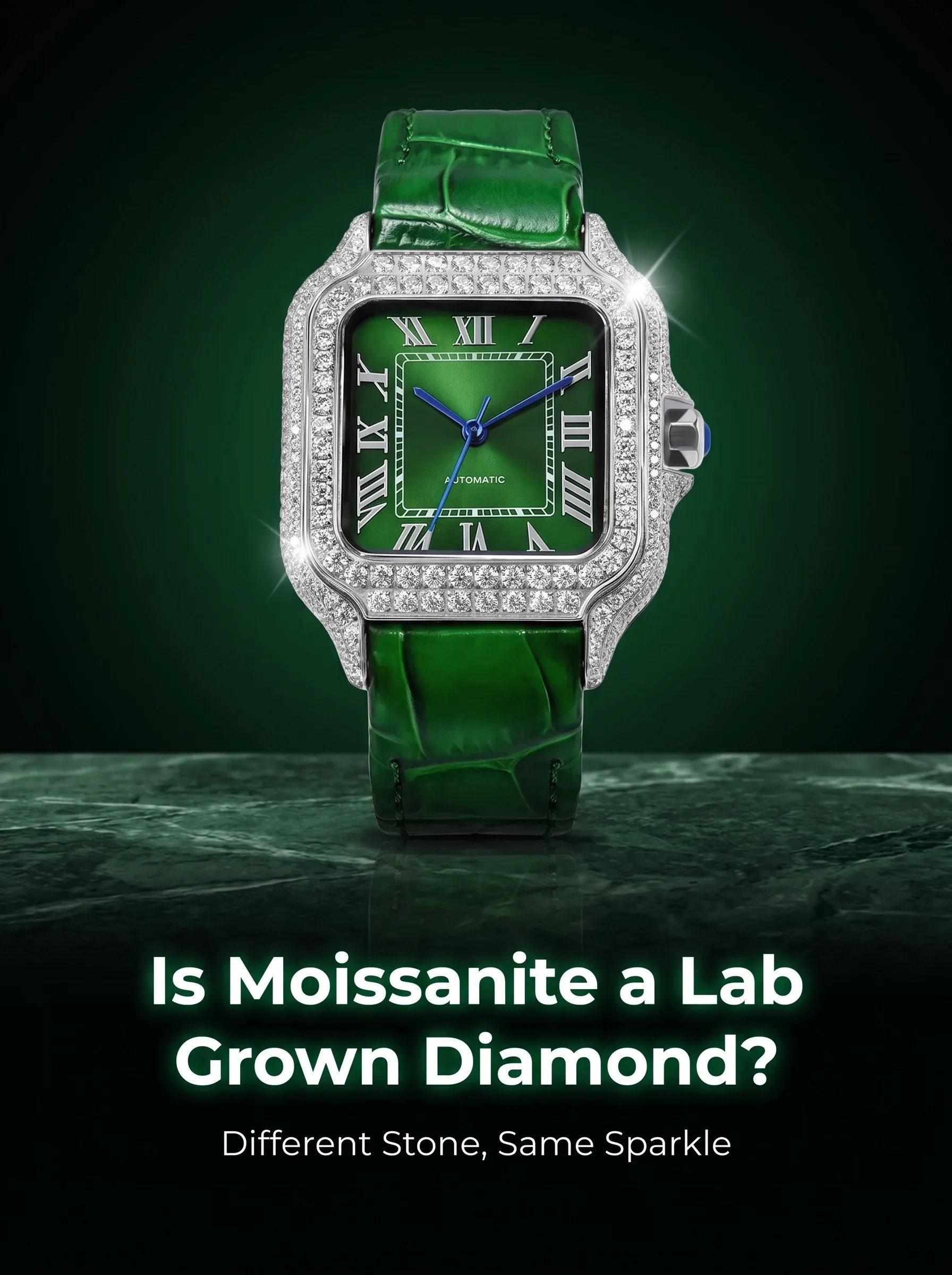
Manufacturing keeps improving on both sides — modern moissanite is more consistently colorless than earlier generations, and lab grown diamonds now span a wider quality range. None of that changes material identity. A more refined moissanite is still silicon carbide; a better-grown diamond is still carbon.
Comparative Analysis: Moissanite vs. Lab Grown Diamonds
If you are shopping, a side-by-side comparison is more useful than abstract definitions. The table below shows the practical differences that affect everyday ownership.
| Criteria | Moissanite | Lab Grown Diamond |
|---|---|---|
| What it is | Silicon carbide gemstone | Real diamond made of carbon |
| Diamond status | Not a diamond; a diamond simulant | A diamond with the same core properties as mined diamond |
| Origin | Nearly all jewelry-grade stones are lab created | Grown in a lab from carbon |
| Hardness | About 9.25 on the Mohs scale | 10 on the Mohs scale |
| Sparkle | More rainbow fire, higher dispersion | More classic white brilliance |
| Dispersion | About 0.104 | About 0.044 |
| Refraction | Doubly refractive | Singly refractive |
| Color handling | Can appear colorless, though larger stones may show warmth | Graded on the D to Z color scale like mined diamonds |
| Certification | Not graded on a diamond report | Graded by independent diamond labs |
| Price | Lower | Higher than moissanite, lower than comparable mined diamond |
| Best fit | You want affordability and bold sparkle | You want a true diamond look and diamond grading |
Physical and Optical Differences
The physical difference starts with hardness. Diamond ranks 10 on the Mohs scale, while moissanite sits near 9.25. Both work well in rings, but diamond is the more scratch-resistant option.
The optical difference is easier to notice with your eyes than the hardness difference is in daily life. Moissanite bends light differently and produces stronger rainbow flashes. Diamond gives you the classic sparkle people associate with engagement rings: bright white brilliance with a more restrained fire pattern.
There is also an identification difference. Under magnification, moissanite can show doubled facet edges because it is doubly refractive. Diamond does. A basic thermal pen tester is not enough to settle the question because both stones conduct heat well enough to confuse simple testers.
Price, Value, and Market Positioning
Moissanite wins on upfront price. If your budget is fixed and you want the biggest visual impact for less money, moissanite is the stronger value play.
Lab grown diamonds occupy the middle ground between moissanite and mined diamonds. They cost more than moissanite because you are buying an actual diamond with independent grading, but they still come in well below comparable mined diamond pricing.
A concrete example shows the gap clearly. For a 1.00ct stone, one published comparison listed lab diamond pricing at $3,400 to $4,300 versus $599 for moissanite. For a 1.90ct stone, the same comparison listed $5,500 to $6,500 for lab diamond versus $1,349 for moissanite. Those figures are examples, not universal market prices, but they illustrate the broad positioning accurately.
Consumer Considerations: Jewelry Trends, Ethical Implications, and Investment Perspectives
Your best choice depends on what you care about most: diamond identity, price, sparkle style, certification, or long-term expectations. There is no universal winner.
Both stones appeal to buyers who want non-mined jewelry options. Neither requires mining, and that matters to shoppers focused on origin. Still, ethical preference does not erase the need for clear labeling. If you want a diamond, buy a lab grown diamond. If you want a diamond alternative, buy moissanite knowingly and confidently.
Investment thinking also deserves realism. A lab grown diamond gives you diamond status and documentation, but that does not automatically make it a financial investment. Moissanite is even more purchase-driven than investment-driven. In both cases, you should buy for wear, design, and budget fit first.
Design, Durability, and Practical Applications
For everyday jewelry, both stones are durable enough for rings, earrings, pendants, and bracelets. Moissanite’s 9.25 hardness is strong for daily wear, while diamond’s 10 gives it the edge for maximum scratch resistance.
Design choice matters because the same stone can look different depending on cut, size, and setting. In larger center stones, moissanite’s extra fire becomes more obvious. If you want a stone that reads immediately as “diamond” in most lighting, a lab diamond is the safer choice.
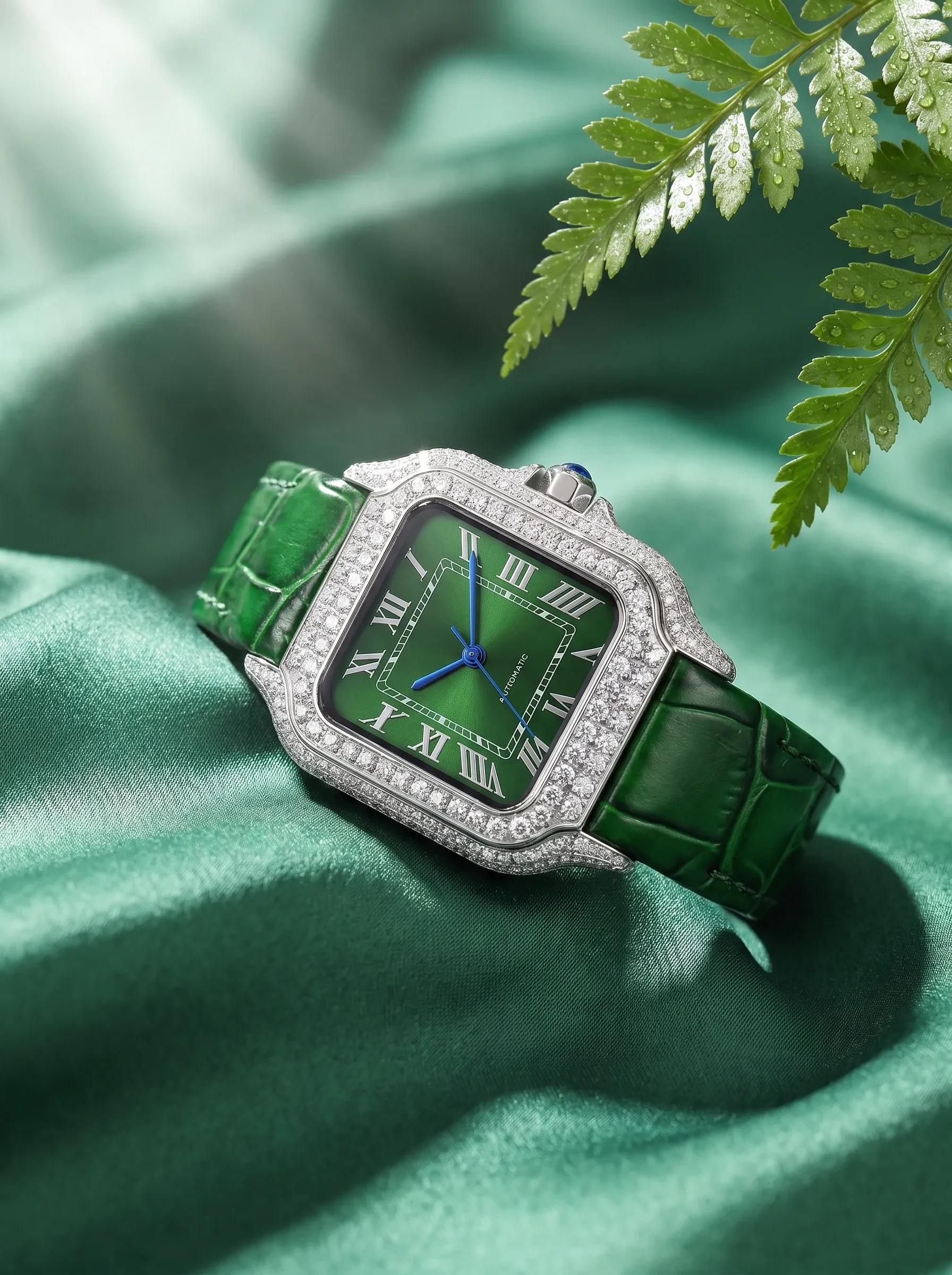
If you prefer a bright, lively gemstone and do not need the word diamond attached to it, moissanite makes practical sense. If you want a center stone that fits standard diamond grading and the classic diamond visual profile, a lab grown diamond is the better fit.
- Choose moissanite if: you want lower price, strong durability, and more colorful sparkle.
- Choose a lab grown diamond if: you want real diamond composition, diamond certification, and the traditional diamond look.
Frequently Asked Questions
Is moissanite a real diamond?
No. Moissanite is a real gemstone, but it is not a real diamond. It is made of silicon carbide, while diamond is made of carbon.
Is moissanite lab created?
Yes. Nearly all moissanite sold in jewelry today is lab created because natural moissanite is extremely rare and impractical for mainstream jewelry use.
Do moissanite and lab grown diamonds look the same?
Not exactly. From a distance they can look similar, but moissanite shows more rainbow fire, while a lab grown diamond has the classic white brilliance associated with mined diamonds.
Which is harder, moissanite or lab grown diamond?
Lab grown diamond is harder. Diamond ranks 10 on the Mohs scale, while moissanite ranks about 9.25.
Is moissanite cheaper than a lab grown diamond?
Yes. Moissanite costs less than a lab grown diamond, often by a wide margin, which is why it appeals to budget-conscious buyers.
Can a jeweler tell the difference between moissanite and lab grown diamond?
Yes, often with magnification or gemological tools. Moissanite is doubly refractive, while diamond is singly refractive, and that creates visible differences under proper examination.
Does moissanite come with a diamond certificate?
No. Moissanite does not receive a diamond grading report because it is not a diamond. Lab grown diamonds do receive independent diamond grading reports.
Should you choose moissanite or a lab grown diamond for an engagement ring?
Choose moissanite if you want lower price and extra sparkle. Choose a lab grown diamond if you want a true diamond, classic diamond optics, and diamond grading documentation.
Still weighing the two? The rest of our side-by-side comparisons cover moissanite against mined diamond and against cubic zirconia, and our moissanite guides go deeper on grading, certificates and care.