What's the Difference Between Moissanite and Diamond?
Composition, hardness, refractive index, price and origin — the five differences that decide which stone belongs in your ring.
The short answer is simple: moissanite and diamond are not the same gemstone. Diamond is crystallized carbon, while moissanite is silicon carbide, and that difference affects everything from sparkle and color to price, durability, and long-term value.
If you are choosing between them for an engagement ring or fine jewelry, the best option depends on what matters most to you: a classic diamond look, maximum hardness, lower price, stronger rainbow fire, or a lab-grown stone that avoids mining.
Overview: Moissanite vs. Diamond
Moissanite and diamond look similar at a glance, especially in rings, earrings, and pendants. Side by side, though, their differences become easier to spot. Moissanite throws more rainbow light, while diamond gives off a more balanced mix of brilliance, dispersion, and scintillation.
The biggest practical differences come down to five areas: composition, hardness, optical performance, price, and origin. Natural and lab-grown diamonds are both diamonds. Moissanite is a different gem entirely.
| Criteria | Moissanite | Diamond | Lab-Grown Diamond |
|---|---|---|---|
| Composition | Silicon carbide | Carbon | Carbon |
| Hardness | 9.25 on the Mohs scale | 10 on the Mohs scale | 10 on the Mohs scale |
| Refractive index | 2.65 to 2.69 | 2.417 to 2.419 | 2.417 to 2.419 |
| Sparkle style | More rainbow fire, brighter flashes | More balanced white and colored light | Same as natural diamond |
| Color range | Colorless, near colorless, and other hues | Colorless to colored | Colorless to colored |
| Price | Lowest of the three | Highest | Less than natural diamond, more than moissanite |
| Source | Lab grown for jewelry | Mined from the earth | Grown in a lab |
| Best fit for | Budget, strong sparkle, everyday wear | Tradition, rarity, resale perception | Diamond look with lower cost than mined diamond |
What is Moissanite?
Moissanite is a gemstone made of silicon carbide. Henri Moissan discovered natural moissanite in 1893 in material from a meteorite at Canyon Diablo, Arizona, and identified it correctly as silicon carbide in 1904.
Natural moissanite is extremely rare, so jewelry moissanite is grown in the lab. GIA classifies moissanite as a diamond substitute, not a diamond, and notes that it can be separated from diamond through its anisotropic optical behavior.
Modern moissanite is popular in engagement rings because it is durable, bright, and much less expensive than a comparable diamond. It also does not require mining.
What is a Diamond?
A diamond is a gemstone made of carbon in a cubic crystal structure. Natural diamonds form deep within the earth under intense heat and pressure, while lab-grown diamonds are produced in controlled facilities but remain chemically, physically, and optically diamond.
That distinction matters. A lab-grown diamond is still a diamond. Moissanite is not. Under U.S. Federal Trade Commission guidance, terms such as laboratory-grown or synthetic should be used only when a product has essentially the same optical, physical, and chemical properties as a mined diamond.
Diamonds remain the benchmark for engagement rings because of their hardness, familiar appearance, and strong cultural association with fine jewelry.
Origins and Formation
Natural Diamonds: Mined vs. Lab-Grown
Natural diamonds form in the earth and are later mined, cut, and polished for jewelry. Their price reflects rarity, mining, and the 4Cs: carat, cut, color, and clarity.
Lab-grown diamonds come from a lab rather than the earth, but they are still diamonds. They have the same hardness rating of 10, the same basic look, and the same sparkle pattern as mined diamonds.
If your goal is the exact diamond identity rather than a diamond alternative, lab-grown diamond is the closest lower-price route. If your goal is simply a beautiful white gemstone, moissanite enters the conversation for a different reason: value.
The Creation of Moissanite: Grown in the Lab
Moissanite sold in jewelry is grown in the lab because natural crystals are too rare and too small for mainstream jewelry use. GIA documented synthetic moissanite for jewelry as early as 1997, including measured refractive indices of 2.648 and 2.691 and a hardness of 9.25 on the Mohs scale.
That lab origin gives moissanite a consistent supply and helps keep its price well below diamond. It also means you are buying a gemstone created for jewelry performance rather than a mined stone pulled from the earth.
For shoppers who want traceability and a mining-free center stone, that origin is a major selling point.
Physical Properties and Performance
Hardness, Scale, and Durability Comparison
Diamond ranks 10 on the Mohs hardness scale. Moissanite ranks 9.25. In real-world wear, both are durable enough for daily jewelry, including engagement rings.
The difference is not trivial, but it is also not a sign that moissanite is fragile. A 9.25 gemstone is still very hard and resists scratching far better than most gems used in jewelry.
If you want the absolute hardest option, choose diamond. If you want a stone that stands up well to everyday life while costing less, moissanite performs strongly.
Refractive Index and Sparkle: How They Shine
Refractive index helps explain why these stones look different in light. Diamond measures about 2.417 to 2.419. Moissanite measures about 2.65 to 2.69, which is higher.
That higher refractive index gives moissanite more fire, meaning more visible rainbow flashes. One comparison widely used in gemology puts moissanite’s dispersion at 0.104 versus diamond’s 0.044, which is why moissanite often looks flashier and more colorful.
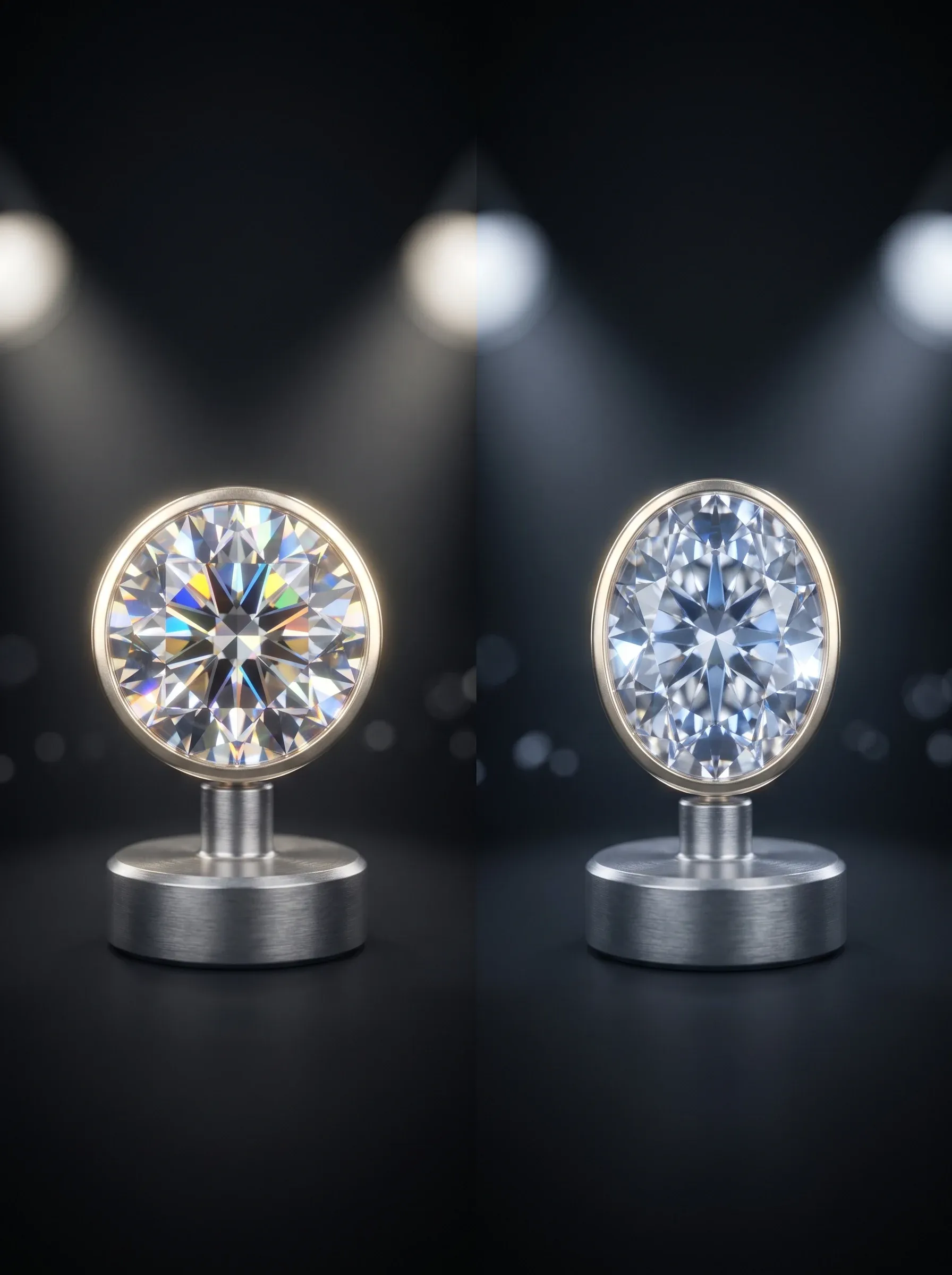
Diamond sparkle is more restrained and balanced. Many buyers describe it as cleaner or crisper, while moissanite reads brighter and more dramatic.
Color and Optical Characteristics
Color Variations: From Colorless to Rainbow Tones
Moissanite is available in colorless and near colorless grades, along with hues such as teal, gray, green, yellow, and black. Diamonds also appear in colorless grades and in fancy colors such as pink, blue, and yellow.
One important shopping point is that moissanite is not graded on the exact same system used for diamonds. Diamonds are commonly discussed through the D-to-Z color scale, while moissanite sellers often use their own quality categories.
If you want a very white center stone, compare stones in person or request clear grading details. “Colorless” in one product line does not always look identical to “colorless” in another.
Light Reflection and Gemstone Brilliance
People often use sparkle as a catch-all word, but three different light effects are at work: brilliance, fire, and scintillation. Brilliance is white light return. Fire is rainbow color. Scintillation is the pattern of flashes you see as the stone moves.
Diamond is prized for its balanced combination of all three. Moissanite produces stronger fire, which can create a more vivid rainbow effect, especially in larger stones and direct light.
This is why a moissanite may look diamond-like from a distance but different up close. If you love colorful flashes, moissanite is appealing. If you want a more traditional diamond look, diamond wins.
Price and Value Considerations
Price Differences and Investment Value
Moissanite costs dramatically less than diamond of similar size. At one carat, a loose moissanite typically sits in the low hundreds of dollars, a lab grown diamond runs several times that, and a natural diamond of comparable quality sits higher still. Those gaps widen as the stone gets bigger, because diamond pricing climbs steeply with carat weight while moissanite pricing does not.
Treat every specific figure you read as a snapshot rather than a rule. Lab grown diamond prices in particular have fallen sharply over the last few years, so a comparison written two years ago will overstate the gap today. Check current listings before you budget.
Natural diamonds sit above both in price. Lab-grown diamonds reduce the gap, but moissanite remains the budget leader.
From an investment perspective, neither moissanite nor most retail diamonds should be bought primarily for profit. If long-term resale perception matters to you, diamond generally carries more market recognition. If purchase value matters more than resale, moissanite often delivers more visual size for less money.
Budget Considerations in Engagement and Jewelry
Your budget changes the decision quickly. With the same amount of money, you can usually buy a larger moissanite than a diamond, or spend less while still getting a durable, attractive gemstone.
That makes moissanite especially appealing for engagement rings, travel jewelry, and buyers who prioritize appearance over gemstone identity. Diamond, by contrast, makes more sense if you care deeply about owning a diamond specifically, not just a white sparkling stone.
A practical way to decide is to rank these in order: price, size, sparkle style, hardness, and whether the word diamond matters to you. Your top two priorities usually reveal the right choice.
Ethical and Environmental Impacts
Earth, Mined, and Lab: Sustainability and Impact
Moissanite is lab grown and does not require mining. Lab-grown diamonds also avoid mining. Natural diamonds come from the earth and involve extraction before cutting and polishing.
For buyers focused on environmental impact, that difference matters. A lab-grown gem is easier to trace through a controlled supply chain and avoids the direct impact of mining.
That said, “lab-grown” does not mean impact-free. Growing gemstones still uses energy and industrial processes. The clearest distinction you can make from the available facts is this: mined diamonds come from the earth, while moissanite and lab-grown diamonds do not.
The Role of Engagement Rings in Market Trends
Engagement rings drive much of the moissanite versus diamond debate because center stones receive the most scrutiny. In smaller side stones, the visual differences are often less obvious. In a larger center gemstone, they become easier to see.
That is why moissanite has gained traction in engagement jewelry. It offers durability, size, and high light performance at a lower price, while diamond holds its place through tradition, symbolism, and recognition.
If you expect frequent questions about whether your ring is a diamond, that social factor belongs in your decision too. It is not superficial; it affects satisfaction after the purchase.
The Science of Light Performance
How Light Interacts with Diamond and Moissanite
Light behaves differently inside these stones because their crystal structures and optical properties differ. Diamond is singly refractive. Moissanite is doubly refractive.
That double refraction can create a visible doubling of facet junctions at certain viewing angles. A trained jeweler or gemologist can use that feature, along with the stone’s stronger rainbow fire, to separate moissanite from diamond. If you want the practical version of that process, we cover which identification tests actually work separately.
If you are trying to tell them apart at home, compare two similarly sized stones side by side in natural light. Moissanite usually shows more colorful flashes, while diamond looks more balanced and less disco-ball-like.
Understanding Gemstone Scale in Sparkle and Brilliance
Stone size changes what you notice. In smaller gems, the differences between moissanite and diamond are subtler. As the scale increases, moissanite’s rainbow fire becomes more obvious.
Cut also matters. A well-cut gemstone returns light more effectively than a poorly cut one, regardless of whether it is diamond or moissanite. That means a bad diamond can look duller than an excellent moissanite.
When you shop, do not judge by material alone. Look at the actual stone, its cut quality, and how it performs in daylight, indoor lighting, and movement.
Frequently Asked Questions
Is moissanite a real gemstone?
Yes. Moissanite is a real gemstone made of silicon carbide. It is not fake diamond, but it is also not a diamond.
Can you tell the difference between moissanite and diamond?
Yes, especially side by side. Moissanite shows stronger rainbow fire, and a professional can also identify it through optical features such as doubled facet lines at certain angles.
Is moissanite good for engagement rings?
Yes. Moissanite is durable enough for everyday wear, ranking 9.25 on the Mohs scale, which makes it a strong choice for engagement rings.
Does moissanite get cloudy over time?
No. Moissanite does not get cloudy over time under normal wear.
Is lab-grown diamond the same as moissanite?
No. A lab-grown diamond is still a diamond made of carbon. Moissanite is a different gemstone made of silicon carbide.
Which is better: moissanite or diamond?
Neither is universally better. Diamond is better for maximum hardness, tradition, and diamond identity. Moissanite is better for lower price, larger look for the money, and stronger rainbow sparkle.
Why is moissanite cheaper than diamond?
Moissanite is grown in the lab for jewelry and has a much lower market price than diamond. Natural diamonds also carry rarity and mining costs, while lab-grown diamonds still sell at a premium because they are diamonds.
Is moissanite a precious stone?
Not under the traditional definition, which reserves the term for diamond, ruby, sapphire, and emerald. That classification is a nineteenth-century trade convention based on rarity, not a measure of hardness, beauty, or how well a stone wears. Moissanite outranks most gems on the Mohs scale and outperforms diamond on fire; it simply sits outside a category that was drawn before it was available as a gemstone at all.