How to Tell Moissanite From Diamond
Which tests actually work, which are myths, and why a handheld diamond tester is not the answer. A practical identification guide.
You usually cannot tell moissanite from diamond with certainty just by looking. To your eye, the two stones can appear almost identical, but moissanite often shows stronger rainbow fire, while diamond tends to return a whiter, steadier sparkle. For a reliable answer, a jeweler or gemologist needs magnification and, in many cases, specialized testing.
If you are comparing an engagement ring, buying a loose stone, or checking jewelry you already own, the key is to understand what differences are visual, what differences are physical, and which tests actually work.
Moissanite and Diamond at a Glance
Moissanite and diamond are different gemstones, even though they can look strikingly similar in a ring. A diamond is made of carbon. Moissanite is made of silicon carbide. That single difference in composition changes how each stone handles light, heat, weight, and wear.
The FTC states that moissanite may look just like a natural mined diamond, but it is not the same. That is why the question is not just which stone sparkles more, but how to tell the difference in a way that is accurate.
If you want a quick comparison before getting into the details, this table covers the main distinctions.
| Feature | Moissanite | Diamond |
|---|---|---|
| Composition | Silicon carbide | Carbon |
| Hardness (Mohs) | 9.25 | 10 |
| Refractive index | 2.65–2.69 | 2.42 |
| Fire (dispersion) | 0.104 | 0.044 |
| Visual clue | More rainbow flashes | More white brilliance |
| Typical 1 ct price range | Varies by seller and market | Varies widely by quality and whether mined or lab grown |
| Origin | Lab grown for jewelry | Mined or lab grown |
Understanding Moissanite
Moissanite is a real gemstone, not a fake diamond and not cubic zirconia. Henri Moissan first found natural moissanite in 1893 in a meteor crater in Arizona. Natural material is extremely rare, so moissanite used in jewelry today is lab grown.
As a gemstone for daily wear, moissanite is popular because it combines high durability, strong sparkle, and a much lower price than diamond. It is especially common in engagement rings because it holds up well and delivers a large visual presence for less money.
Composition and Physical Properties
Moissanite is composed of silicon carbide. Diamond is pure carbon. Because moissanite and diamond are different materials, they do not react to light and testing equipment in exactly the same way.
Moissanite has a Mohs hardness of 9.25, which makes it suitable for everyday wear. Diamond sits at 10, so it is harder, but moissanite is still durable enough for an engagement stone. Moissanite is also less dense than diamond, so a stone with the same face-up size weighs less.
That weight difference matters most when the stone is loose. In a mounted ring, it is not a practical way to separate moissanite from diamond without removing the stone.
Cut, Fire and Brilliance
The biggest visual clue is light performance. Moissanite has a higher refractive index than diamond, which gives it more fire. In plain terms, you see more colorful flashes, especially under direct sunlight, spotlights, and bright LED lighting.
Diamond sparkle is different. A well-cut diamond gives off a balance of brilliance, dispersion, and scintillation that looks whiter and more restrained. Moissanite can look more vivid and more energetic, while diamond often looks sharper and cleaner.
Cut matters enormously here. A poor cut can make either stone look dull. A high-quality cut can make both stones look impressive. In step cuts such as emerald cut, the difference in fire is less dramatic than in round brilliant cuts, so shape influences how easy it is to spot the difference.
Understanding Diamond
Diamond remains the benchmark stone for many buyers because of its hardness, tradition, and market recognition. But “diamond” now includes two origins: natural and lab grown. Both are real diamonds.
That distinction matters because if you are trying to identify a stone, the question may not be only moissanite versus diamond. It may also be mined diamond versus lab grown diamond, which is a separate issue and cannot be solved by sight alone.
Natural Origin Versus Lab Grown
Natural diamonds form under extreme pressure and heat in the Earth. Lab grown diamonds are created in controlled laboratory conditions, but they are still diamonds chemically and optically. GIA states that even a skilled jeweler or trained gemologist cannot distinguish natural from man-made diamonds by sight alone; specialized laboratory equipment is needed.
GIA changed its terminology in 2019, when its Laboratory-Grown Diamond Reports stopped using the term “synthetic.” That matters because modern lab grown diamonds are sold and graded as diamonds, not as diamond simulants.
Moissanite is different. It is not diamond, mined or lab grown. It is a separate gemstone that visually imitates some diamond qualities while keeping its own optical signature.
Cut Quality, Clarity and Light
When you look at a diamond, cut quality has the strongest effect on beauty. A better cut improves brightness, contrast, and sparkle. Clarity matters too, but to your eye, cut usually changes the appearance more dramatically than a small clarity difference.
Diamonds are commonly evaluated using cut, clarity, color, and carat weight. That grading structure shapes how buyers compare stones and why two diamonds of the same size can look very different in person and cost very different amounts.
Light also changes perception. Under jewelry store lighting, both moissanite and diamond can look exceptional. In daylight, moissanite’s extra fire becomes easier to spot, while diamond often keeps a more neutral white return.
The Key Differences Between Moissanite and Diamond
If you want to tell one stone from the other, focus on the differences that remain consistent: composition, optical behavior, density, and market value. Surface impressions alone are not enough.
Physical and Optical Properties
Moissanite is doubly refractive, while diamond is singly refractive. That optical difference is one of the most useful technical ways to separate them. GIA published in 1997 that near-colorless synthetic moissanite was already being produced for jewelry and that thermal probes on the market could react to it “as if it were diamond.” That is why older advice about simple tester pens is incomplete.
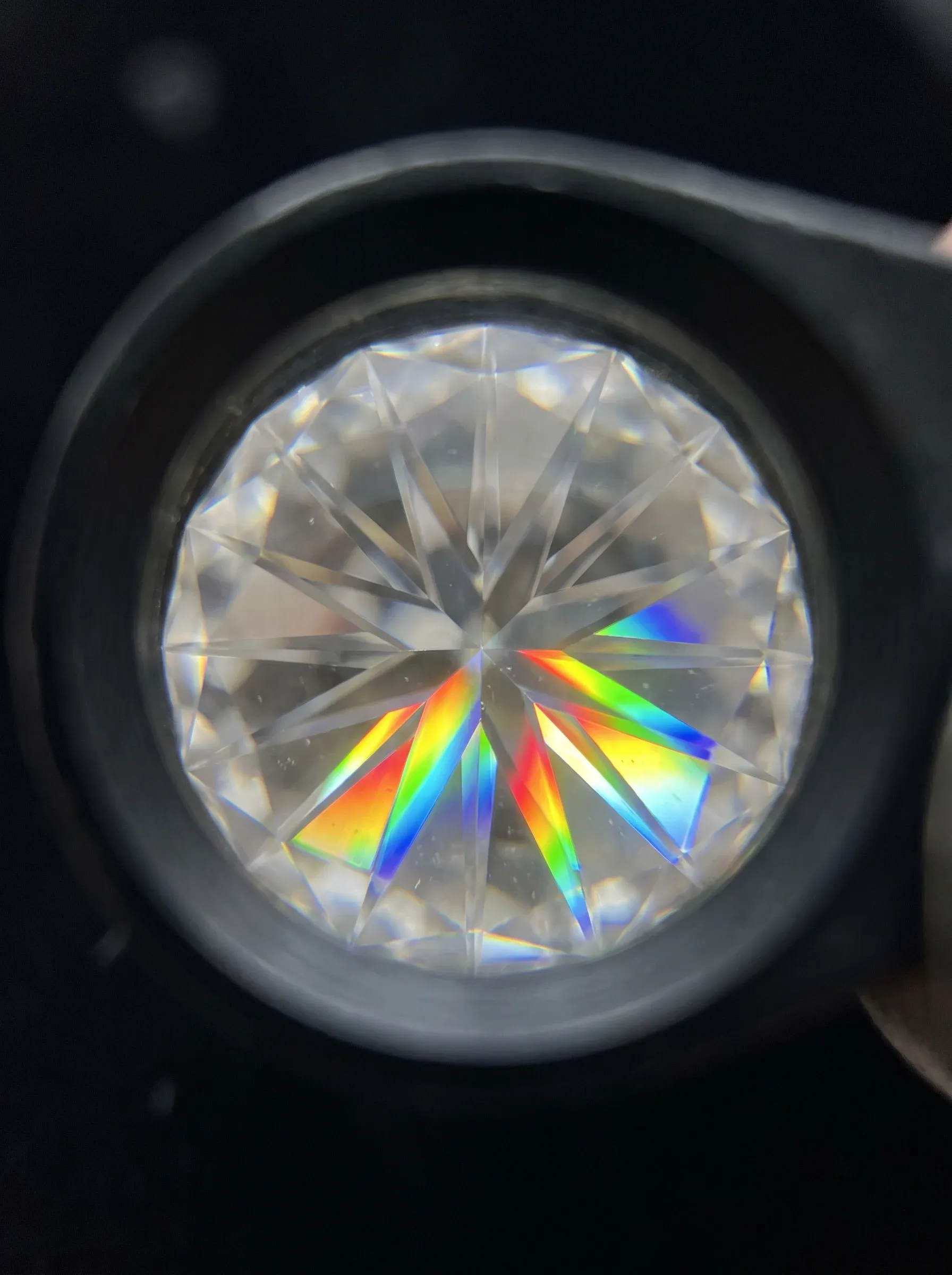
GIA also states that moissanite can be separated from diamond by its anisotropic optical character, which can produce doubling of facet junctions. Under magnification, a jeweler may see a slight doubling or blur in moissanite when viewing facet edges at the right angle.
Visually, moissanite often throws more rainbow fire. Diamond usually shows a tighter balance of white light and sparkle. In larger stones, especially above 1 carat, moissanite’s colorful flashes become easier to notice.
Durability, Wear and Value
Both stones are durable enough for daily wear. Diamond is harder, but moissanite is still highly resistant to scratching and suitable for long-term use in engagement jewelry.
In price, the gap is substantial and varies widely by seller, quality, and market. Lab grown diamonds are generally less expensive than mined diamonds, while moissanite is usually less expensive than both.
Value works differently depending on what you mean. If you mean visual size for money, moissanite offers more. If you mean traditional prestige or resale expectations, diamond carries stronger market recognition. Those are different kinds of value, and confusing them leads to bad buying decisions.
How to Identify and Separate the Two Stones
Some methods are useful screening tools. Others are definitive only in a lab. The most common mistake is trusting a single quick test as final proof.
Field Tests You Can Actually Trust
Look at the sparkle first. In bright light, moissanite often shows stronger rainbow flashes. Diamond usually appears whiter and less fiery. This is the easiest visual clue, but it is not conclusive because cut and lighting affect the result.
Use magnification. A jeweler’s loupe can reveal doubled facet junctions in moissanite. This effect does not show from every angle, and a well-cut stone can reduce how obvious it looks, but it remains one of the most useful field checks.
Do not rely on a thermal diamond tester alone. The FTC warns that thermal diamond testers used to distinguish diamonds from cubic zirconia may not accurately identify moissanite. In practice, that means a standard diamond tester can misread moissanite as diamond — a limitation we unpack in detail in does moissanite pass a diamond tester.
Weight is a weak clue. Moissanite weighs less than diamond for the same visible size. If you have two loose stones side by side, the difference may help. Once the stone is set, this method becomes impractical.
Ignore old scratch and fog myths. Both stones handle heat and everyday wear well enough that these home tests are unreliable and risky. They do not give you a trustworthy answer and can damage jewelry or setting components.
Specialized Laboratory Analysis
If you need certainty, laboratory-grade analysis is the standard. A professional can use magnification, conductivity testing designed for moissanite, and advanced gemological equipment to identify the stone correctly.
This matters even more when the comparison is not moissanite versus mined diamond, but moissanite versus lab grown diamond. Sight alone will not settle that question. GIA identifies moissanite and cubic zirconia as the most important diamond simulants in the market, which is exactly why professional identification remains relevant.
There is also a consumer protection angle. In 2018, the FTC revised its Jewelry Guides to help prevent deception in jewelry marketing, including claims about diamond and gemstone products. If you are buying a stone represented as diamond, proper disclosure is not a detail; it is essential.
| Identification Method | What It Checks | Useful for Moissanite vs Diamond? | Reliability |
|---|---|---|---|
| Naked-eye sparkle check | Rainbow fire vs white brilliance | Yes | Moderate |
| Loupe inspection | Doubling of facet junctions | Yes | High in trained hands |
| Thermal diamond tester | Heat conductivity | No, not by itself | Low for final ID |
| Moissanite-specific tester | Electrical conductivity | Yes | Better, but not universal |
| Laboratory analysis | Optical and material properties | Yes | Highest |
What This Means for an Engagement Ring
For engagement jewelry, the right choice depends less on whether strangers can tell and more on what you want from the stone every day. Appearance, budget, maintenance expectations, and personal values all matter.
Why Fire, Brilliance and Cut Drive the Decision
If you love intense sparkle and colorful fire, moissanite may appeal to you more than diamond. If you prefer a classic white-light look with tighter scintillation, diamond may feel more natural to your taste.
Shape changes the experience. Round cuts emphasize sparkle and make moissanite’s fire more obvious. Emerald cut and other step cuts reduce that “disco ball” effect and highlight clarity and clean lines instead.
The setting matters too. A halo, cathedral, bezel, or low-profile setting changes how much light enters the stone and how much attention the center stone receives. That means the same moissanite or diamond can look very different depending on the ring design.
Comparing the Two in an Engagement Ring
For daily wear, both stones work. Diamond offers maximum hardness and the familiarity many buyers want in an engagement ring. Moissanite offers excellent durability, strong sparkle, and a much lower price.
If your priority is budget efficiency, moissanite lets you buy a larger stone or invest more in the setting. If your priority is owning a diamond specifically, a lab grown diamond can be the middle ground between mined diamond pricing and moissanite pricing.
A practical comparison looks like this:
| If you care most about... | Best fit | Why |
|---|---|---|
| Maximum sparkle for less money | Moissanite | Higher fire and much lower cost |
| Traditional diamond identity | Diamond | Carbon composition and strong market recognition |
| Lower cost than mined diamond but still a diamond | Lab grown diamond | Same material as mined diamond at a lower price |
| Very large center stone on a tighter budget | Moissanite | Lower price per stone size |
Environmental and Ethical Considerations
Moissanite used in jewelry is lab grown, so it avoids mining and offers clear origin transparency. That is one reason many buyers choose it. Environmental impact is lower than mined diamond, and conflict concerns tied to mining do not apply in the same way.
Diamonds require more distinction. Mined diamonds and lab grown diamonds are not the same from an environmental or sourcing perspective. A lab grown diamond avoids mining, while a mined diamond carries a different footprint and a more complex sourcing chain.
Ethics should not be reduced to a slogan. If origin transparency matters to you, ask direct questions about whether the stone is moissanite, mined diamond, or lab grown diamond, and request documentation where relevant. The right choice is the one that matches both your values and your expectations about what you are buying.
Frequently Asked Questions
Can you tell moissanite from diamond with the naked eye?
Not with certainty. You may notice that moissanite shows more rainbow fire and diamond shows a whiter sparkle, but a reliable identification usually requires magnification or professional testing.
Does moissanite pass a diamond tester?
It can pass a standard thermal diamond tester, which is why that tool is not enough on its own. Moissanite-specific testing or a professional gemological examination is more reliable.
What is the easiest visual difference between moissanite and diamond?
The easiest visual difference is fire. Moissanite throws stronger colorful flashes, especially in direct light, while diamond usually looks more white and crisp.
Is moissanite a real gemstone?
Yes. Moissanite is a real gemstone made of silicon carbide. It is not diamond, but it is also not fake or plastic.
Which is better for an engagement ring, moissanite or diamond?
Neither is universally better. Moissanite is better for value and strong sparkle, while diamond is better if you want the traditional diamond material and status.
Does moissanite get cloudy over time?
No. High-quality moissanite does not turn cloudy from age alone and remains suitable for long-term wear with normal cleaning and care.
Is lab grown diamond the same as moissanite?
No. A lab grown diamond is a real diamond made of carbon. Moissanite is a different gemstone made of silicon carbide.
Should you buy moissanite or diamond if resale matters to you?
If resale is a major priority, diamond generally has stronger market recognition. If your priority is appearance and lower upfront cost, moissanite often makes more financial sense.