Moissanite vs Diamond Sparkle: Fire Brilliance and the Disco Ball Question
A clear numbers-first guide to moissanite and diamond sparkle, covering fire, brilliance, tester behavior, and real 2026 price differences.
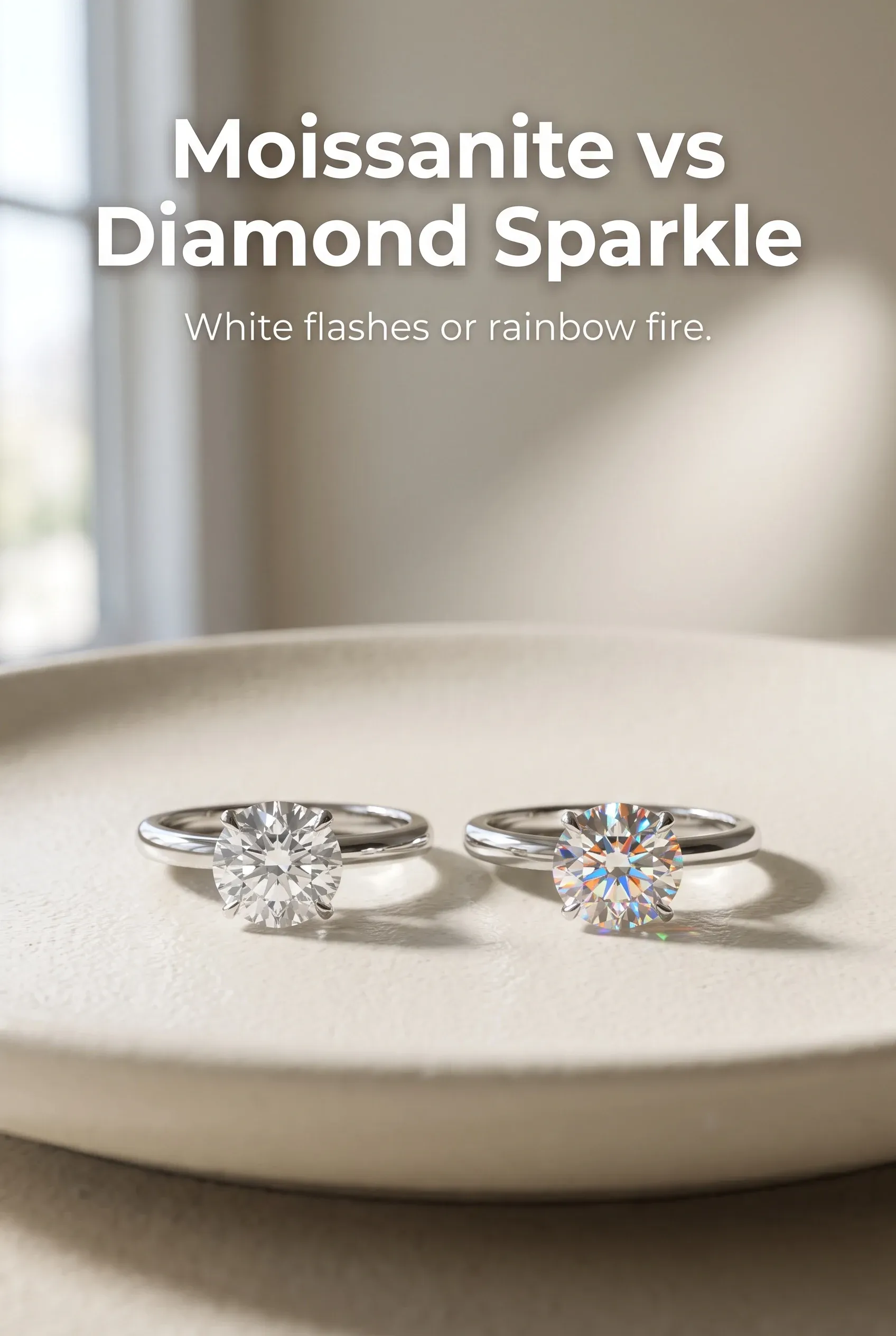
In a moissanite vs diamond sparkle comparison, moissanite usually throws more rainbow fire, while diamond looks whiter and steadier. That means moissanite can look more lively to some eyes, but also more like a disco ball under spot lighting, especially in larger stones. The better choice depends on whether you want white flashes, rainbow flashes, a bigger look for the budget, and how closely you inspect the stone.
Moissanite vs diamond sparkle at a glance
People often ask for a single winner. There is not one. Moissanite and diamond do not sparkle the same way, even when both are well cut and colorless. From normal viewing distance, both can look bright and expensive.
The difference starts with the material. Moissanite is silicon carbide, first identified in a meteor crater in 1893 by Henri Moissan, and nearly all jewelry stones today are lab grown. If you want the longer version of what moissanite is, start there. Diamond is a different crystal with a different light pattern, which is why the two stones separate most clearly in motion.
The numbers behind the sparkle
When people say sparkle, they usually mean several optical effects at once. The most useful comparison is not hardness alone. It is the mix of refractive index, dispersion, and optical structure.
| Property | Moissanite | Diamond | What it changes |
|---|---|---|---|
| Hardness on the Mohs scale | 9.25 | 10 | Durability, not sparkle itself |
| Refractive index | 2.65–2.69 | 2.42 | How strongly the stone bends light |
| Dispersion | 0.104 | 0.044 | How much rainbow fire the stone throws |
| Density | 3.21 | 3.52 | Why equal carat weights do not face up the same size |
| Optical character | Doubly refractive | Singly refractive | Whether facet doubling can appear under magnification |
Those numbers explain most of the visual difference. Moissanite bends light more strongly and splits white light into more color. Diamond still sparkles hard, but its pattern is usually tighter and less rainbow-heavy. Density does not make a stone prettier, but it matters when shoppers compare by carat instead of millimeter size.
What brilliance fire and scintillation mean
Brilliance is white light return. Fire is colored light, the small rainbow flashes you catch when a stone moves. Scintillation is the on and off pattern of bright and dark areas as the stone, light, or viewer shifts.
Most shoppers roll all three into the word sparkle. That is why two people can look at the same ring and disagree. One person is reacting to brightness, another is reacting to rainbow fire, and another is reacting to how crisp the pattern looks. A fair comparison separates those effects instead of treating them as one thing.
Does moissanite sparkle more than diamond
If by sparkle you mean rainbow fire, yes, moissanite usually sparkles more than diamond. Its dispersion is more than double diamond’s, so it throws stronger colored flashes under the same light. This is easiest to see when the stone moves, not when it sits still in a product photo. It is also easier to see in larger stones.
If by sparkle you mean crisp white return and a calmer flash pattern, many eyes prefer diamond. Diamond often looks more restrained and more familiar, which some people read as more refined. Neither reaction is wrong. The real answer is that moissanite often gives more color, while diamond often gives a more classic light mix.
Why some people see a disco ball effect
The phrase usually means too many colored flashes firing at once. That effect shows up most under point-source lighting, like jewelry counter spots, restaurant pendants, stage lighting, or direct phone flash. In those conditions, moissanite can separate light into strong little rainbows very quickly. The result can look energetic, busy, or playful, depending on your taste.
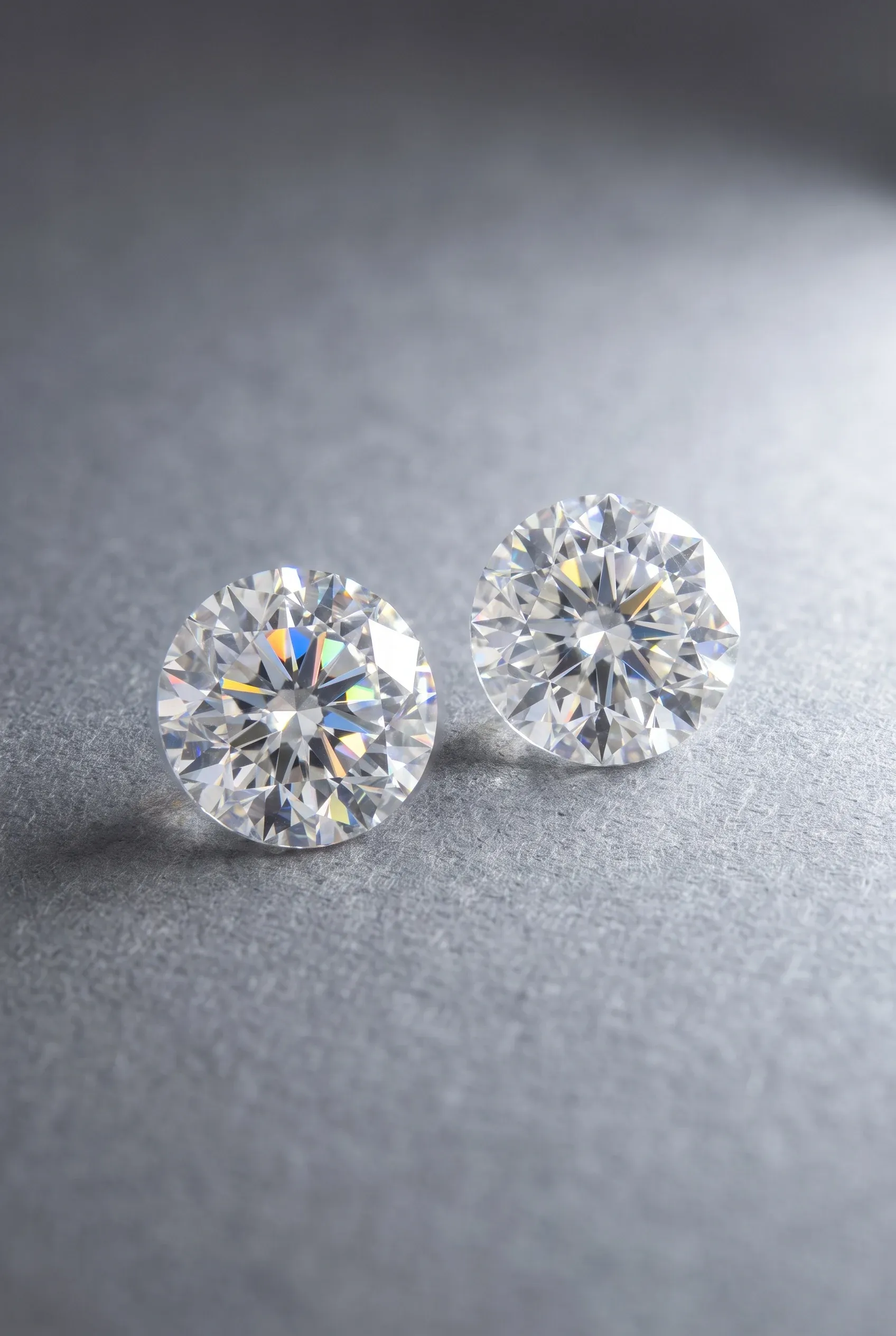
Stone size matters here. Bigger moissanites make the effect easier to notice because each flash has more room to show color. Some brilliant-style shapes also emphasize it more than step cuts. Many buyers love this look and choose moissanite because of it, while others want something closer to the standard diamond look and find it too loud.
Lighting decides which stone you prefer
In open daylight, both stones can look clean and lively. Diamond often shows crisp white brightness with smaller spectral flashes. Moissanite still looks bright, but its color flashes are easier to catch as the stone turns. Neither stone looks the same in every environment, which is why one-minute impressions can mislead.
In soft office light or shaded indoor light, the difference often narrows. Under hard LED spots, moissanite separates into stronger rainbow fire and diamond usually stays more balanced between white and color. Evening lighting tends to exaggerate personality. If you want the fairest test, compare the stones near a window, then in normal room light, then under a spotlight.
What you see up close
At a normal distance, many people will not identify the stone correctly by eye. Up close, the differences become easier. Moissanite is doubly refractive, so facet doubling can appear when you look through the pavilion or from the side with magnification. Diamond is singly refractive, so that doubled look does not appear in the same way.
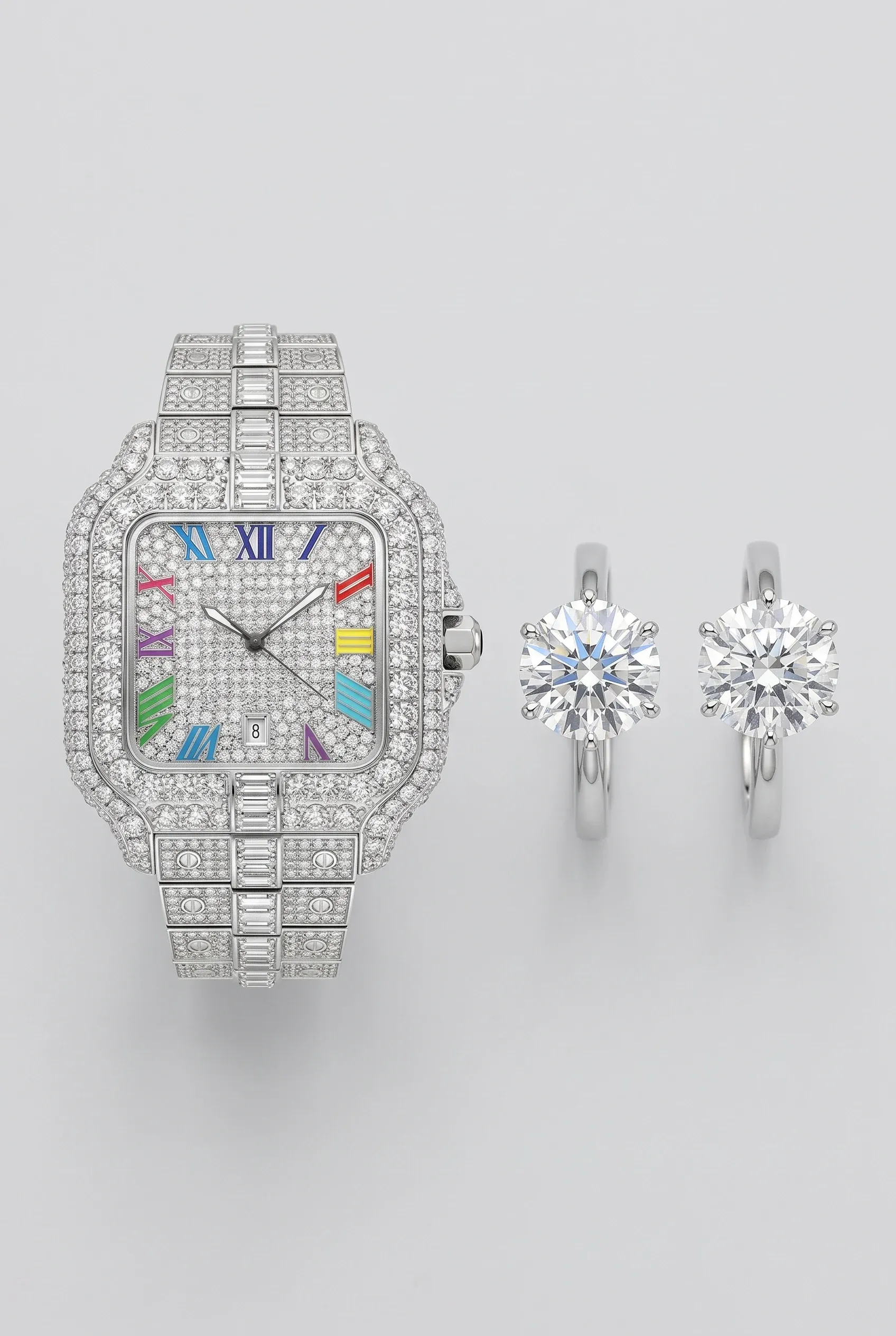
This is one of the clearest visual tells when you tell moissanite from diamond. The effect is not equally visible in every cut, and face-up it can be subtle. Clarity is less of a separator than many buyers think. Most moissanite sold in jewelry is labeled VVS, because very clean lab-grown material is the norm rather than a premium exception.
Testers and common misreads
A basic thermal diamond tester often reads moissanite as diamond. That is normal, not proof that the stones are the same. Simple pens read heat conductivity, and moissanite conducts enough heat to confuse them. A dual thermal and electrical tester separates moissanite from diamond more reliably, which we explain in our diamond tester guide.
This matters because some shoppers assume a positive pen result means identical sparkle. It does not. Tester behavior is about conductivity, while sparkle is about how the crystal handles light. A tester can help identify material, but it cannot tell you which flash pattern you will prefer.
Price changes the trade-off
Budget changes the comparison because size changes visibility. Once stones get larger, the different light pattern becomes easier to notice. That means price is not a side issue here. It directly affects how bold the sparkle looks.
| Stone type | Typical loose 1 ct retail | How pricing scales | What shoppers usually get |
|---|---|---|---|
| Moissanite | $300 to $600 | Rises slowly with size | More face-up size for the budget |
| Lab-grown diamond | $800 to $1,500 | Rises more than moissanite | Diamond sparkle at a lower entry price |
| Natural diamond | $4,000 to $7,000 | Rises steeply with size | The traditional diamond category |
Moissanite lets many buyers move up in millimeter spread without a dramatic jump in cost. Diamonds, especially natural diamonds, get expensive much faster as size increases. That matters because the larger the stone, the more visible the fire pattern becomes. A shopper comparing a modest center stone may see a small difference, while a shopper comparing a larger one may see it immediately.
Cut shape and size change the result
Material is only part of the story. Cut quality has a huge effect on life, contrast, and how organized the sparkle looks. A well-cut stone looks sharper than a sleepy one, no matter what the material is. Poor cut can make either stone underperform.
Rounds usually hide differences best because the flash pattern is familiar and dense. Elongated brilliant cuts can show broader flashes, which may make moissanite’s fire feel stronger. Step cuts show slower, cleaner flashes and can make doubling easier to spot from the side. Color also matters. Colorless D-E-F stones look icier, while G-H-I near-colorless stones can show a touch more warmth in some settings. If a seller points to a common GRA report, read it as identification, not as a GIA-style guarantee of top cut quality.
Who moissanite suits best
Moissanite suits shoppers who want visible size, strong sparkle, and a lower entry price. It also suits people who genuinely like colorful fire instead of merely tolerating it. If your first reaction to moissanite is that it looks lively and fun, that reaction matters. You do not need diamond preferences to validate a moissanite choice.
It also makes sense for buyers who want an everyday stone with high durability but do not want diamond pricing. The look is especially compelling when you accept it on its own terms, not as a secret substitute. Buyers who keep chasing a perfect diamond copy are often happier with diamond, but buyers who enjoy extra fire are often happier with moissanite.
Who diamond suits best
Diamond suits shoppers who want the benchmark most people picture when they hear solitaire, tennis necklace, or stud earrings. Its sparkle pattern is usually whiter, calmer, and more familiar. That can matter a lot if your goal is a traditional engagement ring look. It can also matter if you tend to inspect jewelry closely and dislike seeing extra color under spot lighting.
Diamond is also the better fit if you want the classic diamond appearance in larger sizes. The visual gap tends to grow as stones get bigger and lighting gets harsher. If budget allows, a diamond gives you that traditional light pattern without compromise. If you are choosing between natural and lab-grown diamond, remember that both are diamond and share the same basic sparkle behavior.
How to compare them in person
Compare the same shape first. Keep the millimeter size as close as possible, and keep color range close too. A huge round moissanite and a smaller step-cut diamond are not a fair test of material. They are a test of different sizes and cuts.
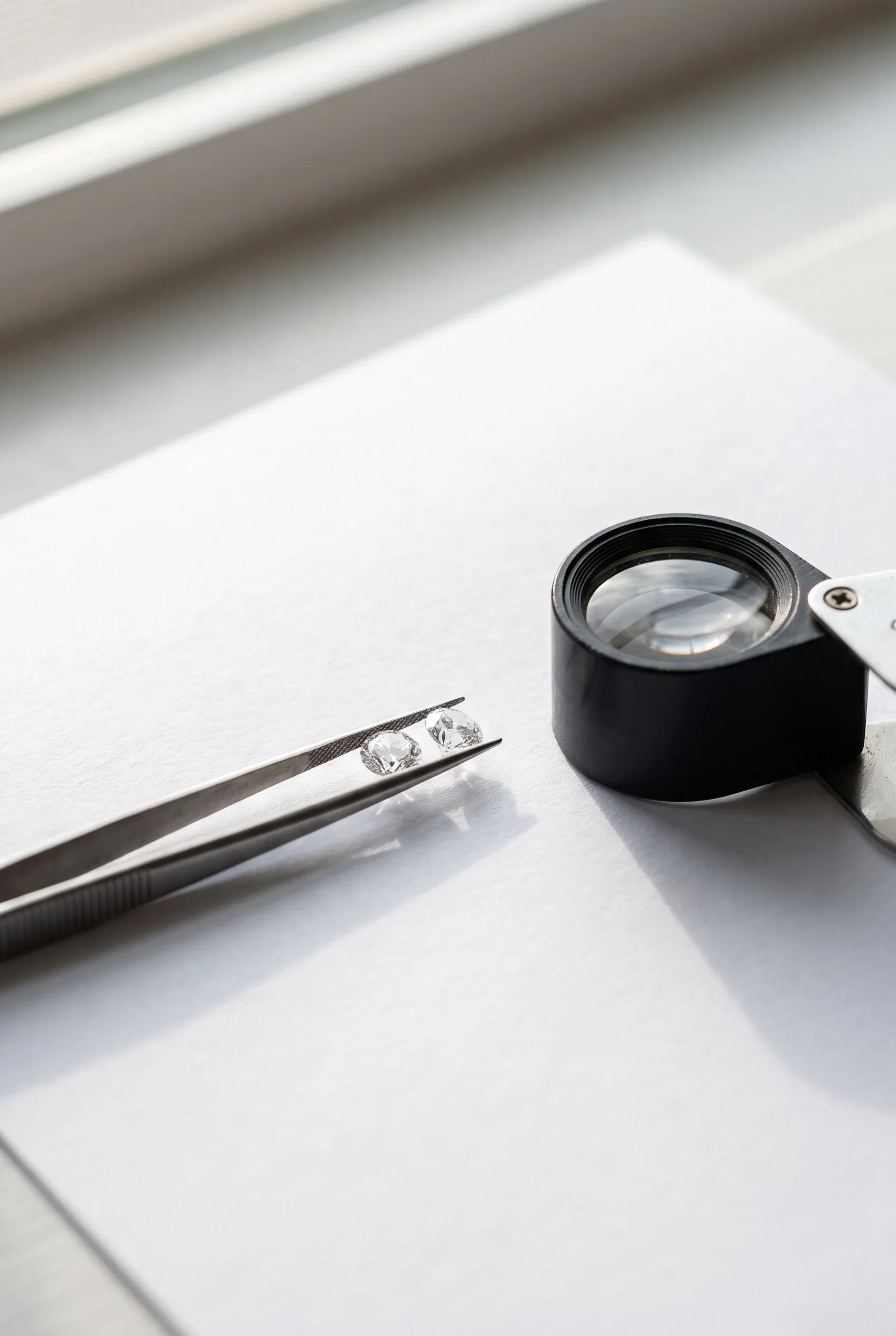
Start near a window. Then move to ordinary indoor light. Finish under direct spot lighting. That sequence shows whether you like white brightness or rainbow fire better. Then tilt the stones and inspect them from the side or through the pavilion. Ask what kind of tester is being used if someone leans on a pen result. For more side-by-side guides, browse our more stone comparisons section.
Care and keeping the sparkle
Neither stone looks its best when coated with lotion, soap film, skin oil, or dust. Dirty facets lose contrast and stop flashing well, which people sometimes mistake for the stone itself. This problem is common with both materials. A quick cleaning often changes the entire impression.
Use warm water, mild soap, and a soft brush, or follow our steps to clean moissanite. Both stones are durable enough for regular wear when the setting is well made. Sparkle is never just about the gem. Clean facets, secure prongs, and fair lighting matter just as much as the material.
Frequently Asked Questions
Does moissanite sparkle more than diamond?
Usually yes, if you mean rainbow fire. Moissanite splits white light into stronger colored flashes than diamond, so it often looks more active under spot lighting. If you mean a whiter, calmer sparkle pattern, many people still prefer diamond. The answer depends on which kind of sparkle you value.
What causes the moissanite disco ball effect?
It is mostly a mix of strong fire, point-source lighting, and stone size. Under LEDs, jewelry counter spots, or phone flash, moissanite can throw many colored flashes at once. Larger stones and brilliant-style cuts make the effect easier to see. Some buyers love it, and others find it less diamond-like.
Can you tell moissanite from diamond without a loupe?
Sometimes, but not always. In larger stones and harsh lighting, moissanite’s extra rainbow fire can stand out. In smaller sizes or softer light, many people cannot tell at a glance. A loupe makes the differences easier because moissanite can show facet doubling through the pavilion.
Does moissanite pass a diamond tester?
A basic thermal pen often says yes, which confuses many shoppers. That does not mean moissanite is diamond. It means the tester is reading heat conductivity. A dual thermal and electrical tester is the better tool when you need to separate the two materials.
Is a lab-grown diamond closer to diamond sparkle than moissanite?
Yes, because a lab-grown diamond is diamond. It has the same basic optical behavior as a natural diamond, including the same style of sparkle. Moissanite is a different material, so even excellent moissanite keeps its own mix of stronger fire and different flash structure.
Do bigger moissanites look more different from diamonds?
Usually they do. As the stone gets larger, the stronger fire becomes easier to notice, especially under spot lighting. That is why some shoppers love moissanite in larger sizes and others prefer diamond once they move up in carat weight. Size makes the personality of each stone more obvious.
Which is better for an engagement ring?
Neither is automatically better for everyone. Choose moissanite if you want more size for the money and enjoy rainbow fire. Choose diamond if you want the classic benchmark look and a whiter, calmer sparkle pattern. The best engagement ring choice is the one whose light behavior still looks right to you in everyday lighting.