Men's Moissanite Watches: How to Choose Case Size, Stone Coverage, and Movement
An independent guide to men's moissanite watches with real 2026 prices, wrist-based size advice, stone coverage options, and movement details that actually matter.
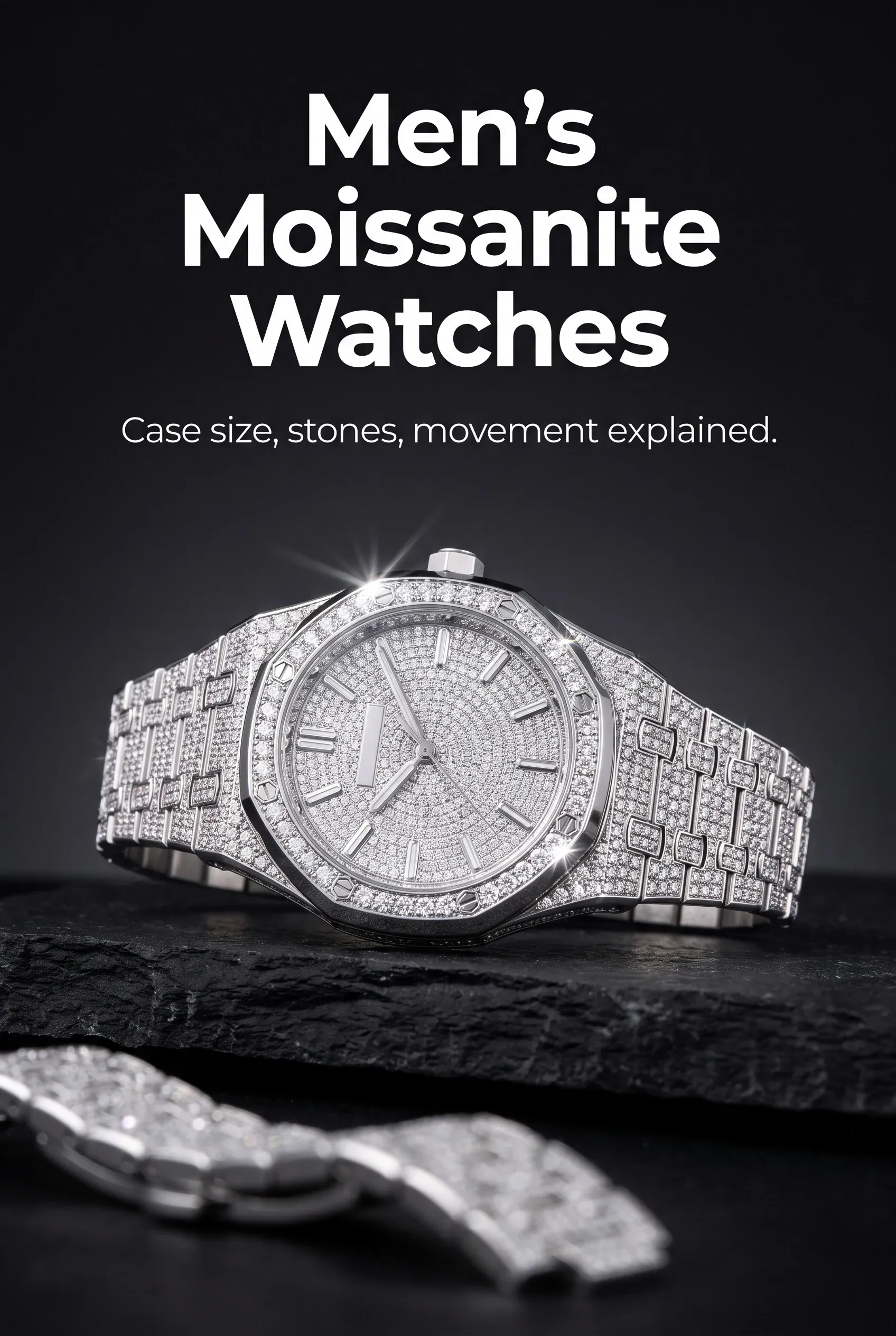
A men's moissanite watch makes sense when you want full stone coverage without diamond prices. Choose by wrist size first, stone coverage second, and movement third. Most bad buys happen when shoppers focus on the word moissanite and ignore the watch underneath it.
What a men's moissanite watch actually is
Moissanite is silicon carbide, first identified in 1893 in a meteor crater. Nearly all jewelry moissanite sold in 2026 is lab grown. On watches, it appears as many small stones across the bezel, case, dial, and bracelet.
A moissanite watch for men is usually bought for surface sparkle, not for traditional watchmaking. That is fine, but it changes how you should shop. The stone choice affects brightness, while the setting method, movement, crystal, and case size decide whether the piece is enjoyable to wear.
If you need a refresher on what moissanite is, start there. The short version is simple. It is not diamond, but it is harder and more optically lively than the crystal and CZ used in many entry-price iced pieces.
Price ranges that make sense
Price is the fastest reality check. In 2026, fully set moissanite watches usually cost $900 to $2,700. Crystal or CZ iced out watches usually cost $100 to $400.
Custom lab-diamond bust downs usually start around $5,000 and run to $15,000. Custom natural-diamond sets usually start around $15,000 and go far higher. Factory diamond-set watches from major houses sit at $40,000 to $250,000 and up.
| Watch category | Typical 2026 price | What you usually get | Main trade-off |
|---|---|---|---|
| Crystal or CZ iced out watch | $100 to $400 | Fashion-first look, basic movement, lower-cost stones | Lower scratch resistance and weaker long-term stone security |
| Moissanite watch | $900 to $2,700 | Real moissanite, stronger durability, much more fire | Still a jewelry-led watch segment, not high horology |
| Custom lab-diamond set watch | $5,000 to $15,000 | Closer diamond visual, much higher material cost | Big jump in budget |
| Custom natural-diamond set watch | $15,000 to $60,000 and up | Natural diamond material and custom setting work | Very high cost for the look |
| Factory diamond-set watch from a major house | $40,000 to $250,000 and up | Brand-level finishing and factory stone setting | Highest pricing by far |
If a watch is sold as moissanite for under about $300, treat the claim skeptically. At that price, it is almost always crystal or CZ. Tester clips and vague stone counts do not change that.
Loose-stone pricing explains part of the gap. A 1 ct colorless moissanite usually retails around $300 to $600. A similar 1 ct diamond costs far more, but watch pricing is driven even more by setting labor and metal work.
Choose case size from your wrist
Case size should be your first filter. Most men's stone-set watches land at 40 to 44 mm. Unisex styles sit at 38 to 40 mm. The average US male wrist is about 7 to 7.5 inches, which is why 40 to 42 mm is the common sweet spot.
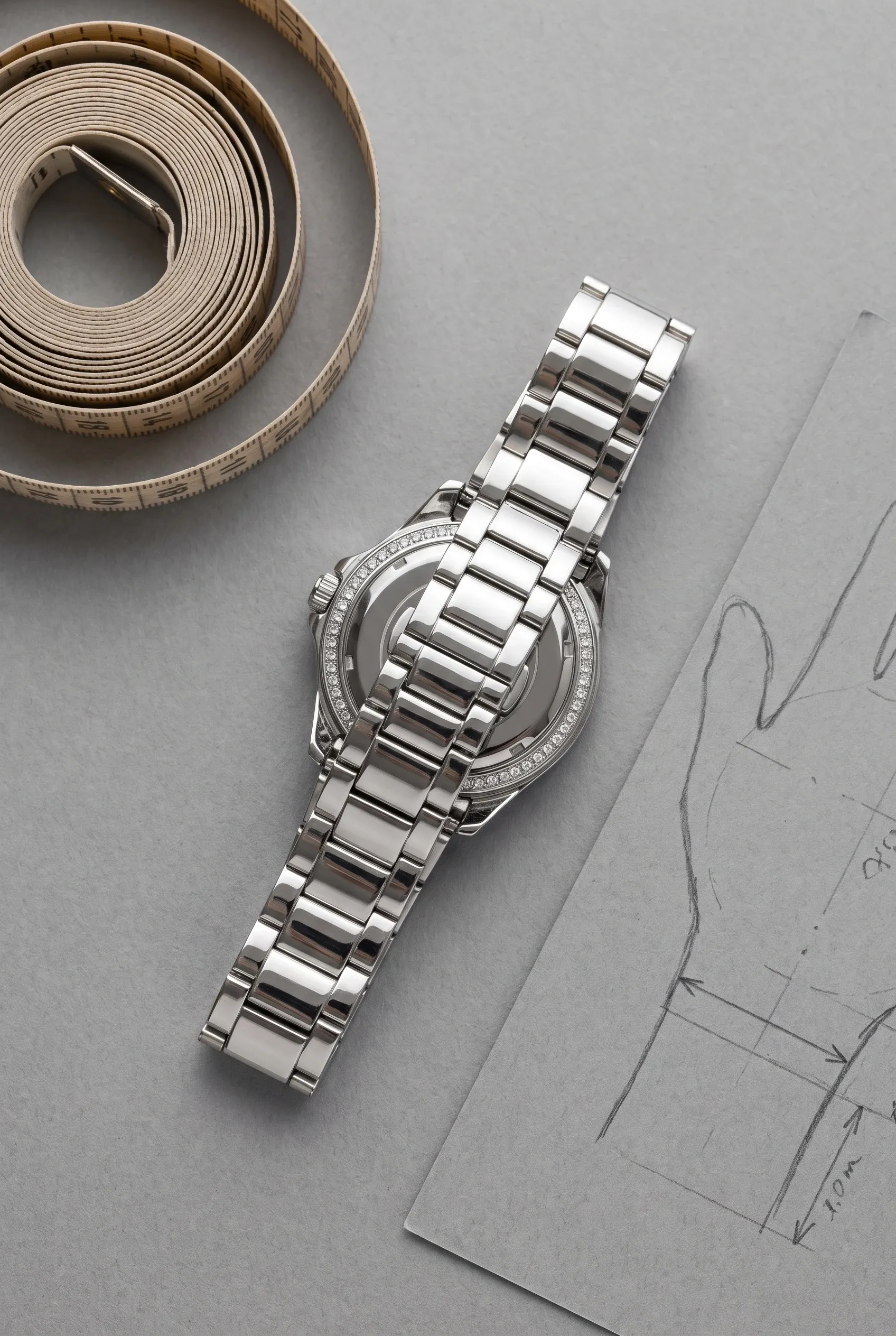
Lug-to-lug matters as much as diameter. The tips of the lugs should not hang past your wrist width. If they do, the watch looks wider than intended and feels clumsy.
| Wrist size | Safer case size | How it usually wears |
|---|---|---|
| Under 6 inches | 34 to 36 mm | Best chance of a balanced fit, especially with a stone-set bracelet |
| 6 to 6.75 inches | 38 to 40 mm | Balanced unisex to smaller men's fit |
| 6.75 to 7.5 inches | 40 to 42 mm | Standard men's fit for most stone-set styles |
| Over 7.5 inches | 42 to 44 mm | Broader wrist can handle heavier full-coverage looks |
A broad bezel and a fully set first link make a watch wear larger. Two 42 mm cases can feel very different. The one paved across the case sides and bracelet will look heavier on the wrist.
If your wrist is under 6 inches, stay at or below 36 mm even if you want a men's look. A stone-set bracelet adds visual mass fast. Size conservatively if you want the watch to look sharp instead of oversized.
Stone coverage changes the look
Stone coverage changes the whole personality of the watch. A bezel-only or bezel-plus-hour-markers layout feels easier with everyday clothes. Full coverage across dial, case, lugs, and bracelet reads more like jewelry.
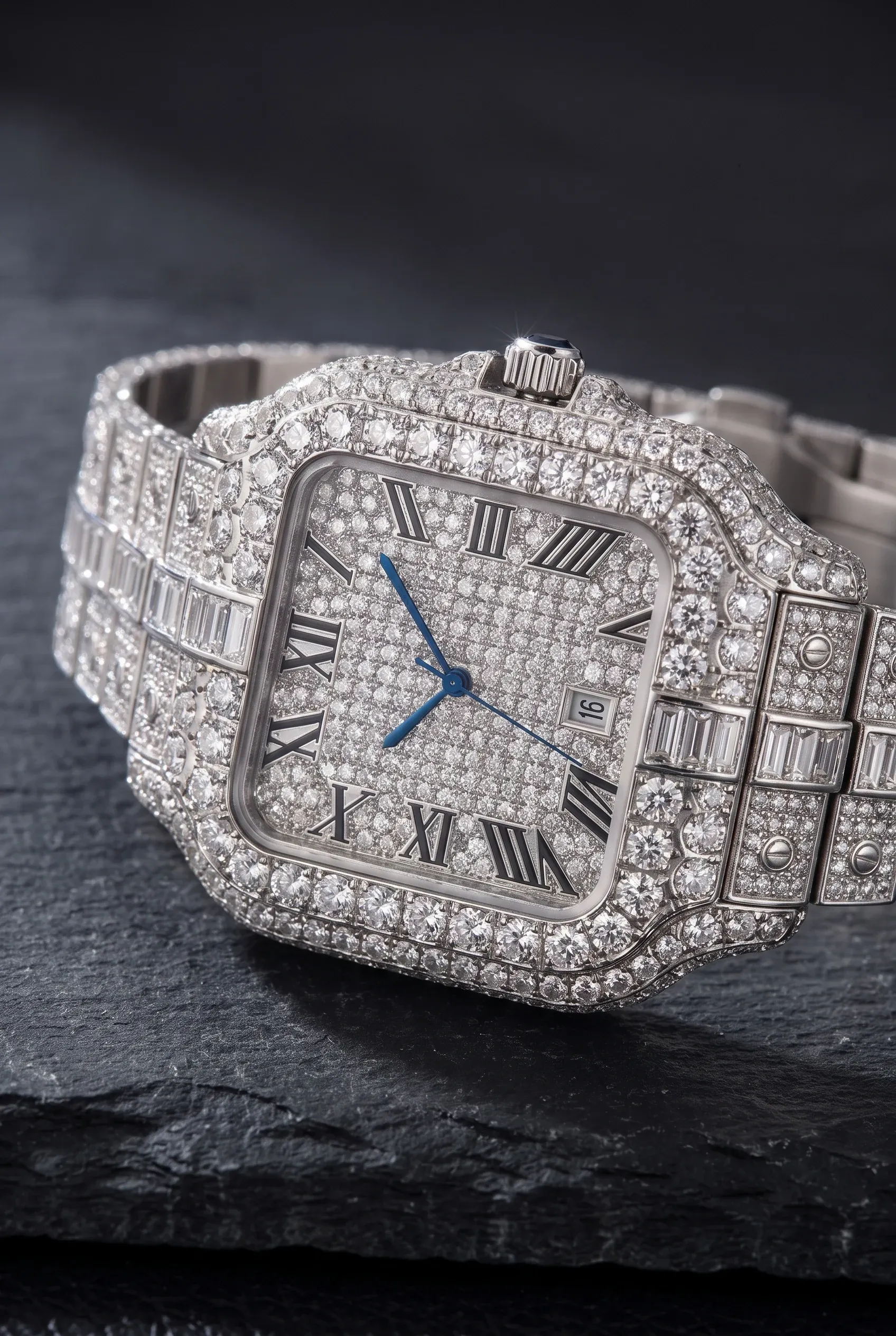
Think about where you will wear it. Full coverage fits evenings, events, and fashion-first outfits. Partial coverage works better if you want one piece that can move between a hoodie, a knit polo, and a dinner jacket.
If you are still sorting out what iced out means, the short answer is heavy stone coverage over most visible surfaces. More stones usually mean more flash, more weight, and more chances for weak settings to show.
Movement and crystal matter more than the dial
Most stone-set watches under $3,000 use Japanese quartz movements. In this segment, that is usually a strength, not a compromise. Quartz keeps cost reasonable, stays slimmer, and is cheaper to replace or service than an automatic.
Automatics can feel more traditional, but they add thickness and future service cost. On a fully set piece, that extra thickness can make the watch top-heavy. The bracelet already carries plenty of metal and stones.
For most buyers, reliability matters more than romance here. A battery change every few years is simpler than automatic service, although costs vary by maker. If you want the watch mainly as jewelry, quartz is usually the practical choice.
The crystal over the dial matters too. Hardened mineral glass is common. Sapphire crystal tends to appear above roughly $1,500. Between two similar watches, a better crystal is often the smarter upgrade than a louder dial color.
How moissanite looks compared with diamond and CZ
Moissanite looks different from diamond once you know what to watch for. It has a Mohs hardness of 9.25. That sits below diamond's 10, but well above CZ at about 8 to 8.5 and ordinary crystal or glass at about 5.5 to 6.
Its optics matter even more on a watch. Moissanite's refractive index is 2.65 to 2.69. Its dispersion is 0.104. Both are higher than diamond at 2.42 and 0.044, so moissanite throws more rainbow fire.
In daylight, that extra fire can look crisp and lively. Under direct LEDs and nightlife lighting, it becomes more obvious. Buyers who want sparkle usually like this. Buyers chasing a stricter diamond look may find it too colorful.
Moissanite is also doubly refractive. Under a loupe, you can sometimes see facet doubling through the pavilion. Diamond is singly refractive, and moissanite's density is lower at 3.21 versus diamond's 3.52, which is another reason the materials handle differently.
Basic thermal pens will usually read moissanite as diamond. If you want the fuller explanation of diamond tester behavior, use a dual thermal and electrical tester, not a single-mode pen.
Read the stone paperwork correctly
Paperwork gets oversold in this category. The documents most commonly bundled with moissanite are GRA reports. They confirm the stone material is moissanite and usually list carat, cut, and color. Read them as identification paperwork, not as proof of elite cut quality.
Color terms follow jewelry conventions. D-E-F means colorless, and G-H-I means near-colorless. VVS is the clarity grade you will see most often. Because lab growth makes clean stones common, VVS in moissanite is normal, not a premium upgrade.
Do not treat stone count alone as value. Thousands of tiny stones can sound impressive in a listing. If the stones are very small, crowded, or weakly cut, the surface can still look flat. Macro photos tell you more than totals.
Pay attention to side shots, clasp views, and the underside of the bracelet. Those angles reveal how the watch is assembled. A watch can have real moissanite and still be poorly built.
Build quality decides whether it lasts
The setting method matters more than stone count. Hand-set stones, usually prong-set or bead-set, are the durable option. Glued stones are the shortcut version, and on a bracelet they often start shedding within months because every link flexes.
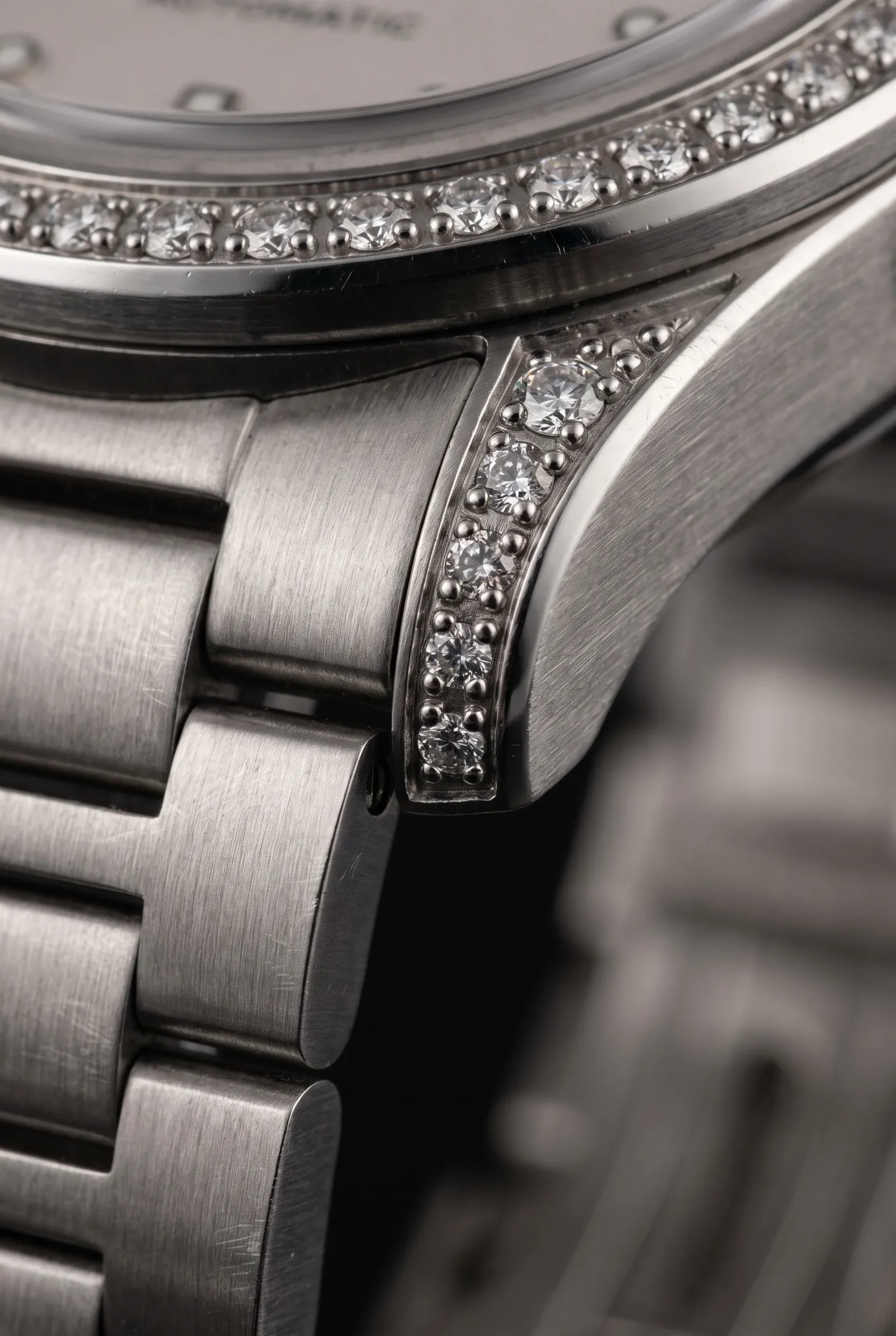
Ask how the stones are secured, not just how many there are. A listing that hides the side of the case, the inside of the clasp, or the prong detail may be hiding the cheapest part of the build.
Water resistance is another place where wording gets stretched. A 3 ATM rating means rain and hand-washing, not swimming. With stone-set watches, seals and finishing vary by maker, so caution is smart.
Style, weight, and when to wear it
The best-looking fit starts with your wrist and wardrobe, not with the biggest bezel you can find. On a slim wrist, a 40 mm case with bezel coverage often looks sharper than a 44 mm full-set piece. The watch stays proportional, and the stones read cleaner from a distance.
Also think about legibility. A heavily set dial with stone hour markers can be harder to read at a glance than a plain dial with a stone bezel. If this is your only dressy watch, readable hands and contrast matter.
A men's iced out watch pairs best with simple clothing around it. Clean sneakers, dark denim, knitwear, plain tees, and solid jackets let the watch be the bright element. When everything else is loud, the piece can look costume-like instead of deliberate.
Weight is easy to ignore online. More metal and more stones usually mean a heavier bracelet and thicker clasp. That matters if you type all day or prefer a loose fit. For more category examples, browse our men's watch coverage.
Who each stone type suits
Moissanite sits in the practical middle. It suits buyers who want a real gemstone, strong durability, obvious fire, and a price that stays in the low four figures. That is the core reason this category exists.
CZ or crystal suits the buyer who wants the look for occasional wear and cares most about initial cost. Lab-diamond set pieces suit buyers who want a closer diamond visual and accept a much higher budget. Natural-diamond pieces are mostly for buyers who want the material and status, not just the look.
A simple budget rule helps. Under $400, assume fashion-watch materials unless proven otherwise. Around the low four figures, expect real moissanite and better setting work or crystal quality. Above that, you are mostly paying for diamond or more complex custom labor.
If you are sorting between materials, our comparison coverage and our guide to a good cleaning routine can help with the practical side.
Care and ownership
Daily care is simple. Wipe the crystal and bracelet after wear, especially if lotion or sweat has built up around the links. Use a soft brush when grime dulls the stones.
Dirty stones make any set watch look flat, and moissanite's fire shows best when the facets are clean. Store the watch so the bracelet does not rub against other metal pieces. Check prongs and link screws from time to time.
If you shop this category with the right expectations, the decision becomes straightforward. Buy by wrist size first, stone coverage second, and build quality third. Then use price as a reality check, not as proof of value by itself.
Frequently Asked Questions
How much should a men's moissanite watch cost?
In 2026, a fully set moissanite watch usually costs $900 to $2,700. If a listing claims moissanite under about $300, it is usually crystal or CZ instead. Prices above that range can be reasonable, but only when the build, crystal, and setting work clearly improve too.
Should I trust a seller's diamond tester video?
Not on its own. Sellers often show a basic thermal pen passing as diamond, but that only proves the stone conducts heat well, which moissanite does too. Ask for a dual thermal and electrical test instead, or confirm the price and setting details match a genuine moissanite watch.
Is moissanite better than CZ on a watch?
For daily wear, yes in most practical ways. Moissanite is harder, more scratch resistant, and throws more fire than CZ. The trade-off is price, because moissanite watches sit in the low four figures while CZ or crystal pieces usually stay in the low hundreds.
What size should I buy for a 7-inch wrist?
For a 7-inch wrist, 40 to 42 mm is usually the safest starting point in a stone-set men's watch. If the bracelet is very heavy or the bezel is broad, 40 mm often looks cleaner. Always check lug-to-lug, not just the case diameter.
Are GRA certificates enough to prove quality?
No. GRA paperwork is useful for identifying the stones as moissanite and listing details such as color or carat. It is not a guarantee that the watch has strong setting work, a good crystal, or careful finishing. Build quality still has to be judged separately.
Can I swim with a 3 ATM moissanite watch?
No. A 3 ATM rating is best treated as protection for rain and hand-washing only. It is not a swimming rating. On stone-set watches, water resistance can also vary by maker, so cautious use is smarter than trusting marketing language.
Do fully iced watches lose stones?
They can, especially when stones are glued instead of hand-set. The bracelet is the stress point because every link bends as you wear it. A properly prong-set or bead-set watch is the better bet, but even then, regular checks of prongs and links are worth doing.