Men’s Iced Out Watches: What $300, $1,000, and $5,000 Actually Buy
See what men’s iced out watches really look like at $300, $1,000, and $5,000, with honest notes on stones, movements, sizing, and shipping.
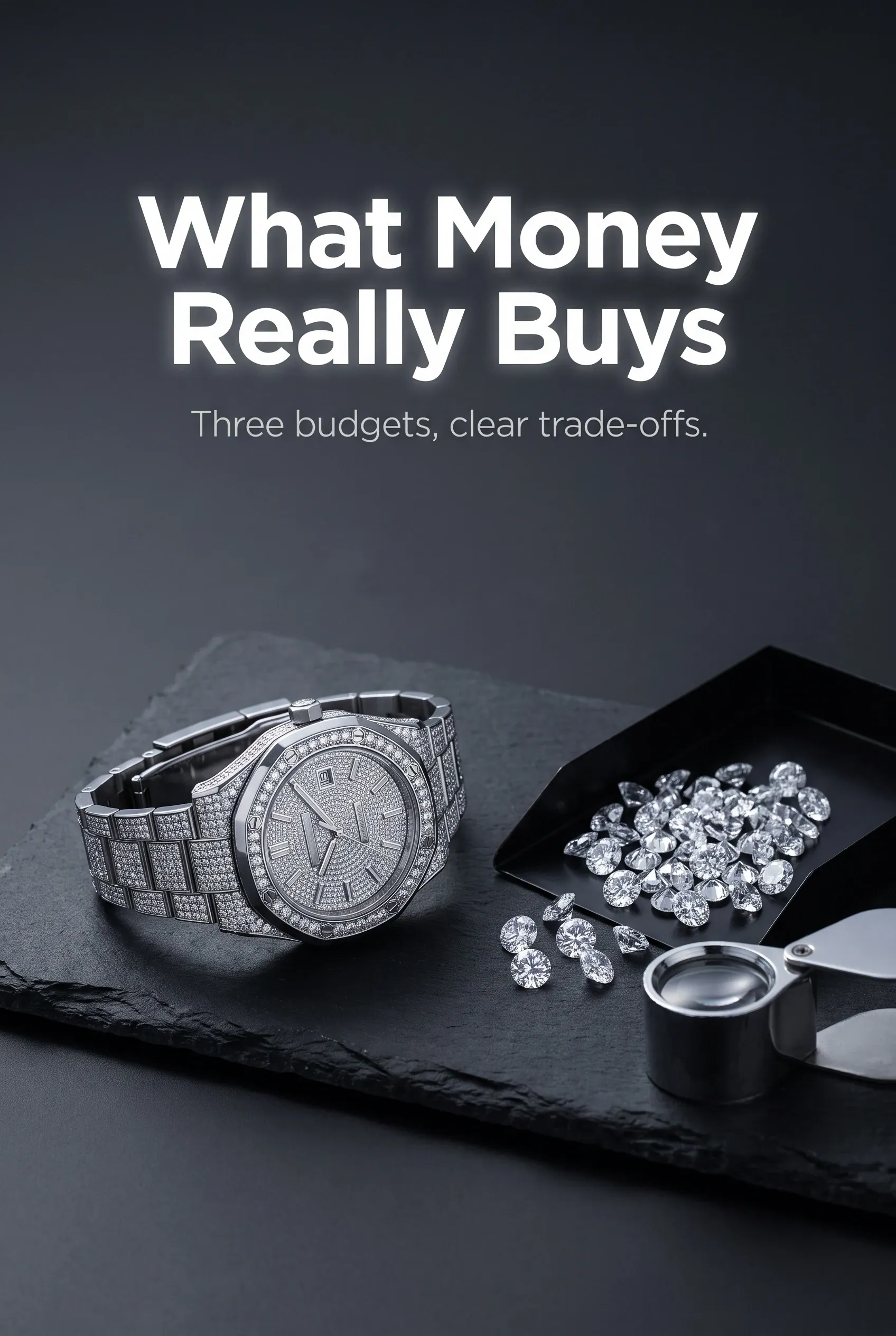
Men’s iced out watches split into three very different markets. At $300, $1,000, and $5,000, you are not choosing between the same watch with better stones. You are usually choosing between crystal fashion pieces, real moissanite, and the first step into custom lab-diamond work.
That is why listings can feel misleading. Two watches may look similar in photos, yet differ in stone material, setting method, movement, crystal, and long-term durability. We will break down what each budget really buys, what corners usually get cut, and how to avoid paying moissanite money for a CZ watch.
The three tiers at a glance
Before details, here is the simplest way to read the market. If you are new to the look itself, we explain the meaning of iced out in a separate guide.
| Budget | What you are usually buying | Stone reality | What to expect |
|---|---|---|---|
| $300 | A full-coverage fashion watch built for visual impact first. | Most pieces here are crystal or CZ. A watch sold as moissanite under about $300 is almost certainly crystal or CZ. | Quartz movement, hardened mineral glass, basic water resistance, and wide variation in stone setting quality. |
| $1,000 | An entry fully set moissanite watch. | This is the lowest band where real moissanite commonly makes sense in a finished watch. | Usually Japanese quartz, better stone durability than CZ, and GRA paperwork that identifies moissanite but does not guarantee cut quality. |
| $5,000 | The opening tier for custom lab-diamond setting, or a very high-finish moissanite piece. | You are paying more for base watch quality and setting labor than for simple sparkle alone. | Natural-diamond custom work starts much higher, and factory diamond-set pieces from major houses sit far above that again. |
What $300 actually buys
At this level, you are buying the look, not gem value. That can still be a fair purchase if you want a weekend watch, a music-video piece, or something loud for short wear. The mistake is expecting the same material quality as the next tier up.
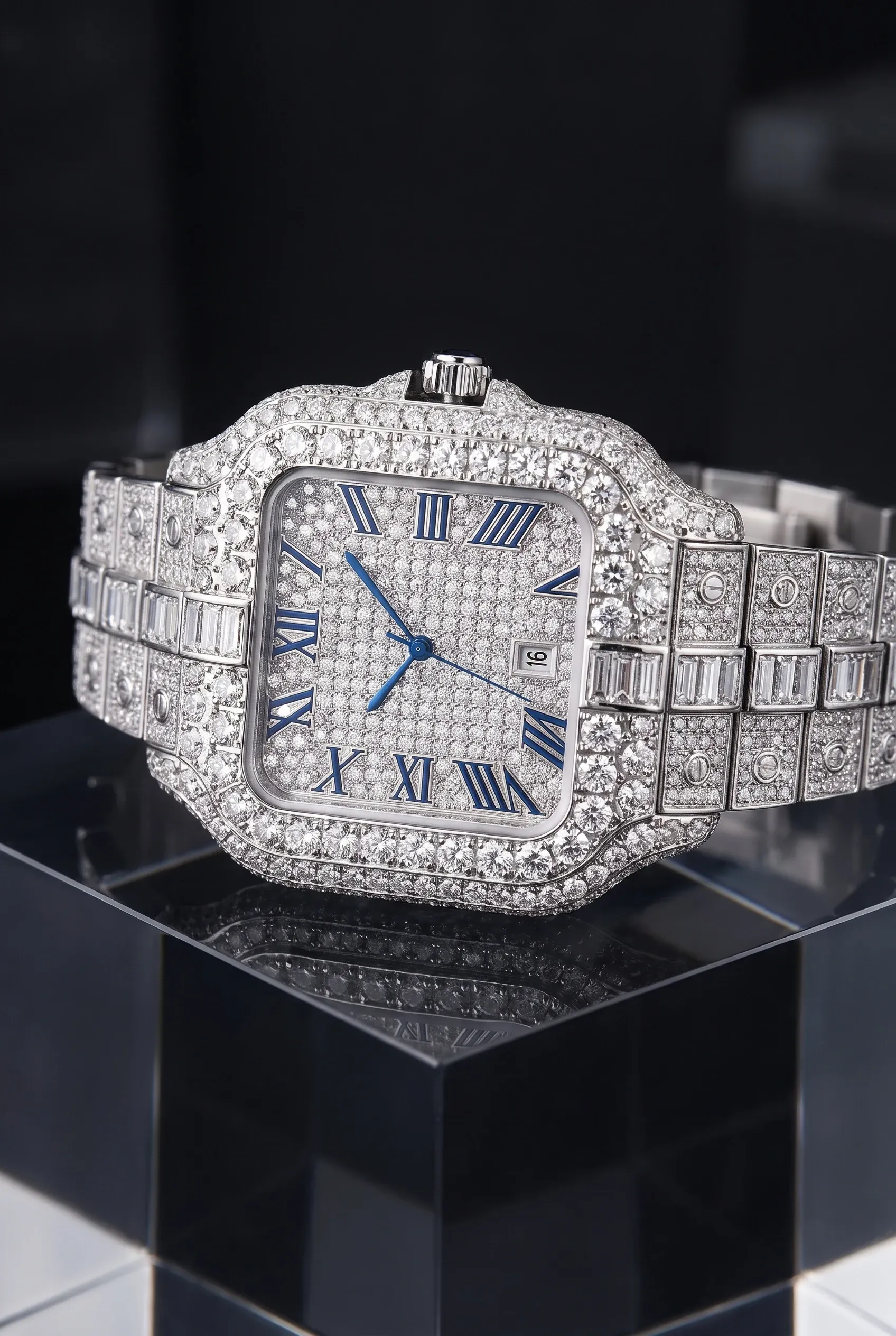
The best $300 watches spend money on coverage, not refinement. You will usually see a big case, lots of small stones, and a quartz movement inside. Finishing tends to be simpler on the clasp, crown, and bracelet edges, which is why comfort can vary more than the listing photos suggest.
If you shop this tier, check the setting method before you care about anything else. Hand-set stones can make a cheap watch usable for longer, while glued stones are the reason some bargain pieces start dropping stones after a few months. Also look for aligned markers, an even bracelet, and a clasp that shuts with a clean click rather than soft resistance.
What $1,000 actually buys
This is the band where men’s iced out watches start to become materially different, not just cosmetically different. Real moissanite becomes realistic here, which means stronger stones, more lively light return, and far better scratch resistance than the bargain tier. For many buyers, this is the practical sweet spot.
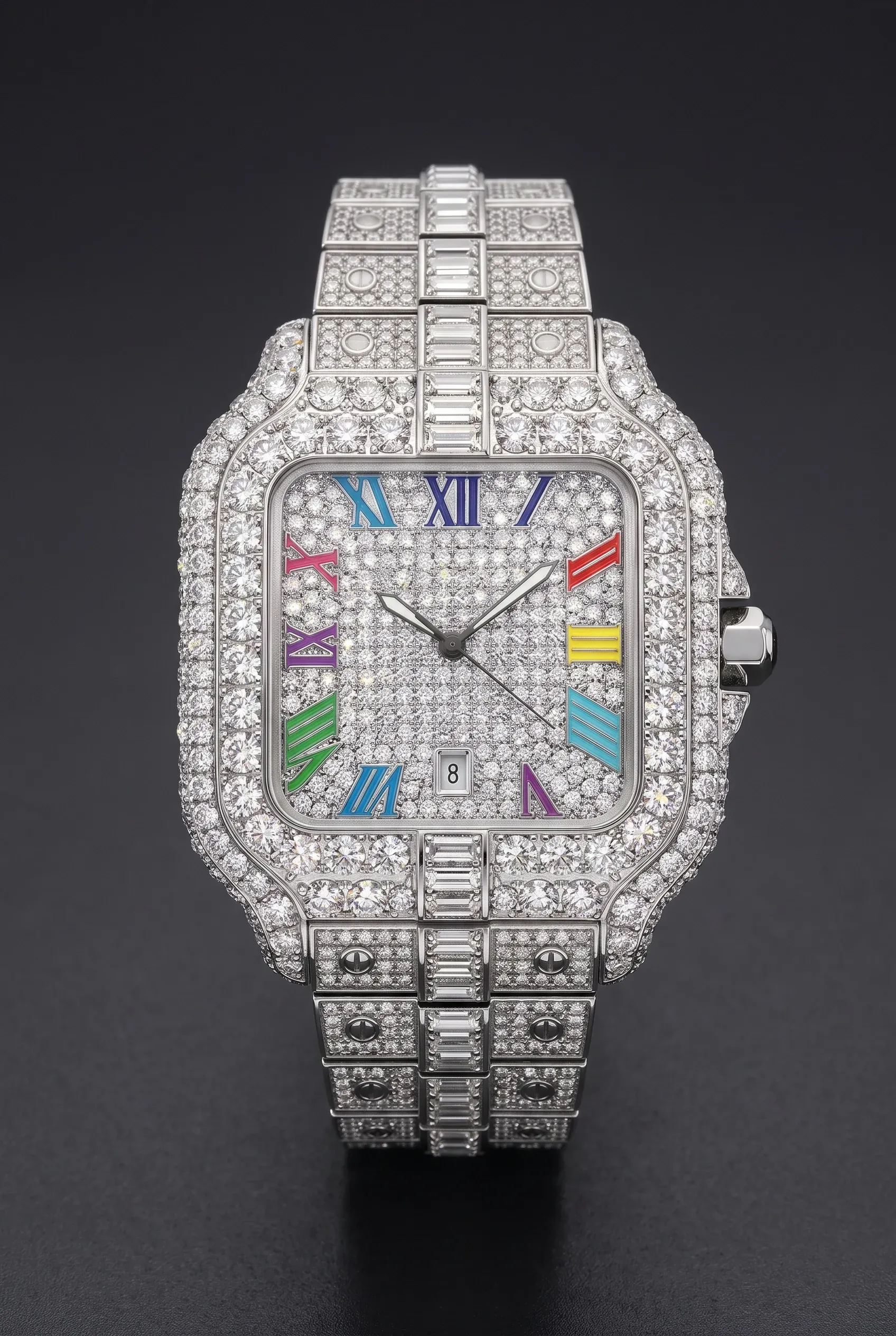
You should still keep expectations grounded. The watch itself is often fashion-led rather than horology-led, so most of the budget goes into stone coverage and setting labor instead of an expensive movement. That is not a flaw if your main goal is wrist presence.
The smart way to compare options here is to ignore inflated stone-count language and focus on wearability. Ask how the bracelet feels, whether the crystal is mineral or sapphire, and whether the stones are hand set. A well-made moissanite watch in this band can look expensive on wrist, but it will not turn into a custom diamond piece just because the listing uses luxury-sounding copy.
What $5,000 actually buys
At this budget, the conversation changes. You are no longer comparing fashion watches with different stones. You are getting into custom work, better base watches, more serious finishing, and the labor cost that comes with setting higher-value stones.
This is also the point where buyers need to be honest about what they care about. If your goal is maximum sparkle per dollar, a strong moissanite watch can still make sense. If your goal is specifically diamond, then this budget is better seen as an entry point than a finish line.
Lead time matters more here too. Custom setting is not only about the stones. It involves disassembly, layout, seat cutting, hand setting, final inspection, and sometimes aftercare if a stone loosens later. That extra work is why two watches can look similar online but live in completely different price worlds.
Stones matter more than listings suggest
Moissanite is silicon carbide, and nearly all jewelry moissanite is lab grown. On durability alone, it sits much closer to diamond than CZ does. On the Mohs scale, moissanite is 9.25, diamond is 10, white sapphire is 9, cubic zirconia is about 8 to 8.5, and glass sits around 5.5 to 6.
Its optics are one reason moissanite works so well in iced out watches. Moissanite has a refractive index of 2.65 to 2.69 and dispersion of 0.104. Diamond is 2.42 with 0.044 dispersion, while CZ is 2.15 to 2.18 with 0.060 dispersion. In plain English, moissanite usually throws more rainbow fire than diamond and more life than CZ.
That does not make moissanite a diamond substitute in every sense. Moissanite is doubly refractive, so facet doubling can appear under a loupe through the pavilion, while diamond is singly refractive. A basic thermal pen also reads moissanite as diamond, which is why we prefer understanding why pen testers confuse moissanite before trusting a quick counter test.
How to read moissanite paperwork
The paperwork most buyers see is a GRA report. In practice, it confirms that the stone is moissanite and lists details such as carat, cut, and color. It is useful as identification, but it is not a GIA-style quality guarantee for the whole watch.
That distinction matters in stone-set watches. A report does not tell you whether the bracelet is comfortable, whether the crystal is better, or whether the stones were set well. It also helps to know that D-E-F means colorless, G-H-I means near-colorless, and VVS is common in moissanite because lab growth makes that clarity normal, not rare. If you want more detail, see our guide to reading GRA paperwork.
How to spot hand-set versus glued stones
For long-term wear, the setting method often matters more than the certificate. Hand-set stones use prongs or bead work that physically holds each stone in place. Glued stones rely on adhesive, and those watches are the ones most likely to start shedding stones early.
Product photos can give clues. If the stones sit in visible seats with metal touching their edges, that is a better sign than a perfectly flat glitter surface with no real structure. We show the common tells in our breakdown of stone setting methods, but the short version is simple: if the price is extremely low and the shine looks pasted on, treat it as temporary fashion.
When the watch arrives, inspect it before removing packaging film. Check for lifted stones, crooked lines, and rough spots where stones catch a fingertip. Those problems do not always mean immediate failure, but they do tell you how carefully the watch was finished.
Movement, crystal, and water resistance
In stone-set watches below about $3,000, Japanese quartz is the normal movement for a reason. It is thinner, easier to live with, and cheaper to replace or service than an automatic. We compare the trade-offs more fully in our guide on quartz compared with automatic movements.
Also check the crystal and water rating because they affect daily use more than marketing photos do. Hardened mineral glass is common, while sapphire crystal tends to appear once pricing moves higher. A 3 ATM rating means rain and hand-washing, not swimming, showering, or pool use.
This is where many first-time buyers overspend on sparkle and underspend on comfort. A reliable quartz watch with a decent clasp and smooth bracelet will get more wrist time than a thicker piece that looks better only in close-up photos.
Picking the right case size for your wrist
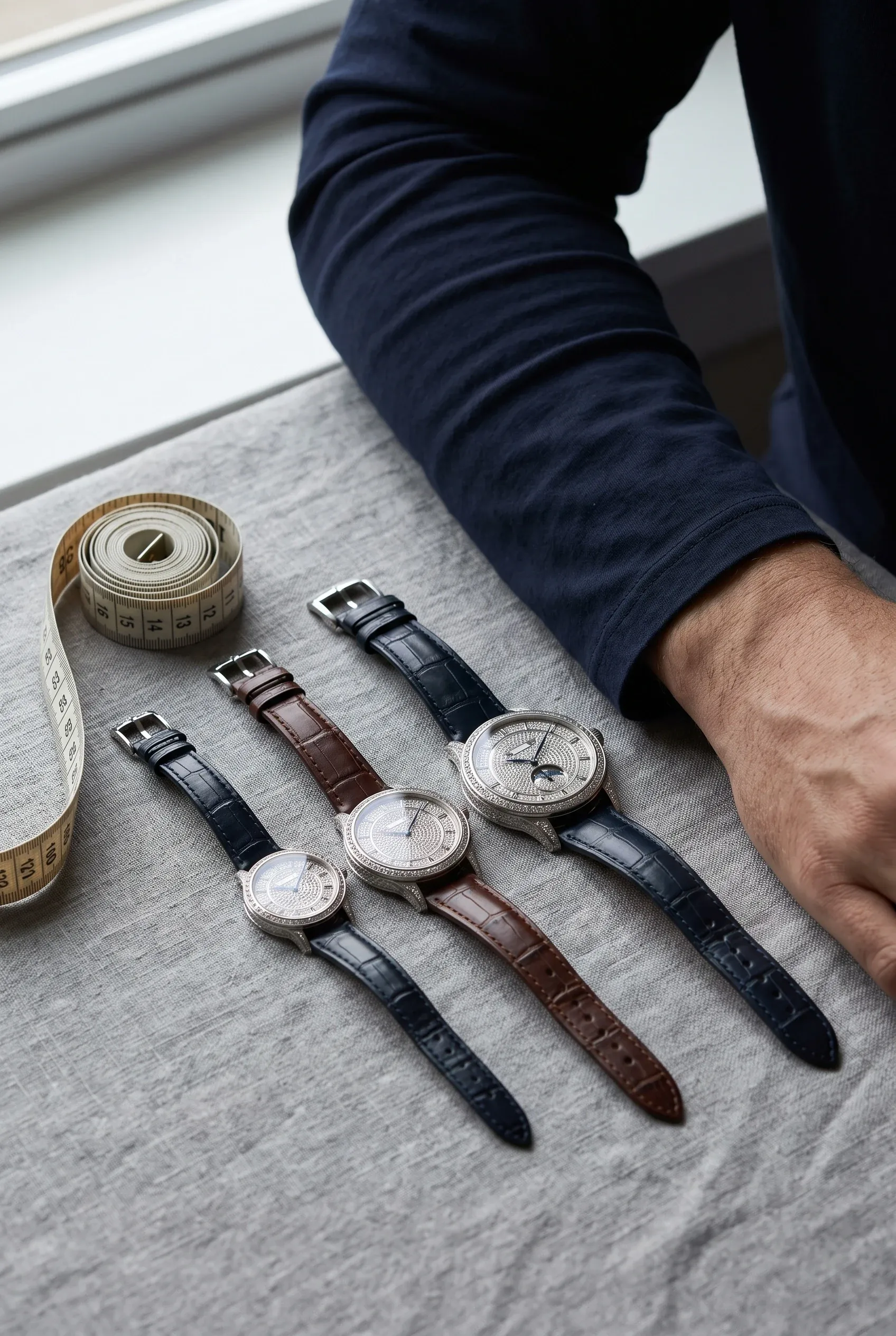
Most men’s iced out watches look best when the case fills the wrist without hanging over the sides. The common men’s zone is 40 to 44 mm, and the common unisex zone is 38 to 40 mm. Lug-to-lug length should not exceed your wrist width, or the watch will wear awkwardly no matter how good the stones look.
| Wrist size | Safer case range | What usually looks best |
|---|---|---|
| Under 6 inches | At or below 36 mm | A compact case that sits inside the wrist edges. |
| 6 to 6.75 inches | 38 to 40 mm | A balanced unisex fit with enough presence for full stone coverage. |
| About 7 to 7.5 inches | 40 to 44 mm | This is the average US men’s wrist, and it handles most standard iced sizes well. |
| Over 7.5 inches | 42 to 44 mm, sometimes larger | Go larger only if the lugs stay short and the bracelet tapers cleanly. |
Remember that heavy stone coverage makes any watch wear bigger than the same case in plain metal. If you are between sizes, going smaller usually looks sharper. For a more detailed fit method, use our guide to sizing a watch for your wrist.
Style and wearability in 2026
Your outfit should decide how loud the watch can be. A fully iced bracelet watch works best when the rest of the look is controlled, such as a solid tee, knit polo, hoodie, or dark suit with minimal other jewelry. The watch should be the brightest surface, not one bright object among five.
Budget changes wearability too. A cheaper piece can make sense for nightlife because no one studies it for eight straight hours. Daily wear reveals sharp bracelet edges, extra thickness, weak clasps, and stones that lose their punch in flat office lighting.
If you want one iced out watch to cover the most situations, choose a cleaner dial and let the case and bracelet do the work. Novelty details age faster than simple stone patterns.
Holiday shipping and last-minute options
For Christmas 2026, standard ground orders in the US usually need to ship by Dec 15 to 17. Expedited shipping usually runs to Dec 20 to 21, and overnight to Dec 22 to 23. Exact cutoffs vary by carrier, so always check the retailer’s shipping page before you assume a date.
For last-minute shopping, stock quartz pieces are the safest bet because they are ready to leave the warehouse. Custom-set watches usually need production time before shipping even starts, which makes the higher budget tier risky for late December. If a seller promises a custom stone job at holiday speed, ask whether it is actually custom or just a stocked model with fast dispatch.
Who should buy each tier
The right budget depends on why you want the watch. Here is the short version.
- $300. Best for the look-first buyer who wants a party watch, occasional wear, or a low-risk way to see if the style suits him.
- $1,000. Best for someone who wants real moissanite sparkle, stronger stones than CZ, and no interest in paying diamond premiums.
- $5,000. Best for the buyer who cares about the base watch, custom setting labor, and the difference between moissanite flash and lab-diamond ownership.
If your goal is simple wrist presence, the middle tier is usually the most rational place to start. If your goal is specifically diamond, skip wishful bargain math and treat the higher tier as a serious entry point.
Frequently Asked Questions
Are men’s iced out watches under $300 real moissanite?
Usually no. In the current US market, a watch sold as moissanite under about $300 is almost always crystal or CZ. That does not make it useless, but it does mean you are buying a fashion watch for appearance, not a real moissanite piece.
Is moissanite better than CZ for an iced out watch?
For most buyers, yes. Moissanite is harder, more scratch resistant, and usually shows more lively fire over time. CZ can look bright when new, but it is softer and more likely to lose that crisp look with regular wear. The trade-off is price.
Does a diamond tester prove an iced out watch is diamond?
No. A basic thermal diamond tester will often read moissanite as diamond because both conduct heat well enough for that tool. You need a dual thermal and electrical tester to separate them reliably, or a more complete inspection by someone who knows stone behavior.
What does a GRA report tell me on a moissanite watch?
It tells you that the stone is moissanite and lists basic details such as color, cut, and carat. It does not certify the whole watch as high quality. It also does not tell you whether the bracelet feels good, the stones are well set, or the movement is better.
Is quartz or automatic better for a stone-set men’s watch?
Quartz is usually the more practical choice, especially in watches focused on stone coverage. It keeps the case thinner, costs less to service, and is common in the market below the luxury tier. Automatic movements can be appealing, but they add thickness and maintenance cost.
What size iced out watch should I buy for a 6.5-inch wrist?
A 38 to 40 mm case is usually the safer place to start. Full stone coverage makes a watch wear larger than plain steel, so going too big can overwhelm the wrist fast. The final check is lug-to-lug length, which should stay inside your wrist width.
Can I swim with a 3 ATM iced out watch?
No. A 3 ATM rating is generally for rain and hand-washing only. Swimming, showering, and pool chemicals are all bad bets, especially on a stone-set watch where water exposure can affect seals and long-term condition. Treat it like jewelry with a clock inside.