GRA Moissanite Certificate Explained: What It Proves and What It Does Not
A clear guide to GRA moissanite certificates, what they confirm, what they leave out, and how to check a stone before you pay.
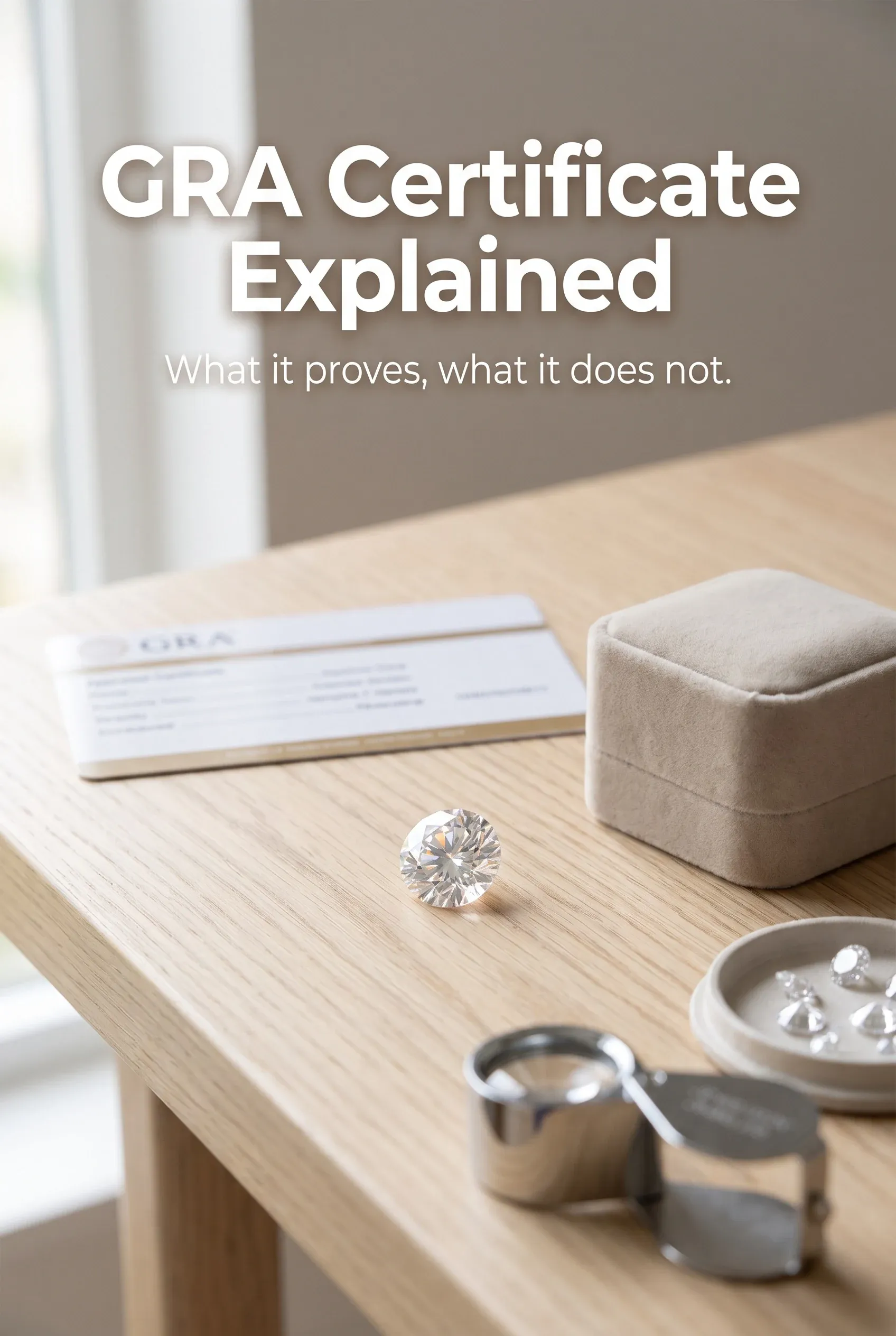
A GRA moissanite certificate usually proves only that the stone is moissanite and lists basic details. It can be useful identification paperwork, but it is not the same thing as an independent promise of elite cut, rarity, or long-term value. That distinction matters because sellers often present a GRA card as if it settles every quality question, and it does not.
What a GRA moissanite certificate is
GRA stands for Global Research Association. In the moissanite market, a GRA report is the common piece of paperwork that comes with a loose stone or a finished jewelry item. It identifies the stone as moissanite and records a few headline traits.
That matters only because moissanite is its own gem, not diamond. Moissanite is silicon carbide, first identified in a meteor crater by Henri Moissan in 1893, and nearly all jewelry moissanite sold today is lab grown. If you need a quick refresher on what moissanite is, start there before judging any certificate.
What the report usually includes
Formats vary, but most GRA paperwork repeats the same small set of data points. Expect shape or cut name, carat weight, color grade, and clarity. Many reports use D-E-F for colorless and G-H-I for near-colorless.
Clarity is where buyers often get misled. VVS is often listed, but lab growth makes VVS normal in this category, not rare. We explain why VVS moissanite is so common in more detail elsewhere.
| Common field | What it tells you | What it does not tell you |
|---|---|---|
| Stone type | The gem is being identified as moissanite | That it is diamond or lab-grown diamond |
| Carat weight | The stone’s stated weight | How large it will look compared with another gem |
| Cut or shape | The basic outline or cut style | How precise the proportions and light return are |
| Color grade | Whether it is sold as colorless or near-colorless | How warm or cool it will appear in every lighting condition |
| Clarity grade | A broad cleanliness grade, often VVS | That the stone is rare or worth a large premium |
What it actually proves
A GRA report is most useful as identification. If the paperwork matches the stone you received, it supports the claim that the stone is moissanite rather than cubic zirconia, white sapphire, crystal, or glass. That is a practical benefit, especially when you buy online and cannot inspect the piece first.
It also gives you a simple record to compare against the listing. If a seller advertised a colorless round and you receive a warmer oval, the mismatch is easier to spot when you have paperwork in hand. Used that way, a GRA certificate helps with verification, not prestige.
For first-time buyers, that basic confirmation can lower the risk of simple bait and switch problems. It is also useful when the jewelry is a gift and the recipient wants a plain record of what the center stone is supposed to be. Those are modest benefits, but they are real ones.
What it does not prove
A GRA report is not a GIA-style quality guarantee. It does not tell you whether the stone has crisp symmetry, strong light return, or especially balanced faceting. Two moissanite stones can both carry paperwork and still look different in brightness, pattern, and overall appeal.
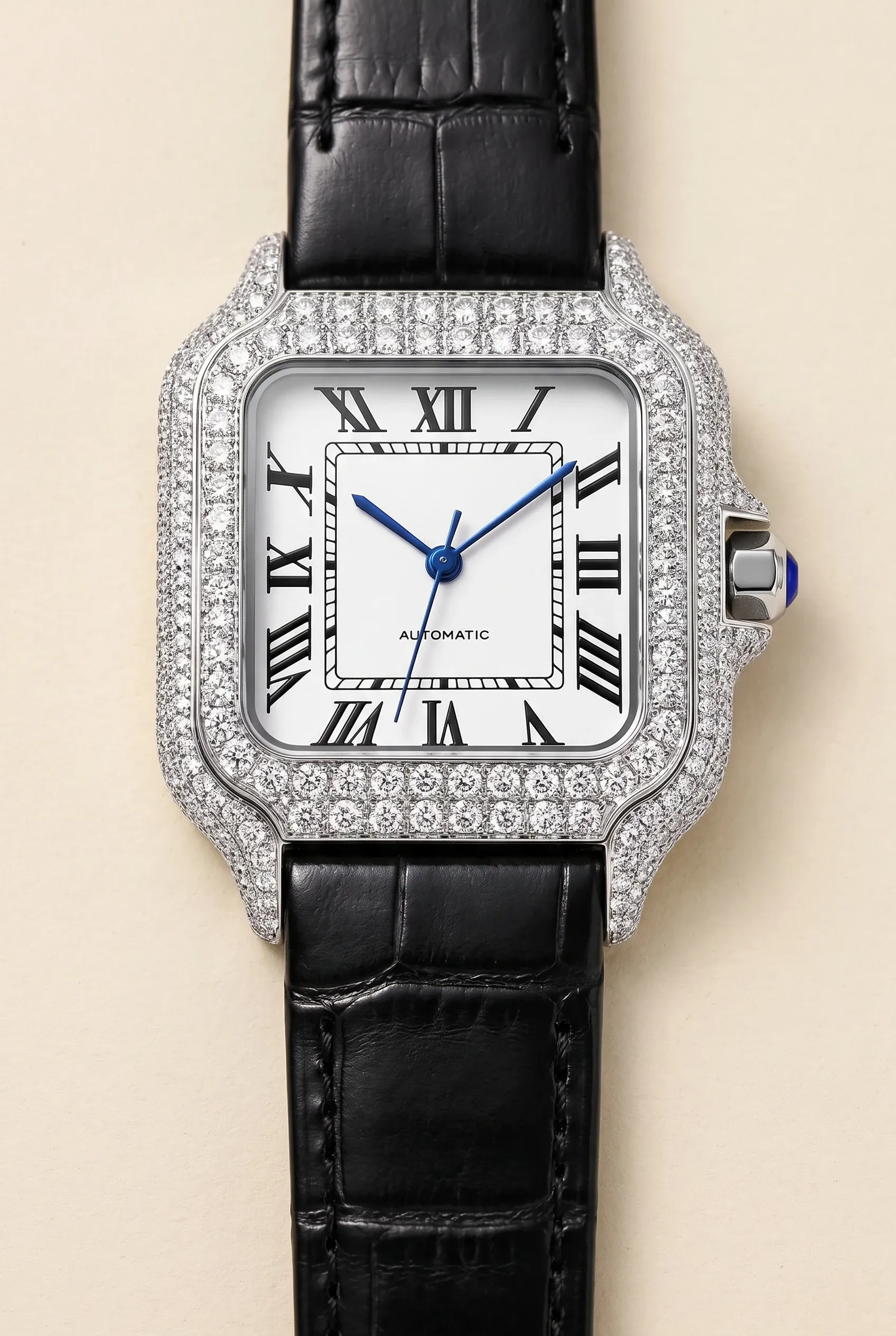
It also says little about the jewelry holding the stone. A ring depends on its prongs, finish, and overall construction. A stone-set watch depends even more on whether the stones are hand set stones or simply glued in place.
Paperwork also does not create scarcity. Because almost all jewelry moissanite is lab grown, a certificate does not turn a common commercial stone into a rare collectible one. It is also not an appraisal, and it should not be read as proof that you are getting exceptional value.
Why sellers lead with GRA certified moissanite
Sellers feature that phrase because many shoppers still assume every bright white stone must be either diamond or fake. A printed card or report answers that fear quickly, especially when the price lands far below diamond pricing. The wording sounds official, and that alone helps sales.
For context, a 1 ct colorless loose moissanite usually retails for about $300 to $600 per carat. A similar 1 ct round diamond runs about $4,000 to $7,000 if natural and about $800 to $1,500 if lab grown. A certificate helps explain why moissanite sits in its own lane, but it does not make the stone more exclusive than the market already says it is.
This is why the phrase GRA certified moissanite often appears in product titles, ad copy, and video captions. It is not always false, but it is often doing more marketing work than gemological work. Treat it as a starting point for questions, not as the final answer.
How GRA paperwork differs from diamond grading
Diamond buyers are used to reports that people treat as major quality documents. GRA paperwork sits in a different lane. It is better understood as identification first, grading second.
| Property | Moissanite | Diamond | Why it matters |
|---|---|---|---|
| Composition | Silicon carbide | Carbon | A report should identify the gem correctly |
| Hardness | 9.25 | 10 | Both are durable enough for daily wear |
| Refractive index | 2.65 to 2.69 | 2.42 | Moissanite bends light more strongly |
| Dispersion | 0.104 | 0.044 | Moissanite usually shows more fire |
| Density | 3.21 | 3.52 | Equal-looking stones do not weigh the same |
| Refraction | Doubly refractive | Singly refractive | Facet doubling can appear under a loupe |
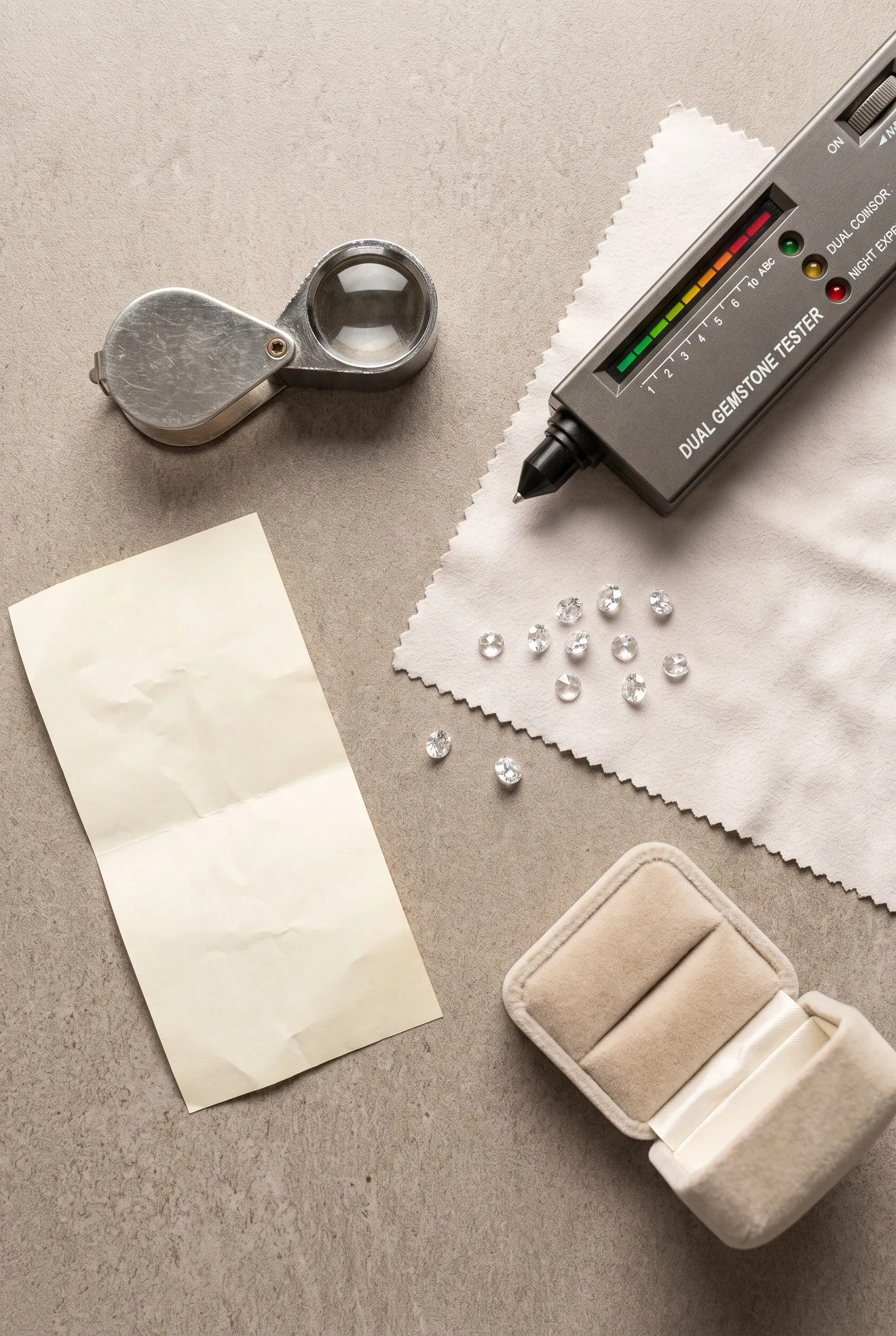
| Tester behavior | Thermal pen often reads as diamond | Thermal pen reads as diamond | A dual thermal and electrical tester separates them |
Those physical differences explain many buyer misunderstandings. Moissanite can throw more rainbow fire than diamond, and it can also pass a basic diamond tester. That is why a thermal pen alone is not enough when you are checking whether paperwork matches the stone.
How to check whether the paperwork matches the stone
Use the report as a checklist, not as a trust fall. Start with what you can see without tools. The stone shape, the color description, and the way the piece was advertised should line up with the paperwork and with the item in front of you.
Visible checks
- Match the shape on the report to the actual stone.
- Compare the stated color range with the listing description.
- Make sure the jewelry style matches what was sold, especially if the stone is already mounted.
- Keep screenshots of the listing with the report and receipt.
Simple tool checks
- Use a loupe and look through the pavilion, where moissanite’s double refraction can show facet doubling.
- Use a dual thermal and electrical tester if you want a stronger identity check.
- Do not rely on a simple thermal pen by itself.
If you want the visual clues explained step by step, this guide on how to tell moissanite from diamond goes deeper. The key point is simple, a GRA certificate is strongest when the stone and the paperwork agree on several visible facts.
When the report matters most
The report matters most when the stone itself carries most of the purchase value. Think loose stones, engagement-ring center stones, solitaire pendants, and first-time online purchases where you cannot compare several stones in person. In those cases, identification paperwork gives you a cleaner basis for acceptance or return.
It also matters more when the recipient is likely to ask what the stone is. A gift ring with a center stone feels more complete when it comes with some form of documentation, even if that documentation is basic. The same logic applies when you are comparing similar listings and want a consistent paper trail.
For fully set watches, the balance changes. A moissanite watch usually sits around $900 to $2,700, and in that segment build details affect daily wear more than the card does. In stone-set watches under $3,000, Japanese quartz is the norm, while automatic movements add thickness and future service cost.
When it matters less
The report matters less when the stone is one part of a design-driven purchase. With halos, tennis styles, or fully set watches, you should care more about how evenly the stones are matched and how securely they are mounted. Documentation on small stones also varies by maker, so paperwork is not always the best tool for judging a finished piece.
It matters less again when a listing leans on the certificate to dodge obvious market math. In this market, a watch sold as moissanite for under about $300 is almost certainly crystal or CZ. A generic certificate image does not cancel that signal.
That does not mean a low-cost watch cannot look good for the money. It means the certificate should not persuade you to believe a stone claim that the price contradicts. When price and paperwork disagree, price is often telling you more.
Red flags in listings
Several patterns should slow you down before checkout. None of them proves fraud by itself, but together they often point to weak documentation or inflated claims.
- The listing leads with GRA paperwork but gives little detail about the actual stone.
- The seller treats the certificate like an appraisal or an investment document.
- The page repeats VVS and colorless claims but hides the carat weight.
- The only proof offered is that the stone passes a diamond tester.
- Close-up photos avoid the setting quality and focus only on sparkle.
- A watch listing never explains whether stones are set mechanically or glued.
- The price sits in the sub-$300 zone while the stone claim says moissanite.
One weak sign can be harmless. A cluster of them is different. If the listing sounds more official than informative, assume the paperwork is being used as decoration.
Questions to ask before you pay
You do not need advanced gemology terms to pressure test a listing. A few direct questions usually expose whether the seller understands the product or is hiding behind stock language.
- Is the report for the exact stone being sold, or is it only a sample image.
- What carat weight and color range am I actually receiving.
- Is the stone loose, or is it already mounted.
- What is the return window if the item and the paperwork do not match.
- For a watch, are the stones hand-set or glued.
- For a watch, is the movement quartz or automatic.
A serious seller should answer in plain language. Evasion matters more than whether the response sounds luxurious. If simple questions produce vague answers, the certificate is not solving the real problem.
The practical takeaway
Treat a GRA report as supporting paperwork, not as the product’s main proof of quality. Its best use is simple, confirm identity, compare it with the listing, and keep it with your receipt.
Then judge the rest on visible facts and realistic pricing. Look at cut, color, craftsmanship, secure setting, and whether the stone claim fits the market around it. That is how to read a GRA certificate without giving it more authority than it has.
Frequently Asked Questions
Is a GRA moissanite certificate a real certificate
Yes, it is real paperwork commonly used in the moissanite market. The important limit is what it does. It usually confirms the stone is moissanite and lists basic traits, but it should be read as identification paperwork, not as a full quality guarantee.
Does a GRA report mean the stone is high quality
No. A GRA report can list cut, color, carat, and clarity, but that does not mean the stone has elite light performance or rare value. Two stones with similar paperwork can still look different once you compare their faceting, brightness, and overall make.
Why does a diamond tester say diamond when the report says moissanite
A simple thermal diamond tester reads moissanite as diamond because both conduct heat in a way the pen recognizes. That is normal. If you need to separate the two, use a dual thermal and electrical tester or check optical clues such as double refraction.
Is VVS on a GRA report a premium upgrade
Usually not. In moissanite, VVS is the standard clarity grade you see most often because lab growth makes very clean stones common. It can describe the stone accurately, but by itself it should not justify a major markup.
Do moissanite watches need GRA paperwork
It is nice to have, but it is not the main thing that decides whether a moissanite watch is worth buying. In a fully set watch, stone retention, setting method, movement type, and overall construction matter more than a certificate card.
Can a weak listing still show a real-looking GRA card
Yes. A generic report image can be reused across many listings, and the paperwork may tell you less than the product title suggests. Always compare the actual item, the listed carat weight, the color language, and the price before trusting the certificate.
Should I avoid jewelry that has no GRA certificate
Not automatically. A missing certificate is more important on a loose stone or a center-stone purchase than on heavily set jewelry with many small stones. If the seller is clear, the return policy is reasonable, and the product details make sense, lack of paperwork is not always a deal breaker.