Moissanite Colors Explained: Colorless Near-Colorless and Fancy Colors
Understand moissanite colors, from D–F colorless to G–I near-colorless and fancy shades, with honest guidance on size, shape, metal, lighting, and price.
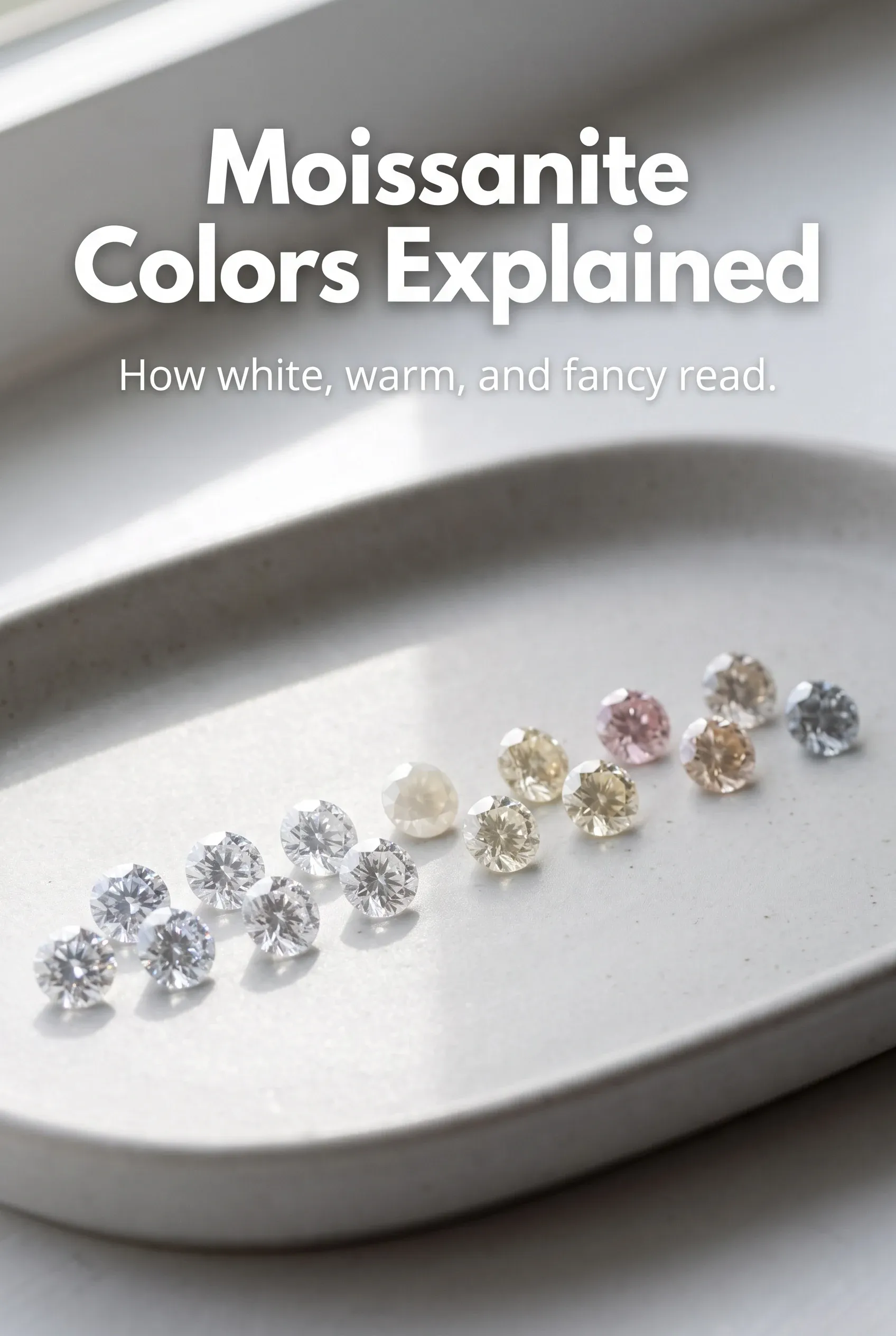
Moissanite colors run from icy D–F colorless to warmer G–I near-colorless and intentional fancy shades. Those moissanite colors can look very different once size, shape, metal, and lighting enter the picture. For most buyers, the right choice is not the whitest stone on paper, it is the color grade that still looks white in the setting you actually want.
Why moissanite has color at all
Moissanite is silicon carbide, not diamond. It was first identified in 1893 by Henri Moissan in material from a meteor crater, but nearly all jewelry moissanite sold in 2026 is lab grown. If you need the basics first, see how moissanite is made and what it is.
Like other gems, moissanite can show body color. The grade reflects how much warmth or tint you can see, especially from the side and under neutral lighting. Modern production is much whiter than the early material many shoppers still remember, but color is still a real buying variable.
That does not mean lower grades are bad. It means color lives on a spectrum, and the visible difference grows or shrinks depending on the finished piece. A near-colorless stone can look almost identical to colorless in one ring and noticeably warmer in another.
The moissanite color grades that matter
The white range is usually split into colorless and near-colorless. Sellers normally label D–E–F as colorless and G–H–I as near-colorless. Fancy colors sit outside that white scale and are described by visible hue rather than by a letter alone.
These labels are useful, but they are still only a starting point. Individual wording varies by seller, and a photo can make a G stone look like an E or the reverse. That is why the practical question is not just the grade name, but where that grade still looks white enough for you.
| Color band | What it usually means | Where it tends to work best | Main watchout |
|---|---|---|---|
| D–F colorless | Little to no visible body color in normal viewing | White metal, larger stones, step cuts, side by side wear with diamonds | Costs more, and the optics still do not copy diamond exactly |
| G–I near-colorless | Mostly white face-up, with faint warmth easier to catch from the side | Brilliant cuts, smaller stones, yellow or rose gold, value-focused buys | Tint shows faster in large stones and open white settings |
| Fancy colors | Intentional visible hue such as blue, green, gray, or champagne | Statement jewelry, accent stones, buyers who want color on purpose | Names are less standardized than white grades |
Color and clarity are separate things
A lot of listings place color and clarity side by side, which makes buyers assume the labels carry equal weight. They do not answer the same question. Color tells you how white or tinted the stone appears, while clarity tells you how free it is from visible inclusions.
That distinction matters because most modern moissanite is sold as VVS. In other words, VVS is usually the baseline, not a rare upgrade, so it should not distract you from judging the actual color you can see. It helps to know why VVS is so common before you pay extra for it.
When buyers mix up these labels, they often overspend on clarity and underspend on color or cut. If the stone will be viewed from arm’s length, the tint you can notice is usually more important than an inclusion grade you cannot. Read the letters separately.
What colorless moissanite looks like in real life
Colorless moissanite is the closest match to the icy white look people picture when they think of a classic white diamond. In well-cut stones it faces up bright and white, especially in round brilliants and smaller sizes. If you want the least visible warmth in white metal, this is the safest lane.
It tends to earn its keep in situations where any tint would stand out. Think large center stones, emerald cuts, Asscher cuts, white gold or platinum-style settings, or rings stacked next to white diamond bands. In those settings, the extra whiteness is easier to appreciate.
Colorless also makes sense for buyers who are simply color sensitive. Some people notice even a small amount of warmth and will keep seeing it once it bothers them. If that sounds like you, buying higher once is usually cheaper than replacing the stone later.
That said, colorless moissanite still does not look identical to diamond. Its refractive index is 2.65 to 2.69 and its dispersion is 0.104, compared with diamond at 2.42 and 0.044, so you get more rainbow fire. If you want to separate whiteness from sparkle, this look at how the two stones throw light is useful.
What near-colorless moissanite looks like in real life
Near-colorless moissanite is the value sweet spot for many buyers. Face-up, a good G–H–I stone can still look very white in everyday wear, especially around 1 ct or below, in brilliant cuts, or when set in yellow or rose gold. The warmth is usually more noticeable from the side than from straight above.
This category asks for context. A larger stone, a step cut, or a very white setting will reveal tint faster than a small round in warm metal. A seller can honestly call both stones near-colorless, while one still looks much warmer once mounted.
That does not make near-colorless a compromise in every case. In earrings, pendants, halos, and many small accent applications, the difference can be hard to spot without close comparison. If the finished piece will be viewed at normal distance, many shoppers would rather keep the savings and go up in size or setting quality.
The key is matching the grade to the job. Near-colorless works best when the design already helps it, instead of fighting it. Warm metal, brilliant facets, and smaller dimensions are all helpful.
Fancy colors are a different category
Fancy colors are different from white grades because the point is visible hue, not the absence of hue. Blue, green, gray, champagne, and other tones can be attractive, but the naming is far less standardized than D–F or G–I. Two sellers can use the same color word for stones that look different in person.
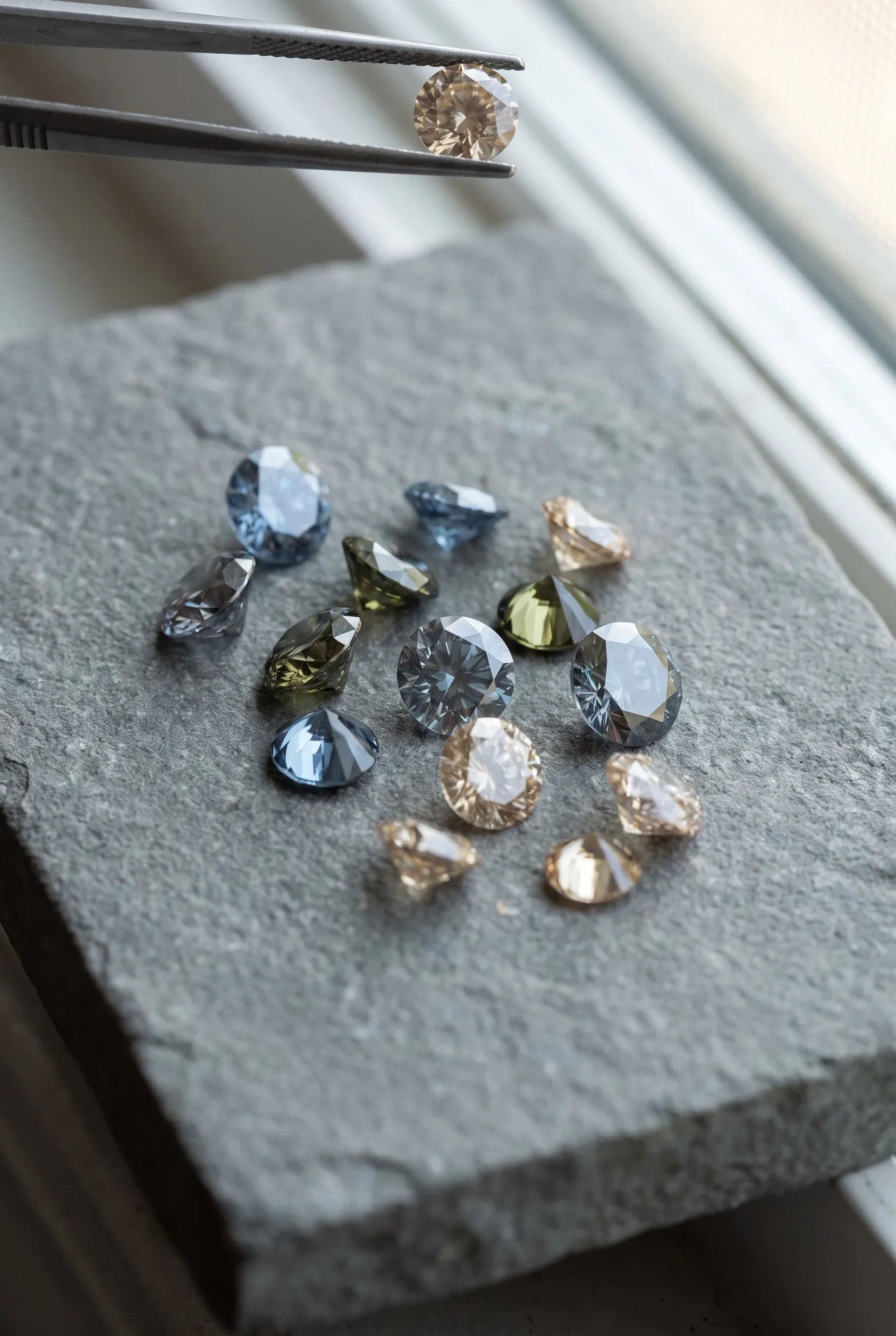
That is why photos alone are not enough. Fancy-color moissanite should be checked in daylight, indoor light, and video, because saturation can shift a lot between environments. Treat the name as a starting label, not as a universal industry grade.
Fancy colors also need a different buying mindset. You are not trying to get as close as possible to a diamond look. You are deciding whether you genuinely like that hue on your skin tone, with your metal choice, and in the size you want.
Small fancy accents can be easier to wear than a large center stone. A soft gray or muted green might feel interesting in a halo, a pendant, or a watch bezel, while the same color in a large solitaire could be more specific than some buyers want long term. Think in terms of styling, not just rarity.
Size changes how much color you notice
Size changes color perception more than many first-time buyers expect. The larger the stone, the more material light passes through, so any warmth or tint becomes easier to spot. That is why a near-colorless grade that looks icy at 0.75 ct can look softer at 2 ct or 3 ct.
This matters because moissanite makes larger sizes common. Buyers who would never consider a large diamond often do consider a large moissanite, which is exactly when color choice becomes more visible. A grade that felt generous on paper can look more realistic once you see the actual dimensions.
Elongated large stones make the effect stronger. There is simply more length for the eye to scan, and the tips of oval, pear, and marquise shapes tend to show tone sooner than a compact round. When size increases, many shoppers either move up in color or change to a shape that hides color better.
The opposite is also true. In very small stones, especially accent stones, the practical difference between colorless and near-colorless can shrink a lot. That is one reason watch bezels and pave surfaces often do not need the same grade strategy as a center stone ring.
Cut shape changes how much tint you see
Cut shape changes how strongly you notice body color. Round brilliant stones usually hide color best because their facet pattern breaks up tint with brightness and fire. Ovals, pears, marquises, and elongated cushions tend to show warmth sooner, especially toward the tips.
Step cuts such as emerald and Asscher styles are the most demanding if you want an icy look. Their long open facets act like windows, so tint is easier to read. A near-colorless emerald cut often looks warmer than a near-colorless round of the same weight.
Cut quality matters too. A well-cut near-colorless stone can look livelier and cleaner than a duller colorless stone. Buyers sometimes chase the top letter grade and forget that a flat or sleepy cut will not look premium just because the paper says D or E.
Under a loupe, moissanite is also doubly refractive, so facet doubling can be visible through the pavilion, while diamond is singly refractive. That optical difference is not a color grade, but in some elongated shapes it can influence how crisp or soft the faceting appears to your eye.
Metal color changes the result
Setting metal can make the same stone look different. White metal pushes the eye toward any warmth that is present, while yellow and rose gold are more forgiving because the surrounding tone already runs warm. A bezel or more closed side profile can also hide some side tint that an open basket leaves exposed.
This is why many shoppers happily buy near-colorless for yellow-gold rings and save colorless for white metal. The stone is not changing, but the frame around it changes your reference point. Metal choice is therefore part of color choice, not a separate decision.
Mixed-metal designs sit in the middle. White prongs can keep the immediate frame bright, while a warmer shank softens the overall contrast. If you are undecided between grades, the setting architecture can sometimes solve the problem more efficiently than paying for a whiter stone.
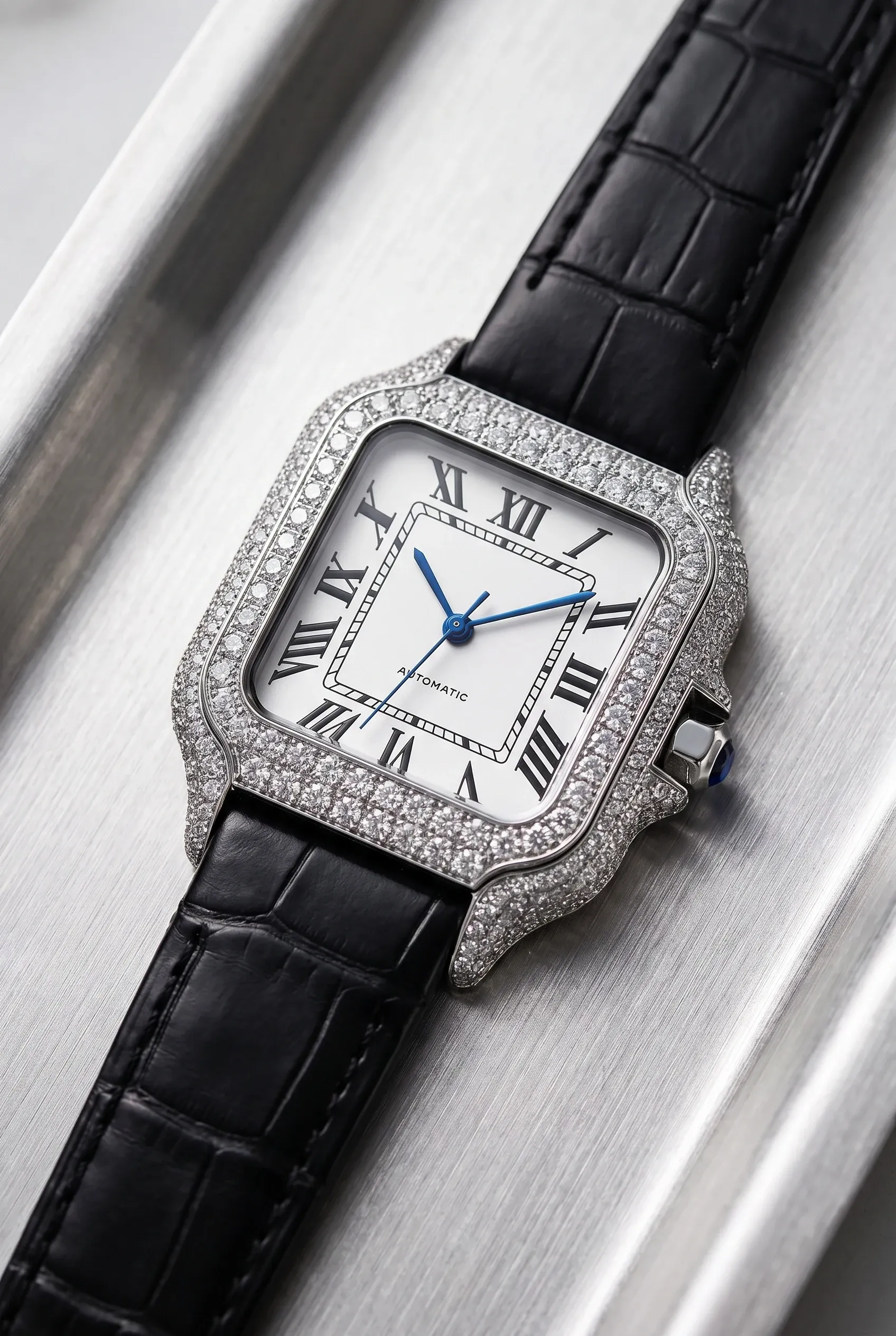
The same idea carries into watches and other stone-heavy pieces. Small white stones around a colored dial can read crisp because each stone is tiny, while a large center stone on a ring gets studied from inches away. Use the viewing distance of the piece as part of the decision.
Daylight store lights and warm indoor light
Lighting can change your opinion fast. Direct jewelry-store LEDs boost sparkle and can make almost any white stone seem whiter than it does at home. Warm indoor bulbs can pull a faint yellow or gray tone forward, while overcast daylight is usually the most honest test.
Always judge a stone in at least three views, face-up, side view, and hand movement. A color grade that passes all three is usually the right one for you. If a seller only shows heavily edited studio images, assume you do not yet know the real color.
A simple shopping method helps. First, look at the stone loose on white paper. Then view it against skin, and finally against the metal color you plan to buy. Those three contexts reveal much more than one glamour shot.
Comparison beats memory every time. If possible, look at two grades side by side under the same light rather than trying to remember what one stone looked like yesterday. Your eye notices relative warmth much faster than absolute warmth.
How moissanite colors compare with diamond and other white stones
Shoppers often use color words as shorthand for whether a stone will pass for diamond. That is only part of the story. White appearance depends on color, but the overall look also depends on fire, brightness, and sharpness.
Moissanite is whiter than some lower-cost alternatives, but its stronger fire makes it look different from diamond even when both are very white. White sapphire has much lower dispersion, so it throws less color. Cubic zirconia can look bright at first, but it is softer and usually less durable in long-term daily wear.
| Stone | Refractive index | Dispersion | Mohs hardness | Color takeaway |
|---|---|---|---|---|
| Moissanite | 2.65 to 2.69 | 0.104 | 9.25 | Very bright, with more rainbow fire even in white grades |
| Diamond | 2.42 | 0.044 | 10 | White look with less fire and crisper single refraction |
| White sapphire | 1.76 to 1.77 | 0.018 | 9 | Lower fire and a calmer, less flashy look |
| Cubic zirconia | 2.15 to 2.18 | 0.060 | About 8 to 8.5 | Bright at first, but softer and less durable over time |
In price terms, a 1 ct colorless moissanite usually lands around $300 to $600. A similar 1 ct round diamond runs about $4,000 to $7,000 if natural, or $800 to $1,500 if lab grown. If you are cross-shopping beyond diamond, more head to head comparisons can help you decide which trade-off actually matters to you.
What paperwork can and cannot tell you
Paperwork helps with identification, but not as much as many buyers think. The common moissanite report in 2026 is a GRA report, which usually confirms the stone is moissanite and lists carat, cut, and color. It is best read as identification, not as a GIA-style guarantee of quality or cut performance.
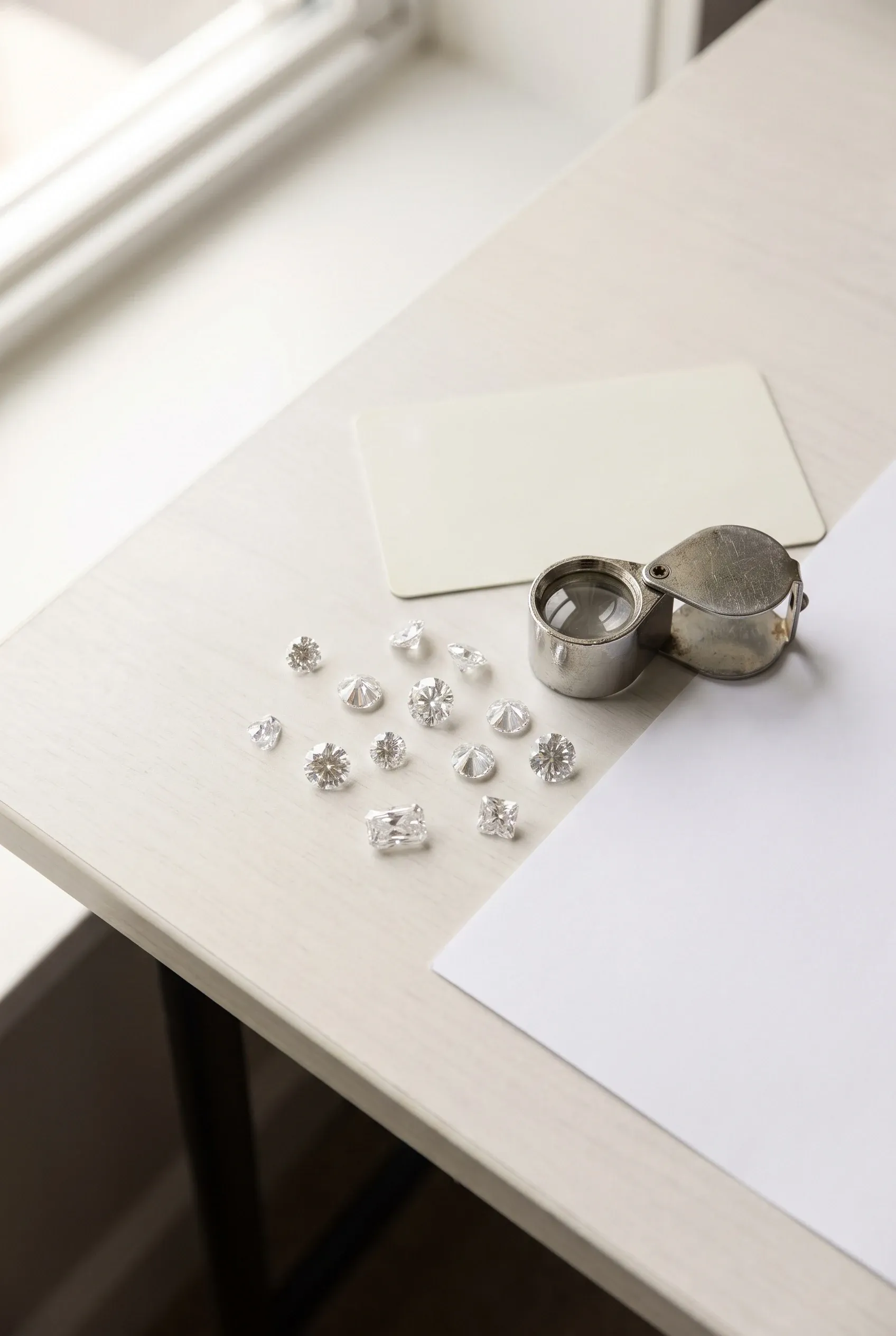
That matters because two stones with the same paper color grade can still look different once cut precision, shape, and lighting enter the picture. A report can tell you the label, but it cannot replace clear video, side views, and comparison shots. Before paying more for paperwork, understand what a GRA report actually proves and what it does not.
Use reports to confirm the stone category, not to stop asking visual questions. Ask how the stone looks in daylight, how it compares to the next grade, and whether the side profile shows warmth. Those answers decide satisfaction more than the paper alone.
How to choose the right color for your ring or watch
There is no best moissanite color for everyone. Colorless suits buyers who want the iciest look, larger stones in white metal, and step cuts where warmth shows easily. Near-colorless suits people who want a white face-up look without paying for the top grade, especially in warm metal or smaller sizes.
Fancy colors suit buyers who want visible personality rather than a diamond substitute. None of these options is softer or harder because of color, moissanite remains 9.25 on the Mohs scale either way. Focus on the finished look, not on the letter alone.
Choose colorless if
You want the least visible warmth, you prefer very white settings, or you are choosing an emerald cut, Asscher cut, or a large elongated stone. It is also the safer pick if you are very color sensitive and know a faint tint will bother you every time you notice it. Buyers who wear their piece next to white diamond jewelry also tend to prefer this range.
Choose near-colorless if
You want strong value and still expect a stone that reads white in normal wear. This is often the practical pick for rounds, smaller center stones, halo stones, earrings, pendants, and many watch applications where individual stones are tiny. In yellow or rose gold, it often gives up very little visually while saving money.
Choose fancy color if
You are buying the stone as a color statement rather than as a diamond lookalike. Make sure you like that hue under several lighting conditions and at the full size you plan to wear. A subtle gray or champagne can feel versatile, while a stronger blue or green is usually a more deliberate style choice.
Common mistakes people make
Most color mistakes come from evaluating the grade in isolation. Buyers see one letter, one photo, and one price, then assume the answer is fixed. In reality, the setting and the viewing conditions finish the story.
- Buying the letter without the shape. A G round and a G emerald cut will not show color the same way.
- Judging only the top view. Side tint is often the part that separates colorless from near-colorless in real life.
- Paying for VVS and ignoring color. Clarity and whiteness are different questions, and VVS is normal in moissanite.
- Trusting only spotlight photos. Daylight and warm indoor light reveal much more than bright studio LEDs.
- Expecting colorless moissanite to copy diamond exactly. The color can be close, but the stronger fire changes the overall look.
- Treating fancy names as universal grades. Fancy-color labels are descriptive, and the actual hue still has to be checked by eye.
If you remember one rule, make it this one. Choose the lowest grade that still looks right in your exact size, shape, metal, and lighting. That is usually the point where value and appearance finally line up.
Frequently Asked Questions
What do D–E–F and G–H–I mean on a moissanite listing
D–E–F means colorless, which is the whitest common white range. G–H–I means near-colorless, which still faces up white in many designs but can show faint warmth more easily from the side, in large stones, or in very white settings.
Is colorless moissanite always better than near-colorless
No. Colorless is better only if the finished piece makes warmth easy to notice or if you are highly color sensitive. In warm metal, smaller sizes, brilliant cuts, and many accent-stone applications, near-colorless can look excellent and offer better value.
Which moissanite shapes show the most color
Step cuts such as emerald and Asscher usually show tint most easily because their broad open facets act like windows. Elongated shapes such as oval, pear, and marquise can also reveal warmth sooner than rounds, especially toward the tips and in larger sizes.
Do moissanite colors change over time
The grade itself does not normally change with wear. What changes is surface buildup, because lotion, soap, and everyday film can mute brightness and make a stone look less crisp. A dirty stone can read warmer than a clean one, even though the actual color grade is the same.
Can a certificate guarantee that two stones with the same grade will look identical
No. A report can identify moissanite and list a stated color grade, but cut quality, shape, size, and lighting still change the visual result. Two stones with the same paper grade can look different once one is larger, step cut, or shown in a whiter setting.
Does colorless moissanite look exactly like diamond
Not exactly. It can look very white, but moissanite has more fire because its dispersion is much higher than diamond’s. Also, a basic thermal diamond tester will read moissanite as diamond, while a dual thermal and electrical tester is what separates them.
Are fancy-color moissanites graded the same way as white moissanite
No. White moissanite usually uses the familiar colorless and near-colorless ranges, while fancy stones are described by visible hue. Those fancy color names are less standardized, so video and real-light viewing matter more than the label itself.