Square Watches for Women: The Return of the Tank Shape
A practical guide to square watches for women, with real sizing, styling, movement, and stone-set price advice for 2026.
Square watches for women are back because they look polished, wear slim, and break up a wrist stack nicely. The best one for you depends on wrist size, case proportions, strap choice, and whether you want plain metal, a few stones, or a fully set moissanite look.
Why the tank shape is back
The appeal is simple. A square or tank-style watch looks more intentional than a basic round case, but it is still easy to wear with work clothes, denim, knits, or evening outfits.
That shape also reads dressier at smaller sizes. A 26 to 32 mm square case can look like jewelry, especially on a leather strap or a slim bracelet, while still staying practical as an everyday watch.
There is also some fashion fatigue behind the return. After years of oversized sports watches, many women want something flatter, cleaner, and more tailored. Square cases do that well because the straight lines feel sharp without needing a large dial.
Square, rectangular, and what sellers mean
Many listings blur these terms. A true square case has similar width and height, while a rectangular watch is longer than it is wide. In practice, plenty of shoppers use both terms for the same family of dress watches.
If you are searching for a square face watch for women, you will often see slightly elongated cases mixed into the results. That is not wrong, but it changes how the watch wears. A rectangle usually looks more classic and formal, while a squarer case feels a bit more modern and graphic.
Look beyond the seller's label and check three things: the case width, the case length, and the dial opening. Some watches have a square outer case but a small rounded dial inside, which softens the whole effect. Others have a long, narrow dial that gives you the full rectangular watch for women look.
Start with your wrist size
With square watches, wrist fit matters more than trend. Straight case sides create stronger visual edges, so a watch that is technically small can still look big if the lugs extend past your wrist.
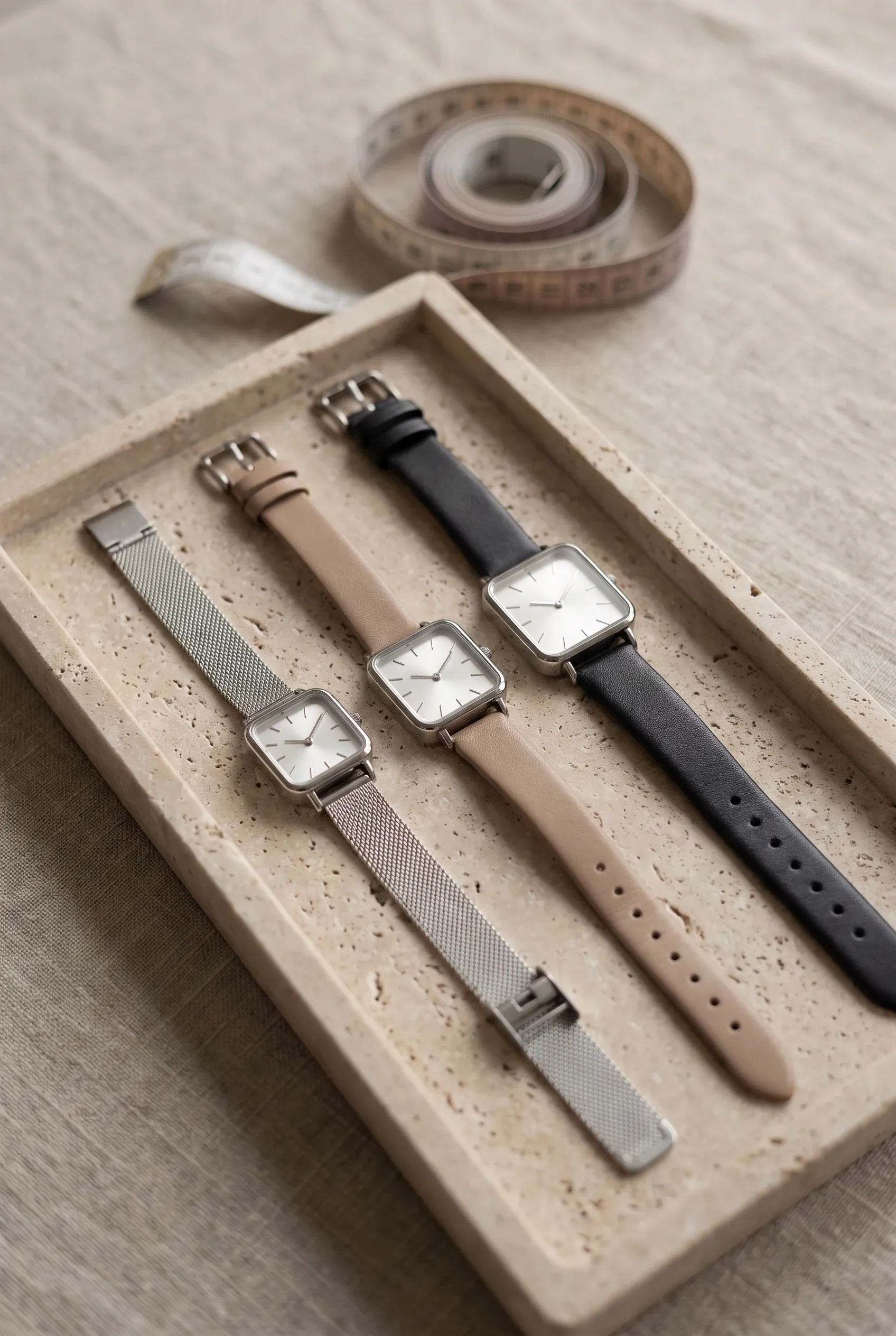
The safest rule is this: the lug-to-lug length should not exceed your wrist width. If your wrist is under 6 inches, stay at or below 36 mm overall, and start by looking at classic women's sizing first. If you want more detail on proportions, our piece on sizing advice for smaller wrists goes deeper.
| Your wrist size | Good starting range | How it usually reads |
|---|---|---|
| Under 6 inches | 26–32 mm, stay at or below 36 mm | Classic, balanced, and easiest to dress up |
| 6 to 7 inches | 26–32 mm for dressy, 34–36 mm for a modern look | Most versatile range for square cases |
| 7 inches and up | 34–36 mm, or 38–40 mm for a unisex feel | More dial presence and more bracelet weight |
Square cases often feel larger than round watches with the same number on paper. If you are between sizes, go smaller, especially for a leather-strap dress watch. The sharper outline does a lot of the visual work already.
Decide how much dial presence you want
Not every square watch gives the same effect. A thin bezel and open dial read modern and a little more casual. A smaller dial opening, Roman numerals, or a rail-track minute ring read dressier and more vintage.
This is where many bad buys happen. Shoppers see a 34 mm square watch online and assume it will wear like a 34 mm round watch. It usually will not. The broader face and straight edges make it feel more present, especially in bright metal.
If you want a subtle everyday piece, start with a simple dial and a plain bezel. If you want the watch to act like jewelry, a polished bezel, mother-of-pearl dial, or stone outline can do that without needing a bigger case.
Pick the right strap or bracelet
The strap changes the personality more than the case shape does. Leather gives a square watch its cleanest, most classic look. It also makes fit easier on small wrists because you can fine-tune the hole position and avoid the extra bulk of a full metal bracelet.
A bracelet makes the watch feel more like jewelry. This works well if you wear chain bracelets, tennis bracelets, or rings every day. It is less forgiving, though. If the first removable link sits too close to the case, the watch can stand up on the wrist instead of wrapping around it.
For a square case, a leather strap usually looks best when the watch itself is the focal point. A bracelet works better if you want a shinier, more city look. Fully stone-set bracelets look heavier and flashier, which can be great at night but feel like too much for office wear.
Match the finish to your wardrobe
Your metal tone should match what you already wear, not what looks best under studio lights. If most of your jewelry is yellow tone, a square watch in the same family will blend in faster. If you wear mixed metals, a steel-tone or two-tone case is easier to keep in rotation.
Polished finishes look dressier than brushed ones because they reflect more light across the flat edges of the case. That is one reason square watches pair so well with tailoring. A crisp blazer cuff, straight-leg trousers, and a slim square watch all speak the same design language.
Colored dials can work here too. A white, black, or champagne dial is the safest long-term pick. Green, burgundy, pink, or mother-of-pearl dials feel more personal, but they work best when the rest of your jewelry stays simple.
Should you buy a stone-set square watch
This depends on budget, wardrobe, and how often you plan to wear it. If you want one watch for meetings, dinner, and travel, a plain metal square watch is usually the safer buy. If the watch is more of a finishing piece for going out, a stone-set bezel can make sense.
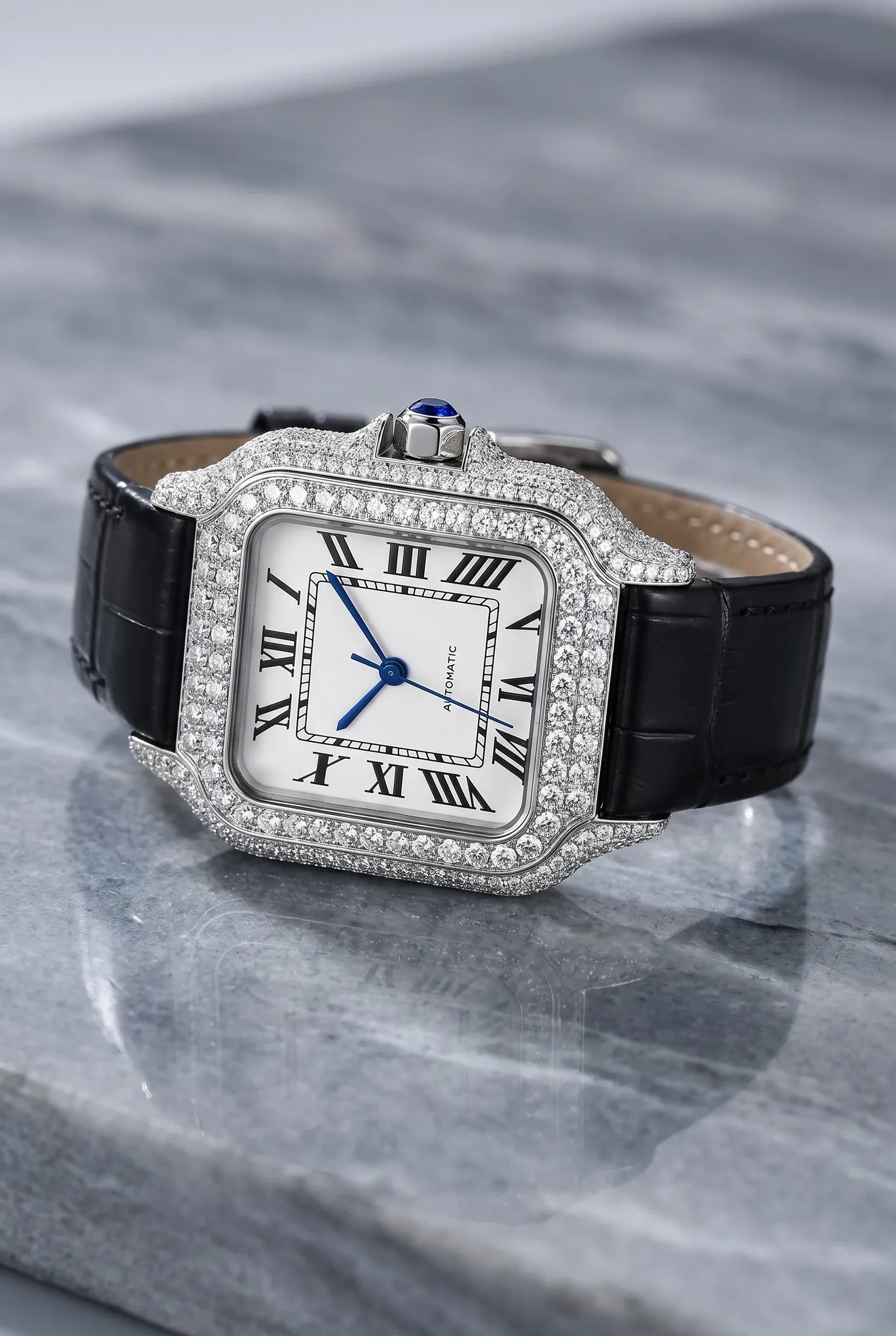
Moissanite is the strongest value option if you want real sparkle without diamond pricing. It is silicon carbide, nearly all jewelry moissanite is lab grown, and it has a Mohs hardness of 9.25. That makes it much tougher than crystal or glass, and harder than cubic zirconia at about 8 to 8.5.
It also has a refractive index of 2.65 to 2.69 and dispersion of 0.104, both higher than diamond. In plain English, it throws a lot of bright fire. On a small square watch, that can look lively and dressy, but it can also feel busier than some shoppers expect. If you are browsing this category, our explainer on stone set women's watches helps sort out sizes, dial styles, and stone coverage.
A good middle ground is a square watch with stones on the bezel and a plain strap. You get sparkle near the dial, but not the full weight and shine of an iced bracelet watch.
What moissanite, CZ, and crystal cost in 2026
Price is where the square-watch market splits fast. A simple fashion watch and a real moissanite watch may look similar in a thumbnail, but they are not priced the same because the stones, setting labor, and case details are different.
| Stone option | Typical watch price | What to expect |
|---|---|---|
| Crystal or CZ | $100 to $400 | Bright at first, lower durability, common at the fashion end |
| Moissanite | $900 to $2,700 | Better durability and stronger fire, usually with quartz movements |
| Custom lab-diamond set | $5,000 to $15,000 | Custom labor and much higher stone cost |
| Custom natural-diamond set | $15,000 to $60,000 and up | Luxury pricing driven by stones and labor |
| Factory diamond-set | $40,000 to $250,000 and up | Major-house pricing, not directly comparable to fashion watches |
The cheapest listings are where you need the most skepticism. A watch sold as moissanite for under $300 is almost certainly crystal or CZ. That does not make it useless, but it does mean you should treat it as a fashion watch, not a stone watch built for long wear.
The price gap makes sense when you zoom out. Loose 1 ct colorless moissanite usually retails around $300 to $600 per carat, while a similar 1 ct diamond costs far more, about $4,000 to $7,000 if natural and roughly $800 to $1,500 if lab grown. Watch stones are much smaller, but the same value ladder shows up in finished pieces.
Movement, crystal, and water resistance matter more than most listings suggest
Many shoppers fixate on case shape and ignore the parts that decide daily satisfaction. In stone-set watches under $3,000, Japanese quartz is the normal movement, and that is usually fine. Quartz keeps the case thinner, costs less, and avoids the extra service burden of an automatic movement.
Automatics can be appealing if you like mechanics, but they add thickness. On a square dress watch, that can ruin the look. If you want the pros and cons laid out plainly, see our guide on the tradeoffs between quartz and automatic movements.
Then check the crystal and water rating. Hardened mineral glass is common. Sapphire crystal usually appears above roughly $1,500. Water resistance is often 3 ATM, which means rain and hand-washing, not swimming. If stones are involved, ask how they are set. Hand-set prong or bead work stays put. Glued stones tend to shed within months, which we explain in our breakdown of why hand set stones last longer.
How to style a square watch
For work
A slim square watch on leather is one of the easiest office watches to wear. It slips under a shirt cuff better than a thick sports watch and looks intentional with straight lines, loafers, and structured bags.
For weekends
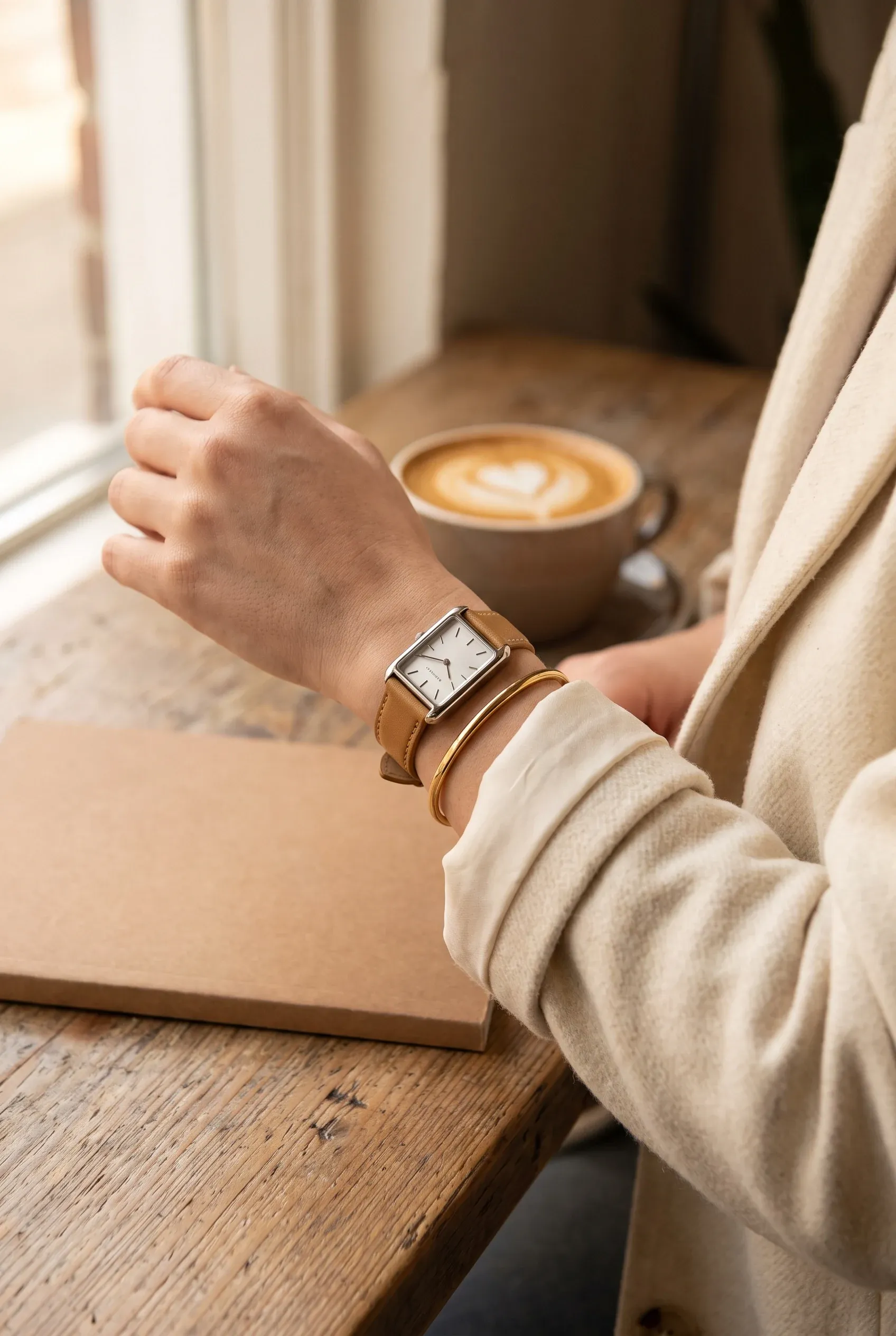
A metal bracelet square watch works well with denim, knitwear, and simple gold or silver jewelry. Keep the rest clean. The shape already adds character, so you do not need an oversized bezel or a busy stack.
For evening
This is where polished cases and stones earn their place. A bezel-set or fully set square watch can stand in for a bracelet. If the watch is bright, scale back the necklace and let the wrist do the work. For more combinations, we have easy outfit formulas for a bold watch that translate well to this shape.
A smart buying checklist
Before you buy, slow down and check the boring details. They matter more than a glamorous product photo.
- Measure your wrist first. Use inches or millimeters and compare that with case width and lug-to-lug length.
- Choose the category on purpose. A 26 to 32 mm watch reads classic, while 34 to 36 mm looks more contemporary.
- Confirm the movement. If the listing is vague, assume it is basic quartz until proven otherwise.
- Check the crystal. Mineral is normal, sapphire is better, and the price often reflects that jump.
- Read the water rating literally. A 3 ATM dress watch is for daily splashes, not the pool.
- Ask how the stones are mounted. Hand-set is the standard worth paying for, glue is not.
- Treat GRA paperwork correctly. A GRA report confirms the stone is moissanite and lists carat, cut, and color. It is identification, not a GIA-style quality guarantee.
- Do not overpay for buzzwords. D-E-F means colorless, G-H-I means near-colorless, and VVS is common in moissanite because lab growth makes that clarity normal, not rare.
The best square watch is usually the one that fits your wrist, matches your clothes, and does not ask a dress watch to act like a dive watch. Get those basics right, and the tank shape earns its return.
Frequently Asked Questions
Are square watches for women flattering on a small wrist?
Yes, often more than people expect. A slim square case can look very balanced on a small wrist because it sits flat and reads dressy at smaller sizes. If your wrist is under 6 inches, start in the 26–32 mm range and stay at or below 36 mm overall.
What is the difference between a square and rectangular watch for women?
A square watch has a case that is closer in height and width, while a rectangular watch is visibly longer than it is wide. In stores, the terms overlap a lot. What matters more is the actual width, length, and dial opening, because those three details decide how formal or modern the watch looks.
Do square watches look formal?
Usually, yes. Straight case lines, smaller dials, and leather straps make square watches read dressier than most casual round watches. That does not mean they are only for formal wear. A simple metal or leather version also works well with denim, knitwear, and work outfits if the case stays slim.
Are moissanite square watches worth it?
They can be, if you want real sparkle without moving into diamond pricing. In 2026, fully set moissanite watches generally run $900 to $2,700. The key is making sure the stones are truly moissanite and hand-set. Under about $300, a watch advertised as moissanite is usually crystal or CZ instead.
What movement is best in a women's square watch?
For most shoppers, quartz is the practical choice. It keeps the watch thinner, simpler, and cheaper to own, which matters in a dress watch. Automatic movements appeal to collectors, but they add thickness and service cost. Under $3,000, Japanese quartz is the normal movement in stone-set watches.
Can you swim with a square dress watch?
Usually not. Many square dress watches, especially stone-set ones, are rated to 3 ATM. That level is fine for rain and hand-washing, but not for swimming or showering. Always read the water-resistance rating literally, and remember that a dress watch is not meant to replace a sports watch.
Is a square watch a good anniversary gift?
Yes, especially if the person already wears bracelets or ring stacks and likes classic style. It lines up neatly with traditional and modern gift themes too. In the US, first anniversary gifts include clocks, and the 15th anniversary is linked with crystal and watches, so the category makes sense beyond fashion alone.