Women's Watch Sizes Explained: What Looks Right on a Small Wrist
A clear guide to women's watch sizes with real case ranges, fit rules, and a plain answer to 28 mm vs 36 mm on a small wrist.
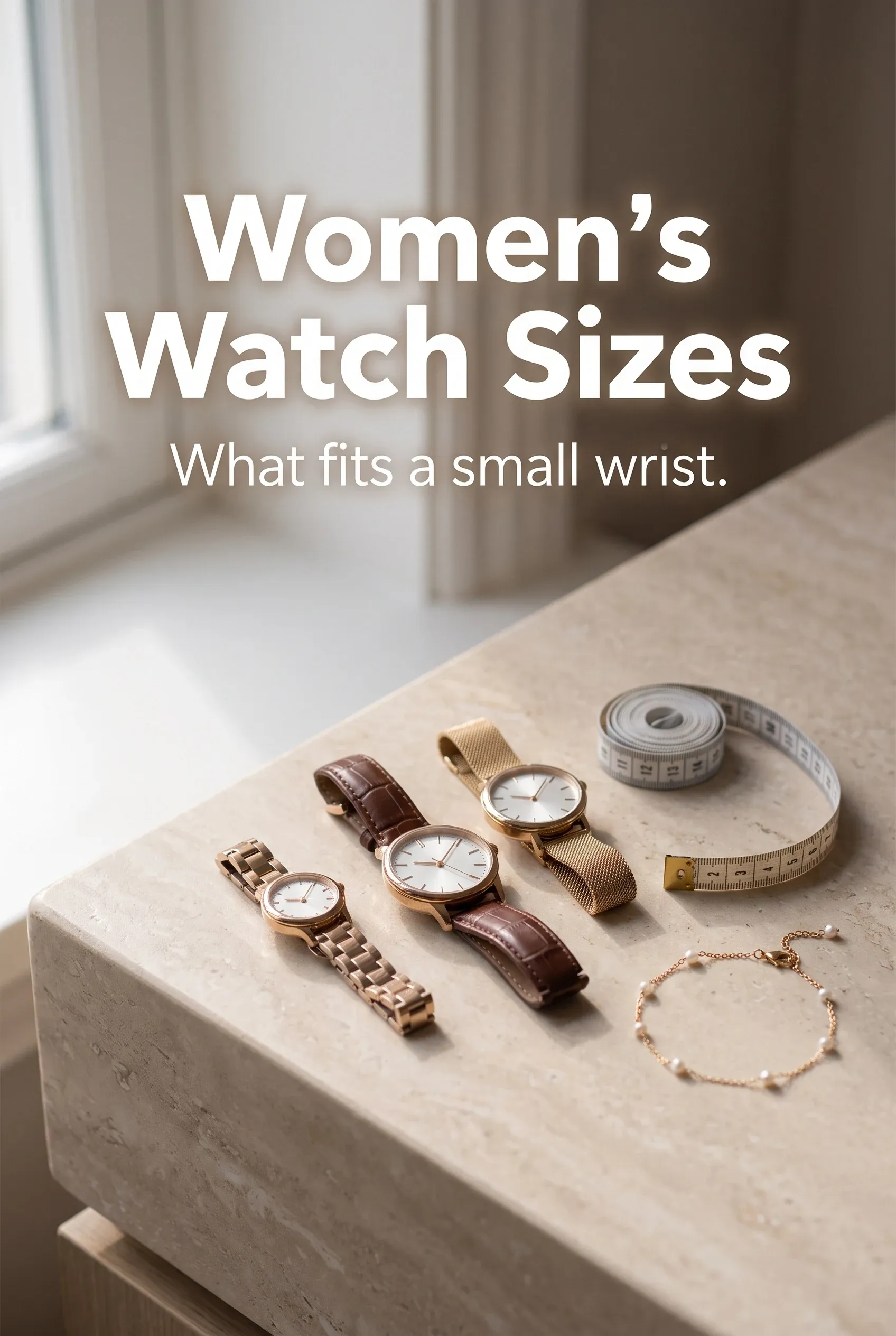
Women's watch sizes look right when case diameter, lug-to-lug, and strap fit all match your wrist. For most small wrists, the safest starting zone is 26 to 32 mm, while 34 to 36 mm can work if the watch is compact from lug to lug. This guide explains women's watch sizes with real numbers, plus what changes when you compare a 28 mm watch with a 36 mm watch.
How watch size is measured
Most people start with case diameter, the width of the watch head, usually measured without the crown. That number matters, but it is only the first filter. Two watches with the same diameter can look very different once they are on the wrist.
The other numbers to care about are lug-to-lug and thickness. Lug-to-lug is the full length from the top lug tip to the bottom lug tip. Thickness affects whether the watch slides under sleeves and whether it feels neat or bulky on a smaller wrist.
Visual weight matters too. A narrow bezel makes more dial visible, so a watch can wear larger than its stated size. A heavy stone-set bezel, thick bracelet, or broad case shape can make the same diameter look more dominant.
The size ranges that usually work
Women's watch sizing is less confusing once you group it by the ranges commonly used in the market. The numbers below are the most useful starting point if you are comparing watches online or in store.
| Case size | Common category | How it usually wears |
|---|---|---|
| 26 to 32 mm | Women's classic | Refined, dressy, and usually easy on a small wrist |
| 34 to 36 mm | Women's contemporary | Modern and more visible, still wearable if the case is compact |
| 38 to 40 mm | Unisex | Intentional oversized look on many women, often too broad for very small wrists |
| 40 to 44 mm | Men's | Large presence, usually better on medium to larger wrists |
If your wrist is under 6 inches, stay at or below 36 mm. That does not mean every 36 mm watch will fit. It means 36 mm is the ceiling, not the default.
If you want to compare more shapes and stone coverage, our broader women's watch coverage helps once you know your size range. Start there only after you know the fit numbers you want.
Start with your wrist circumference
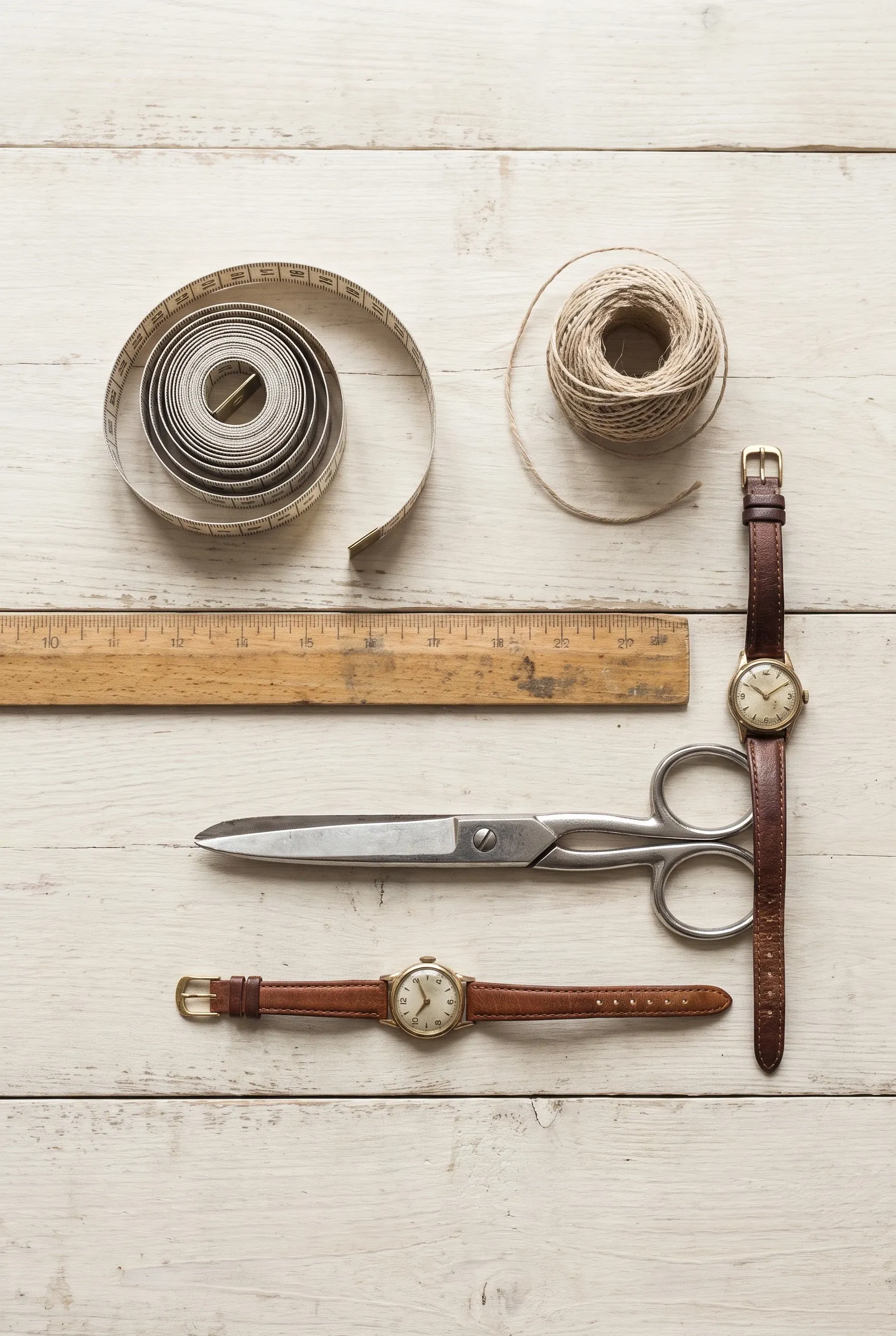
Your wrist circumference is the simplest first check. Wrap a soft tape where you actually wear a watch, not against your hand. Write that number down in inches and millimeters if you can, because some sellers list cases in one and bracelets in the other.
On a small wrist, most sizing mistakes happen when shoppers jump straight to style photos. A head-on wrist shot can hide overhang, and studio photos often make a case look smaller than it feels. Knowing your own measurement keeps you from buying a watch that only works in pictures.
As a starting point, smaller wrists usually do best in the classic range, then move upward only if the lugs are short and the dial is clean. If you want a watch to feel like jewelry, stay near the lower end of that range. If you want a modern everyday look, move upward carefully.
Why lug-to-lug matters more than diameter
Lug-to-lug is often the deal breaker on a small wrist. The simple rule is that the watch should not extend past the visible width of your wrist. If the lugs hang over the edges, the watch will look awkward and feel unstable.
This is why a 34 mm watch can fit better than a 30 mm watch. A compact case with short downward-curving lugs hugs the wrist, while a smaller watch with long straight lugs can sit flat and wide. When a listing hides this measurement, ask for it or look for side angles.
Bracelet end links matter here too. Solid first links that do not articulate early can add apparent length. On a small wrist, that can turn a technically wearable watch into one that never sits cleanly.
28 mm vs 36 mm watch
This is one of the most common real-world choices, and the answer depends on what role the watch plays in your wardrobe. Neither size is automatically right. They simply create different proportions.
| Question | 28 mm watch | 36 mm watch |
|---|---|---|
| Overall look | Classic, jewelry-like, discreet | Modern, more legible, more noticeable |
| Best use | Dress watch, office, stacked with bracelets | Daily wear, casual outfits, unisex styling |
| On a small wrist | Usually safe and easy | Works only if the lugs are short and the dial is not visually crowded |
| With a metal bracelet | Balanced and light | Can feel heavier and wider than expected |
| With stone setting | Reads as refined sparkle | Reads as a statement piece much faster |
A 28 mm watch tends to disappear into an outfit in a good way. It looks neat under sleeves, formalwear, and knitwear. If your goal is elegance first, it is still a very current size.
A 36 mm watch has more dial space and more visual authority. It is easier to read at a glance, and it can look sharp with relaxed tailoring or a simple T-shirt. On a small wrist, though, it needs the rest of the design to stay controlled.
Dial design can make the same case wear bigger
Dial layout changes perceived size more than many shoppers expect. A thin bezel leaves more open dial, so the watch looks larger on the wrist. A thick bezel shrinks the visible dial and can make a watch feel smaller than the case number suggests.
Light dials, mirror-finish markers, and all-over stone work catch more attention and expand the watch visually. Dark dials tend to recede. Busy subdials, large numerals, and bold chapter rings can make a modest case feel crowded, which often looks harsher on a small wrist.
If you are between two sizes, choose the calmer dial. A simple 34 mm can look cleaner than a decorated 30 mm because your eye reads order, not just diameter.
Bracelets and straps on a small wrist
Case size is only half the fit story. The strap or bracelet decides whether the watch actually sits where it should. On small wrists, leather straps usually offer the easiest fit because the holes let you fine tune the position more precisely than removable links alone.
Metal bracelets can still work well, but the first links need to drape quickly. Stiff bracelets create extra spread, and that makes the watch feel larger than the case number suggests. If the bracelet does not taper much, the whole watch can look blocky on a narrow wrist.
For stone-set styles, a strap often keeps the watch elegant because the sparkle stays concentrated around the case. A fully set bracelet adds mass and brightness across the whole wrist. That can be great if you want presence, but it will not read subtle.
Shape changes everything
Round watches are the easiest to size because most people have a feel for what the diameter means. Square watches are different. They usually wear broader than a round watch with the same measurement because the corners fill more wrist surface.
Rectangular cases can be excellent on a small wrist because they spread length vertically without creating too much width. That is why many dress watches for women look graceful even when the case seems long on paper. The width stays contained.
If you are unsure, size down one step when moving from round to square. You can often wear more presence through shape without adding more diameter.
Stone-set and moissanite watches on smaller wrists
Stone coverage changes sizing because sparkle increases visual weight. A slim plain watch and a fully set watch of the same diameter will not read the same on the wrist. The stone-set version always looks more assertive.
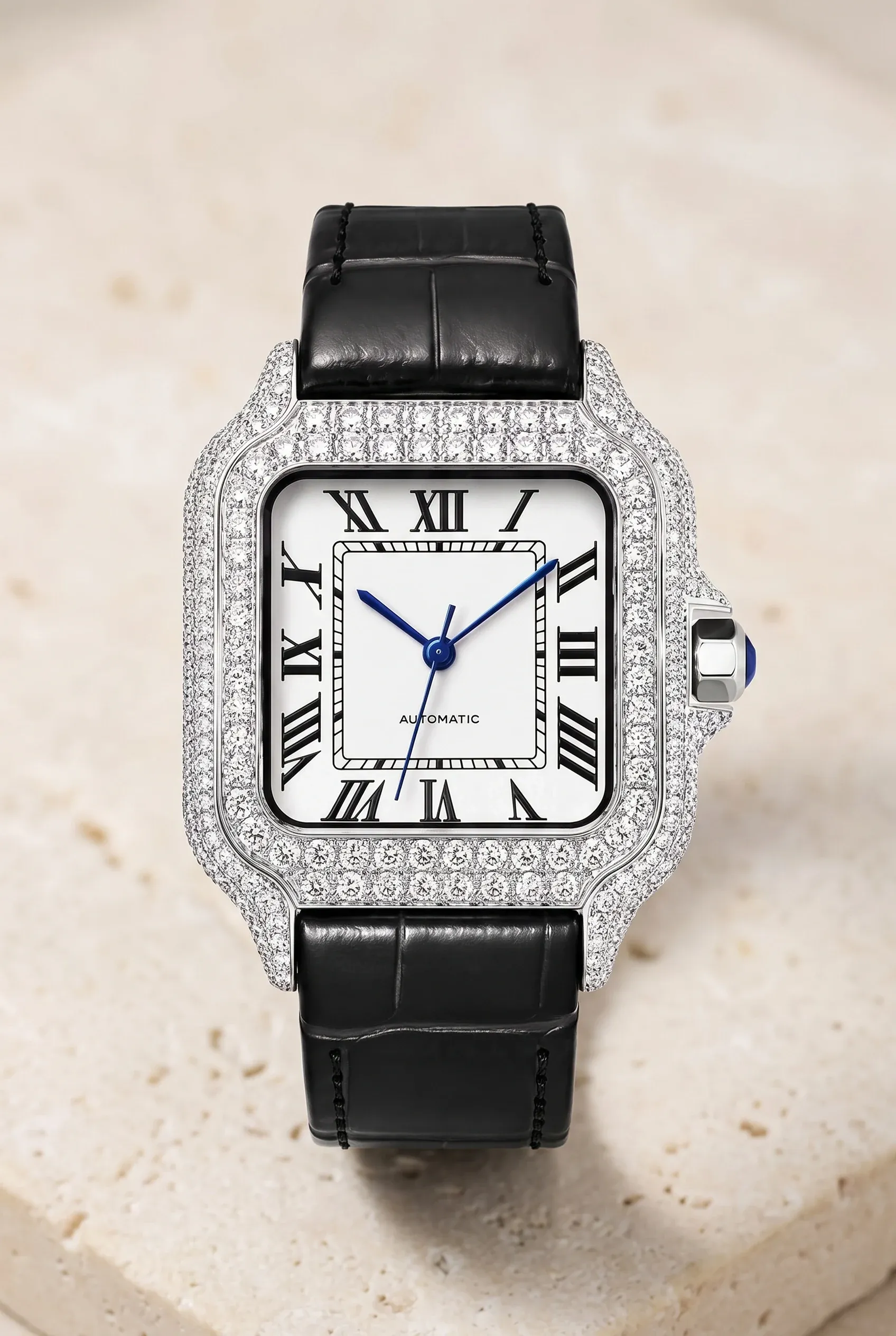
That matters even more with moissanite. Moissanite is silicon carbide, nearly all jewelry moissanite is lab grown, and its fire is stronger than diamond. On a small wrist, that extra flash can make a compact watch look dressier and larger without actually adding millimeters.
Price is a useful reality check. Fully set moissanite watches usually sit around $900 to $2,700, while crystal or CZ iced-out watches are commonly $100 to $400. If a watch is sold as moissanite for under about $300, it is almost certainly crystal or CZ, not moissanite. For a deeper look at sizes, dials, and costs, see our guide to smaller stone-set watches.
Build quality matters too. Hand-set stones, using prongs or bead setting, hold up far better than glued stones, which often shed within months. If you are comparing budget iced pieces, read why hand-set stones matter before you focus on size alone.
Most stone-set watches under $3,000 use Japanese quartz movements, and that is not a drawback for a small wrist. Quartz usually keeps the case thinner and lighter than a similar automatic. In this category, that often helps the fit more than a movement upgrade would.
Best size by style goal
Quiet and classic
If you want a watch that behaves like jewelry, stay near the lower end of the classic range. Think slim case, short lugs, and either a narrow bracelet or a leather strap. This is the easiest direction for formalwear and the least likely to overwhelm a small wrist.
Modern everyday
If you want one watch for work, weekends, and travel, move toward the upper end of the classic range or the start of the contemporary range. This gives you a cleaner read of the time and a more current proportion. The key is restraint in the dial and bracelet.
Statement watch
If you want the watch to lead the outfit, a larger case can work, but the design needs discipline. A compact 34 to 36 mm with stones, a colored dial, or a square profile often makes more sense than jumping straight to an oversized men's case. If you need outfit ideas around a bolder piece, these ways to style a statement watch are more useful than copying product photos.
The mistake is assuming a statement watch has to be physically huge. On a small wrist, brightness, shape, and bracelet style create impact faster than diameter does.
Common sizing mistakes
The first mistake is buying by diameter alone. A neat 32 mm can fit badly if the lugs are long, while a careful 35 mm can fit beautifully. The second mistake is ignoring how a bracelet behaves off the case, especially on watches with heavy center links or stone-set first links.
The third mistake is chasing trend photos without looking at your wardrobe. If you mostly wear sleeves, knits, and fine jewelry, a wide sports case may stay in the box. If you dress casually and like a unisex look, the smallest dress watch can feel too timid.
Another common mistake is forgetting thickness. A watch can be the right width and still feel clumsy if it sits high. This shows up often in stone-set pieces because crystal, bezel height, and bracelet weight all add presence.
How to measure at home and shop online
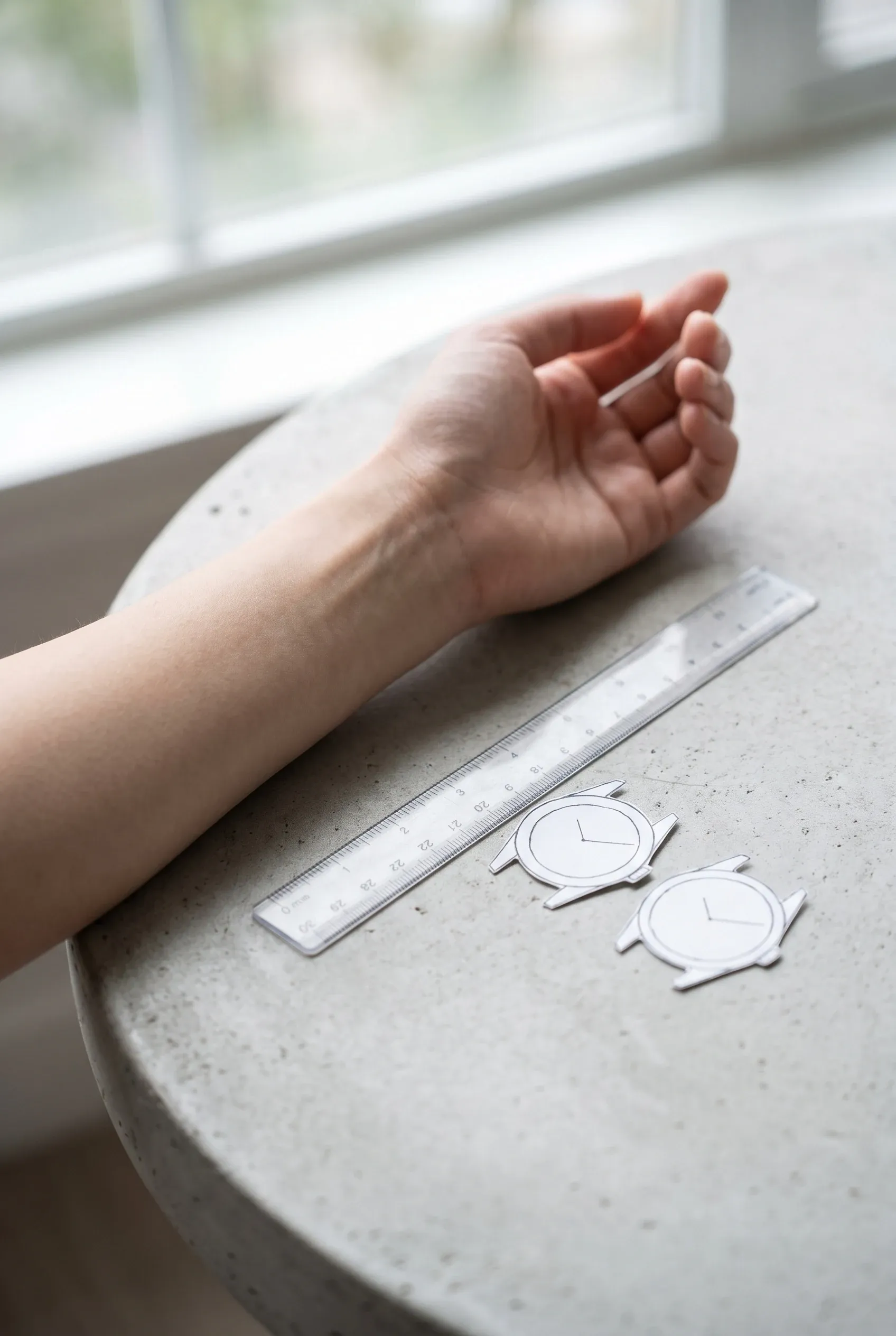
Use a soft tape to measure wrist circumference where the watch will sit. Then measure the visible top of your wrist from side to side with a ruler while your arm rests flat. That second number helps you judge whether lug-to-lug will overhang.
A simple home test works well. Cut paper circles or squares in the case sizes you are considering, place them on your wrist, and check them in a mirror from arm's length. A phone camera from straight above helps too, but a mirror is usually more honest because it matches how other people see the watch.
When shopping online, look for four things before you order: case diameter, lug-to-lug, thickness, and bracelet or strap style. If one of those is missing, you are guessing. Side views and clasped-on-wrist photos are more valuable than close-up glamour shots.
Also check practical specs. On many stone-set watches, hardened mineral glass is common, while sapphire crystal usually appears above roughly $1,500. A 3 ATM rating is fine for rain and hand-washing, not swimming.
A practical starting point
If you want one short answer, start with 28 to 32 mm if your wrist is small and you want the easiest win. Move toward 34 to 36 mm only if the watch has short lugs, a restrained dial, and a strap or bracelet that curves quickly. That is the safest way to approach a watch size for a small wrist.
If you are choosing between a 28 mm and a 36 mm watch, ask what you want the watch to do. Pick 28 mm if you want refinement, jewelry feel, and low effort. Pick 36 mm if you want readability, a modern unisex proportion, and enough wrist width to support it.
Most people do not need a bigger watch. They need a better-shaped one.
Frequently Asked Questions
What do women's watch sizes mean?
They usually refer to case diameter, measured across the watch head without the crown. That number is useful, but it is not enough by itself. Lug-to-lug, thickness, bracelet behavior, and case shape all affect how the watch actually looks and feels on the wrist.
Is 36 mm too big for a small wrist?
Not always, but it is the upper edge for many small wrists. A 36 mm watch can work if the lugs are short, the case is not too thick, and the bracelet or strap curves quickly. If the watch is square or fully stone-set, it will usually feel larger than the number suggests.
Does a 28 mm watch look too small today?
No. A 28 mm watch still looks current if your style leans classic, dressy, or jewelry-like. It works especially well under sleeves and with fine bracelets. It only looks too small if you specifically want a modern unisex proportion or a very easy-to-read dial.
Are square watches measured differently?
They are usually listed by width, but they tend to wear broader than a round watch with the same number. The corners occupy more wrist surface, so the watch has more presence. If you are moving from round to square, sizing down one step is often the safer choice.
What is the best bracelet type for a small wrist?
A bracelet that articulates quickly near the case usually fits best. Shorter first links and some taper help the watch wrap the wrist instead of sitting flat and wide. Leather straps are even easier because the holes allow finer adjustment than link removal alone.
Should I avoid iced-out watches on a small wrist?
No, but scale matters. Sparkle adds visual weight, so a compact stone-set watch often gives more balance than a large fully iced bracelet model. On a small wrist, a square or classic-sized case with stones can look dressy and intentional without feeling oversized.
Is a quartz women's watch better than an automatic for small wrists?
Often, yes, especially in stone-set categories. Quartz movements are common in watches under $3,000 and usually allow a thinner, lighter case. That helps comfort and proportion on a small wrist more than an automatic movement does, unless you specifically care about mechanical watch ownership.