How to Wear a Watch: Which Wrist How Tight and With Other Jewelry
A practical guide to wearing a watch, from which wrist and fit to case size, bracelets, cuffs, and stone-set styles.
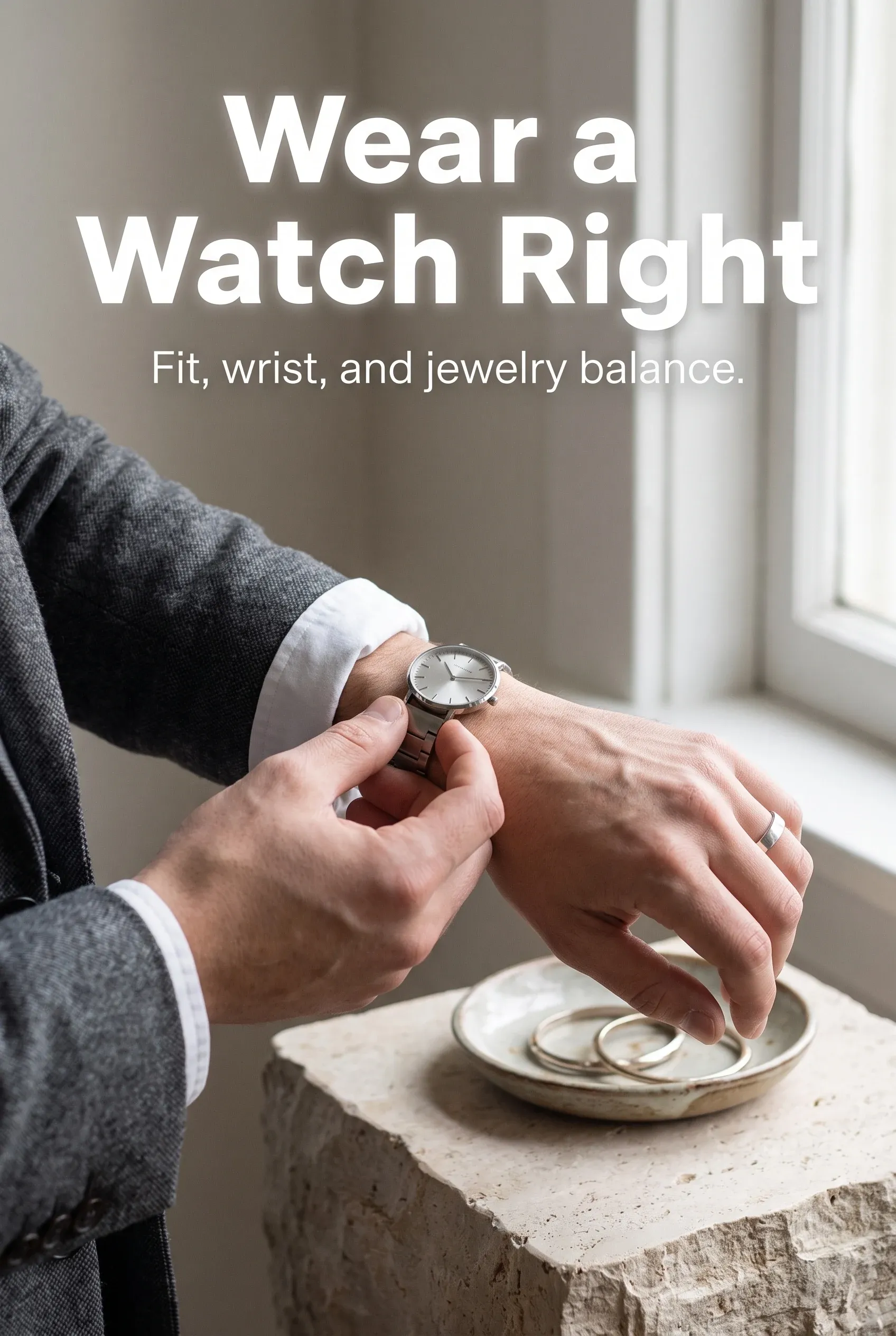
How to wear a watch is simple: wear it on the hand that moves less, keep it centered, and fit it snug. For most people, that means the non-dominant wrist, just above the wrist bone, with enough room for one finger under the strap. Then match the case size, metal, and stone coverage to your wrist, clothes, and daily routine.
Start with comfort, not old rules
Most watch advice starts with tradition. Daily wear starts with comfort. If a watch digs into your hand, slides over your wrist bone, catches every cuff, or fights your bracelets, it is not being worn correctly for you.
Old etiquette said left wrist by default because most people are right-handed, and many watches were designed to be wound or adjusted with the right hand. That still explains why the non-dominant wrist feels natural for many people. It does not mean the other wrist is wrong.
A useful watch should disappear until you need the time. You should notice the look, not the irritation. That is why wrist choice, fit, size, and jewelry balance matter more than any old rulebook.
Which wrist should you wear a watch on
The best answer is usually your non-dominant hand. A right-handed person often wears a watch on the left wrist. A left-handed person often wears it on the right. The logic is practical, your writing hand, mouse hand, and bag-carrying hand move more and knock into more things.
If you try both wrists, one often feels calmer. The watch stays straighter, the crown bothers you less, and the bracelet pinches less while typing. That is the wrist to start with.
There are good reasons to choose your dominant wrist anyway. You may stack bracelets on the other side, have a ring-heavy hand you want to balance, or simply read the time more naturally there. If the fit is right and the watch does not hit your hand, wearing it on your dominant side is fine.
The exception is work. If you cook, lift, style hair, carry a child, or use tools all day, try the less active wrist first. Less impact usually means more comfort and less wear on the watch.
Place the case above the wrist bone
A watch should sit just above the wrist bone, not on top of it and not halfway down your hand. That spot keeps the case stable and reduces rubbing. It also helps the crown avoid pressing into the back of your hand.
If the watch slides over the wrist bone every time your arm drops, it is too loose, too heavy for its strap, or simply too large. If it leaves a hard mark on the bone, it is sitting too low. Small placement changes often fix what people blame on size.
This matters even more with long sleeves. A watch worn too low catches cuffs and feels bulky. Worn slightly higher, it reads cleaner and slips under fabric more easily.
How tight should a watch be
A watch should feel secure, not squeezed. The easiest test is one finger under the strap or bracelet. If you can fit one finger, the watch is usually snug enough to stay centered and loose enough to stay comfortable.
If you can fit two fingers easily, it is probably too loose. The case will rotate, the underside will collect sweat, and the watch will crash into bracelets. If you cannot fit one finger at all, it is probably too tight.
Too-tight fit has clear signs. You see deep strap marks, the skin bulges at the edges, or your hand feels pressure while typing or driving. Too-loose fit has signs too, the case slips over the bone, the bracelet twists, or the dial ends up under your wrist.
Bracelets and straps behave differently through the day. Skin swells in heat, after walking, and during travel. A metal bracelet can feel perfect in the morning and tight by afternoon, so a small amount of play is normal. A leather or fabric strap should usually sit a touch closer because it weighs less and does not drape like metal.
Use the right case size for your wrist
Fit is not only about tightness. It is also about visual proportion. The quickest mistake is buying for trend instead of wrist width. A large case can look sharp, but the lugs should not extend past your wrist.
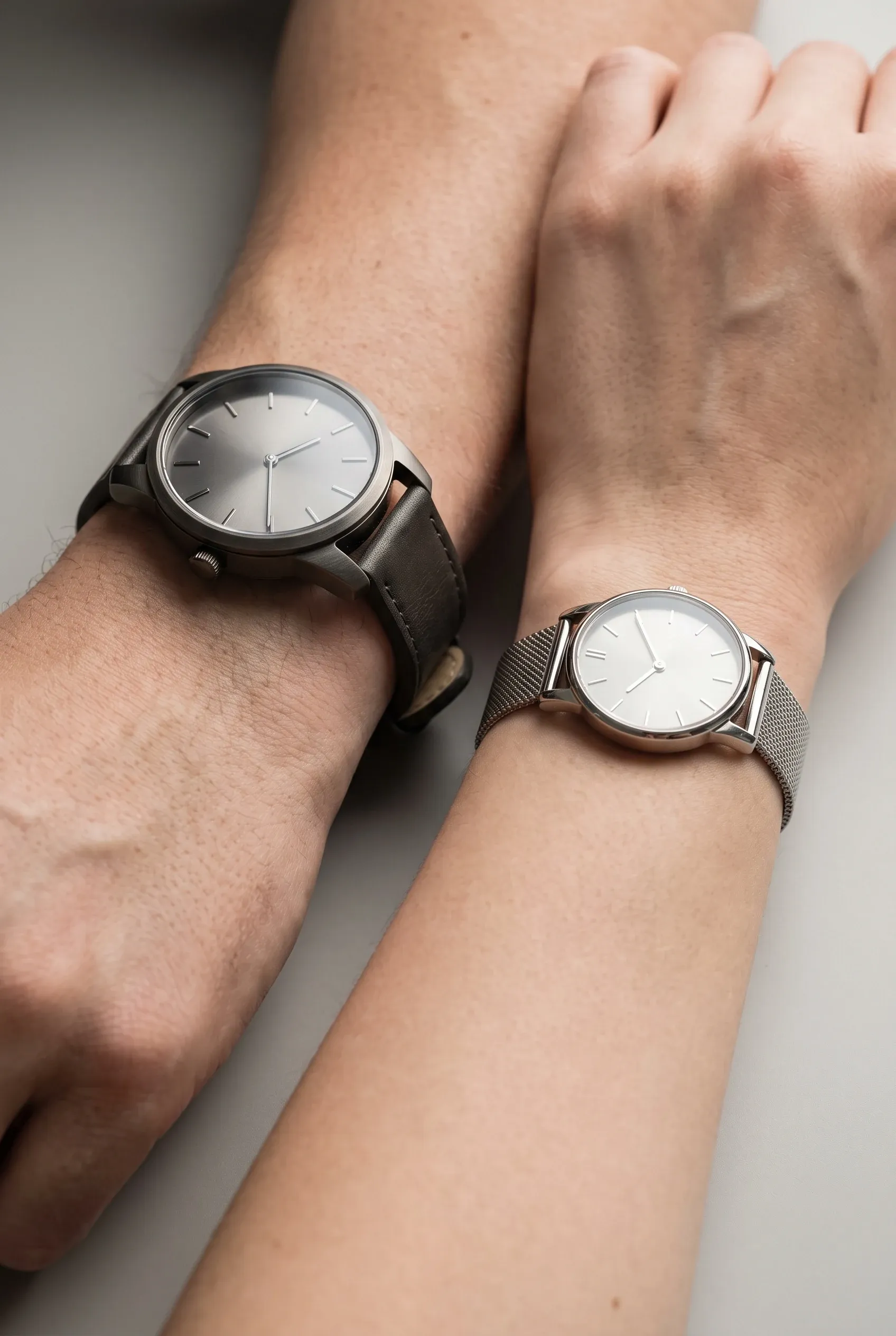
That lug-to-lug rule matters more than diameter alone. A slim 40 mm watch can wear smaller than a square 36 mm case with long lugs. If your wrist is under 6 inches, staying at or below 36 mm is the safest starting point.
For reference, women’s classic sizes usually run 26–32 mm. Women’s contemporary sizes usually run 34–36 mm. Unisex sizing is often 38–40 mm, and men’s watches usually land at 40–44 mm. If you want more detail, see this coverage on case size advice for different wrists and this breakdown with more detail on smaller wrists.
| Wearer or style | Common case size | What to watch for |
|---|---|---|
| Women’s classic | 26–32 mm | Clean fit, easy under sleeves |
| Women’s contemporary | 34–36 mm | More presence without looking oversized on many wrists |
| Unisex | 38–40 mm | Can look bold on smaller wrists |
| Men’s | 40–44 mm | Best when lug to lug stays within wrist width |
| Any wrist under 6 inches | Start at or below 36 mm | Reduces overhang and improves comfort |
The average US men’s wrist is about 7 to 7.5 inches, so many 40–42 mm watches look balanced there. That does not make them universal. A square case, thick bezel, or full stone setting makes any watch wear larger than the number suggests.
Strap and bracelet change the fit
Two watches with the same case size can feel completely different because the attachment changes the weight and drape. A leather strap, fabric strap, or slim rubber strap usually keeps the watch lighter and closer to the wrist. A metal bracelet adds weight and visual width.
If you want a dressier look that disappears under a cuff, a strap is usually easier. If you want more presence, a bracelet does some of that work before you even increase case size. This is why a 36 mm watch on a bracelet can feel bolder than the same case on leather.
Bracelets also need better sizing. One extra link can turn a good fit into a spinner. Straps are more forgiving because you can move one hole at a time. If you are between looks, keep the same case and change the attachment first.
Wear it with rings, bracelets, and cuffs
The cleanest rule is to let one item lead each wrist. If the watch is slim and quiet, you can add one narrow bracelet on the same side. If the watch is wide, bright, or stone set, keep that wrist mostly alone and move other jewelry to the opposite hand.
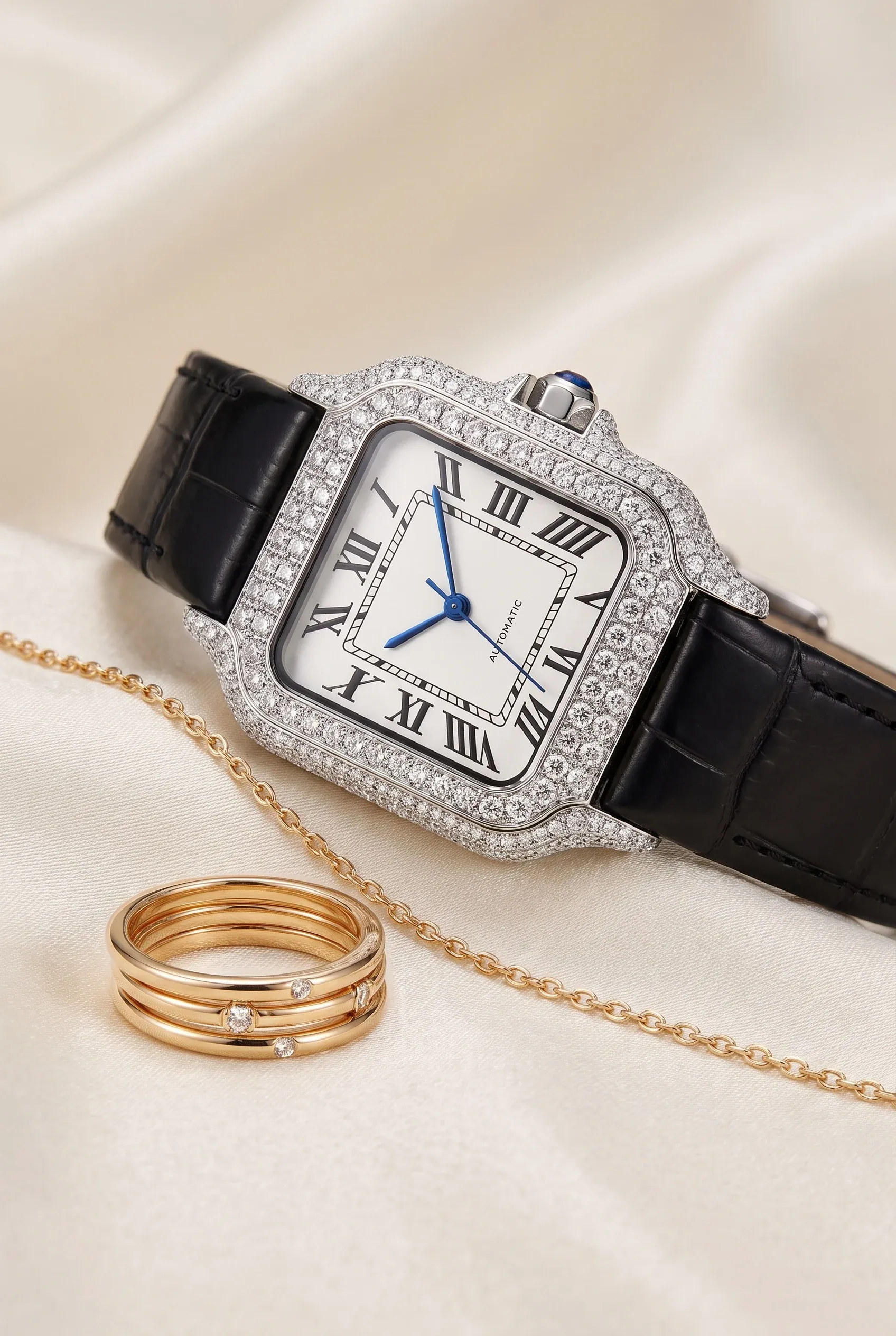
When stacking on the same wrist, soft pieces are safer than hard ones. A thin chain bracelet or cord bracelet rubs less than a rigid bangle. Put the watch nearest your hand and the bracelet above it toward the elbow, so the case remains readable.
Rings matter too. If you wear a heavy ring stack on one hand, the watch can balance the other hand visually. If both sides are loud, the whole look starts competing. For ideas on proportion, see these outfit notes on a few outfit formulas.
Cuffs need room. A bracelet cuff shirt works best with a slimmer watch, while a full French cuff often pairs better with something thin and plain. If the cuff catches repeatedly, either the watch is too thick or it is sitting too low.
Match the watch to sleeves and dress codes
Watch size should change with clothing, not just with wrist size. Under a suit, blazer, or fine knit, thinner and less busy usually look better. A clean dial and moderate case read sharper than a thick sport case fighting the fabric.
With short sleeves, denim, sweats, or a casual jacket, you have more room to go larger. That does not mean biggest is best. It means the watch can take a little more space because there is no cuff to compete with it.
For formal settings, quieter finishes tend to read better. Think fewer visual breaks, less stone coverage, and proportions that stay inside the wrist line. For casual settings, texture, color, and chunkier bracelets make more sense.
This is also why the same watch can feel perfect on Friday and wrong on Monday. The watch did not change. The sleeve, shoe, and occasion did.
Balance the watch with the rest of your outfit
A watch should connect to the outfit somewhere. The easiest match points are shoe hardware, belt buckle, earrings, rings, or the zipper tone on a jacket or bag. Exact matching is not required, but random mixing looks less intentional.
If the watch has a colored dial, repeat that color lightly elsewhere. That might be a knit, bag, nail color, or shirt stripe. One echo is enough. More than that starts looking themed.
If the watch is fully bright, keep the rest cleaner. That matters most with large metal bracelets and fully set stone watches. If you want background on the term, here is the background on iced out watches.
The outfit should also match the watch’s attitude. Minimal watch, minimal hardware. Bold watch, simpler clothes. When everything shouts, nothing looks expensive.
Stone-set and moissanite watches need extra restraint
Stone-set watches read larger and louder than plain watches at the same diameter. A 40 mm fully set watch often looks bigger than a plain 40 mm steel watch because the sparkle pulls attention to every edge. That means fit and styling need more discipline.
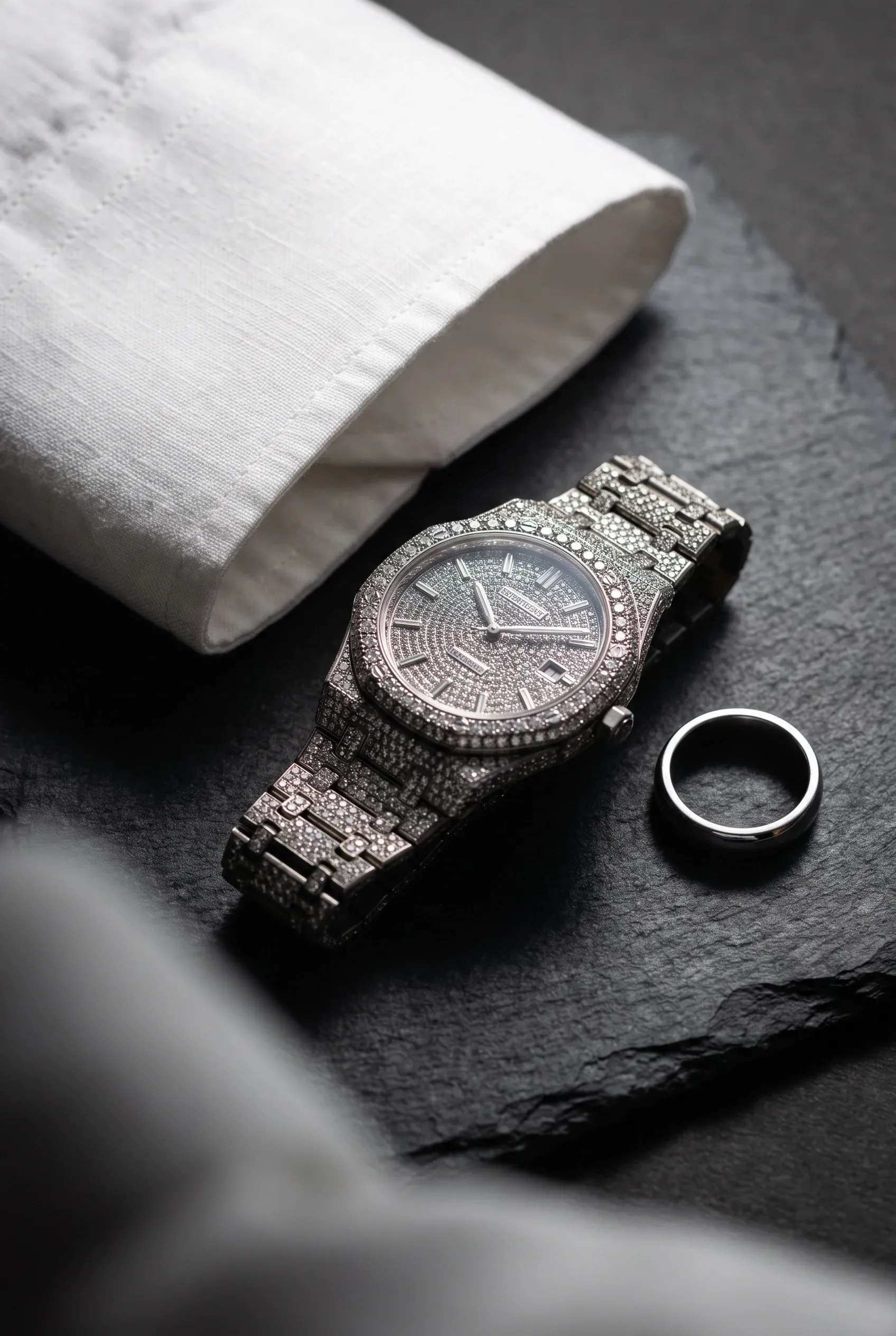
Moissanite is a legitimate stone category, not costume glass. It is silicon carbide, nearly always lab grown for jewelry, and it is hard enough for daily wear at 9.25 on the Mohs scale. It also throws more rainbow fire than diamond, with dispersion of 0.104 versus 0.044, so it flashes harder in direct light.
That stronger fire is why a fully set moissanite watch usually looks best with simpler clothes and fewer competing bracelets. Let the watch be the main event. Add rings if you want, but keep them cleaner than the wrist.
| Stone watch category | Typical 2026 price | What that usually means |
|---|---|---|
| Crystal or CZ fully iced watch | $100 to $400 | Entry level look, usually quartz |
| Fully set moissanite watch | $900 to $2,700 | Real moissanite stones, usually Japanese quartz under $3,000 |
| Custom lab diamond set watch | $5,000 to $15,000 | Higher material cost, thicker budget and servicing plan |
| Custom natural diamond set watch | $15,000 to $60,000 and up | Luxury custom work with much higher stone cost |
| Factory diamond set watch from a major house | $40,000 to $250,000 and up | Brand premium and factory setting |
If a watch is sold as moissanite for under about $300, it is almost certainly crystal or CZ, not moissanite. That does not automatically make it unwearable, but it should change your expectations. The look may be fine. The material is different.
Setting quality matters as much as stone type. Watches with why hand set stones matter stay together better than glued stones, which often start shedding within months. For day-to-day use, remember that 3 ATM water resistance means rain and hand-washing, not swimming. Hardened mineral glass is common at lower prices, while sapphire crystal usually starts showing up above roughly $1,500.
Adjust for work, weather, and daily movement
A watch is not static all day. Your wrist changes with temperature, travel, and movement. In hot weather, a bracelet may need a touch more room. In cold weather, that same watch can suddenly feel loose.
Your job also changes the right setup. If you type all day, a smaller case and smoother bracelet are easier on the desk and the back of your hand. If you are active, a lighter watch on a strap often stays put better than a heavy bracelet.
Think about what your wrist actually does. If you lift weights, push a stroller, ride a bike, or carry grocery bags, test the watch during those motions. A watch that only feels good when standing still is not fitted well enough.
Rotation helps too. You do not need one watch to do everything. A slim everyday piece, a dress piece, and a louder weekend piece cover most real wardrobes better than one giant compromise.
Common mistakes and a simple checklist
Most watch problems come from four mistakes. The watch is too loose, too low on the wrist, too large for the lug span, or too busy for the rest of the outfit. Fix those and most styling questions solve themselves.
- Choose the less active wrist. Start there, then switch only if comfort or jewelry balance is better on the other side.
- Place the case above the wrist bone. If it drops onto your hand, adjust the fit or choose a smaller watch.
- Use the one finger test. One finger under the strap is usually right. Two is loose. None is tight.
- Check lug overhang. The lugs should not extend past your wrist width.
- Let one wrist lead. If the watch is bold, keep same-side bracelets minimal.
- Match the watch to the outfit. Thin and simple for cuffs, larger and bolder for casual looks.
If you want one rule to remember, make it this. A watch should look centered, move only a little, clear your hand, and make the rest of your jewelry look more intentional.
Frequently Asked Questions
Should a watch sit above or on the wrist bone
A watch should sit just above the wrist bone. That position keeps the case stable, reduces sliding, and stops the crown from pressing into your hand. If it keeps dropping onto the bone, the fit is too loose, the case is too heavy, or the watch is simply too large for your wrist.
Can you wear a watch on your dominant hand
Yes. The non-dominant wrist is the usual starting point because it moves less, but there is no hard rule. If your dominant wrist feels better, balances your rings and bracelets better, or makes the dial easier to read, it is a valid choice as long as the watch does not hit your hand.
How much movement is normal in a watch fit
A little movement is normal, especially with metal bracelets and in warm weather. What you do not want is rotation around the wrist or the case sliding down over your wrist bone. If the dial ends up under your wrist, the watch is too loose or too heavy for its current fit.
Should bracelets go on the same wrist as a watch
They can, but the watch should remain the main piece on that wrist. Thin and soft bracelets work better than rigid bangles because they rub less and crowd the case less. If the watch is large, bright, or fully stone set, bracelets usually look cleaner on the opposite wrist.
What size watch looks best on a small wrist
If your wrist is under 6 inches, start at or below 36 mm. Also check the lug span, because lug to lug should not exceed your wrist width. Women’s classic sizes usually run 26–32 mm, while 34–36 mm gives a more current look without automatically going oversized.
Can a fully iced watch work as an everyday watch
It can, but it is harder to style every day than a plain watch. Fully set watches read bigger, brighter, and dressier, even in casual clothes. They work best when the rest of the outfit is simple and the setting quality is solid, especially if you plan to wear it often.
Are moissanite watches only for dressy outfits
No. A moissanite watch can work casually, especially if the case size is controlled and the stone coverage is moderate. The key is balance. Because moissanite throws strong fire, it usually looks best with quieter clothing, fewer same-side bracelets, and cleaner metal choices elsewhere in the outfit.