Where Does Moissanite Come From?
A meteor crater in Arizona, then a lab. The geology behind the stone and why nearly every moissanite in jewelry is grown, not mined.
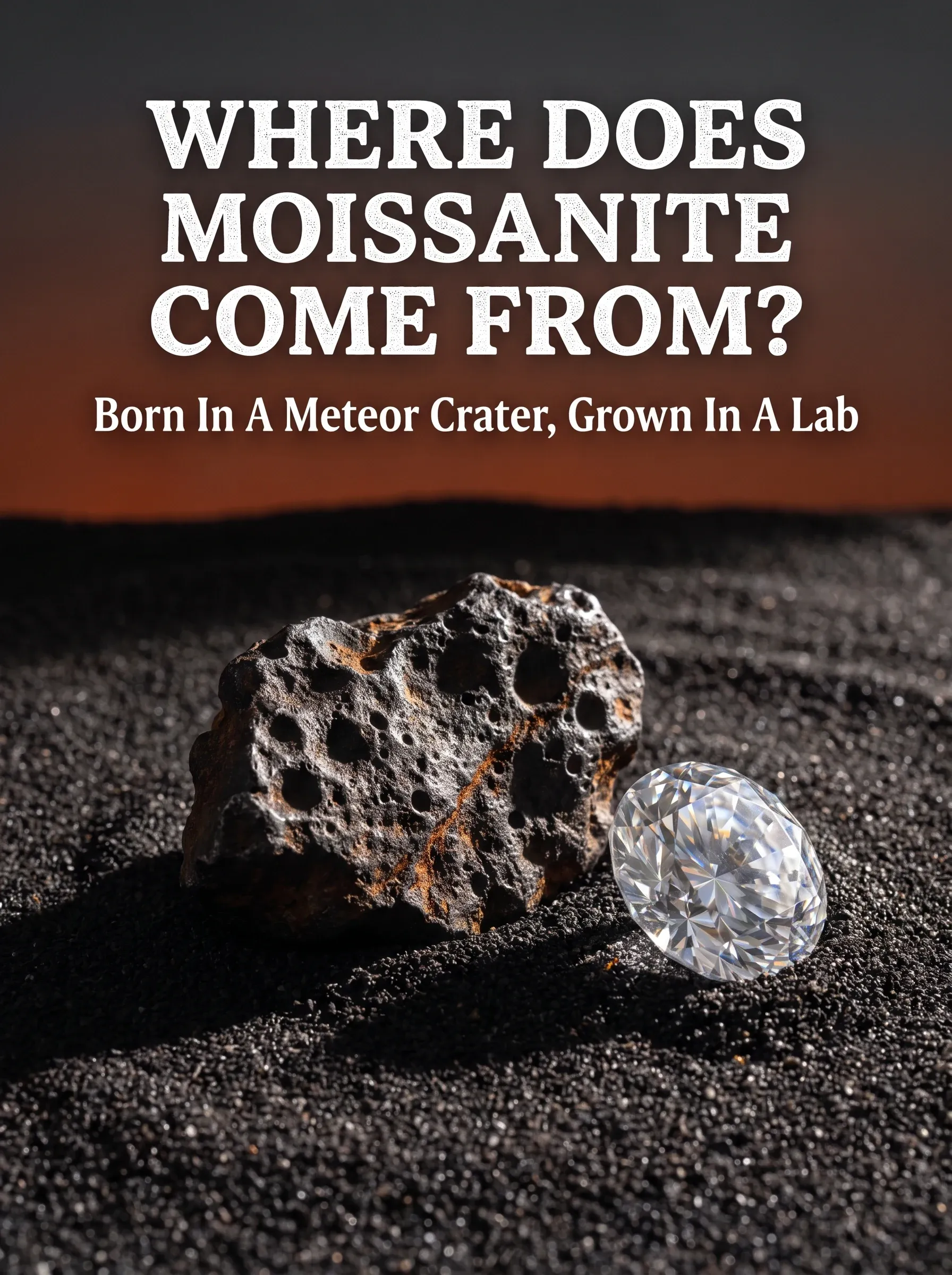
Moissanite comes from two places: nature and the lab. Natural moissanite was first identified in 1893 by French chemist Henri Moissan after he examined tiny crystals from a meteor crater in Arizona, but the moissanite used in modern jewelry is almost entirely lab created because natural moissanite is extraordinarily rare and usually too small for gemstone use.
If you are shopping for an engagement ring or simply want to understand what this stone really is, the key fact is simple: moissanite is a real gemstone made of silicon carbide, not a diamond imitation made of glass or cubic zirconia.
Introduction to Moissanite
Defining Moissanite and Its Unique Qualities
Moissanite is the natural mineral form of silicon carbide. In gem form, it stands out for three traits that matter most in jewelry: hardness, brilliance, and durability. On the Mohs scale, moissanite ranks about 9.25, which makes it one of the hardest stones used in fine jewelry.
Its optical character also sets it apart. Moissanite has strong brilliance and pronounced fire, so you see bright white sparkle along with rainbow flashes under light. That lively look is one reason the gemstone became a serious alternative to diamonds rather than a niche substitute.
Moissanite’s Role in Contemporary Jewelry
Today, moissanite plays a major role in engagement jewelry, wedding bands, earrings, pendants, and everyday rings. Its combination of toughness and sparkle makes it practical for daily wear, especially in pieces that take regular contact, such as engagement rings.
It also fills a clear market need. Many buyers want a stone that looks luxurious, wears well, and costs less than comparable diamonds. Moissanite meets that need while remaining a genuine gemstone with its own mineral identity.
Natural Occurrence and Formation of Moissanite
Naturally Occurring Moissanite vs. Lab-Created Versions
Natural moissanite exists, but it is one of the rarest naturally occurring gem materials associated with jewelry. It has been found in meteorites and in limited geological settings such as upper mantle rock. It also appears as tiny inclusions in diamonds, xenoliths, kimberlite, and lamproite.
That rarity explains why nearly all moissanite sold today is lab created. Natural crystals are usually microscopic, which makes gem-quality natural moissanite exceptionally difficult to source. In practical terms, if you see a moissanite center stone in a ring, it is almost certainly lab grown.
The important distinction is not “real versus fake.” Both natural moissanite and lab-created moissanite are silicon carbide. They share the same basic chemical composition. The difference is origin: one formed naturally, the other was made under controlled laboratory conditions.
Geological Formation: Silicon, Silicon Carbide, and Carbide Origins
To understand where moissanite comes from, you need to start with its chemistry. Moissanite forms from silicon and carbon bonded together as silicon carbide. That carbide structure is what gives the mineral its hardness and thermal stability.
In nature, moissanite formed under extreme conditions linked to high heat and pressure. Some natural particles arrived on Earth through meteorites, which is why its discovery story begins in a crater rather than a mine. Other naturally occurring traces have been found in deep-earth geological environments.
Because those conditions do not produce abundant, jewelry-sized crystals on Earth, natural moissanite never became a mainstream mined gemstone. Its natural origin is scientifically fascinating, but its rarity kept it from becoming widely available until laboratory production solved the size and supply problem.
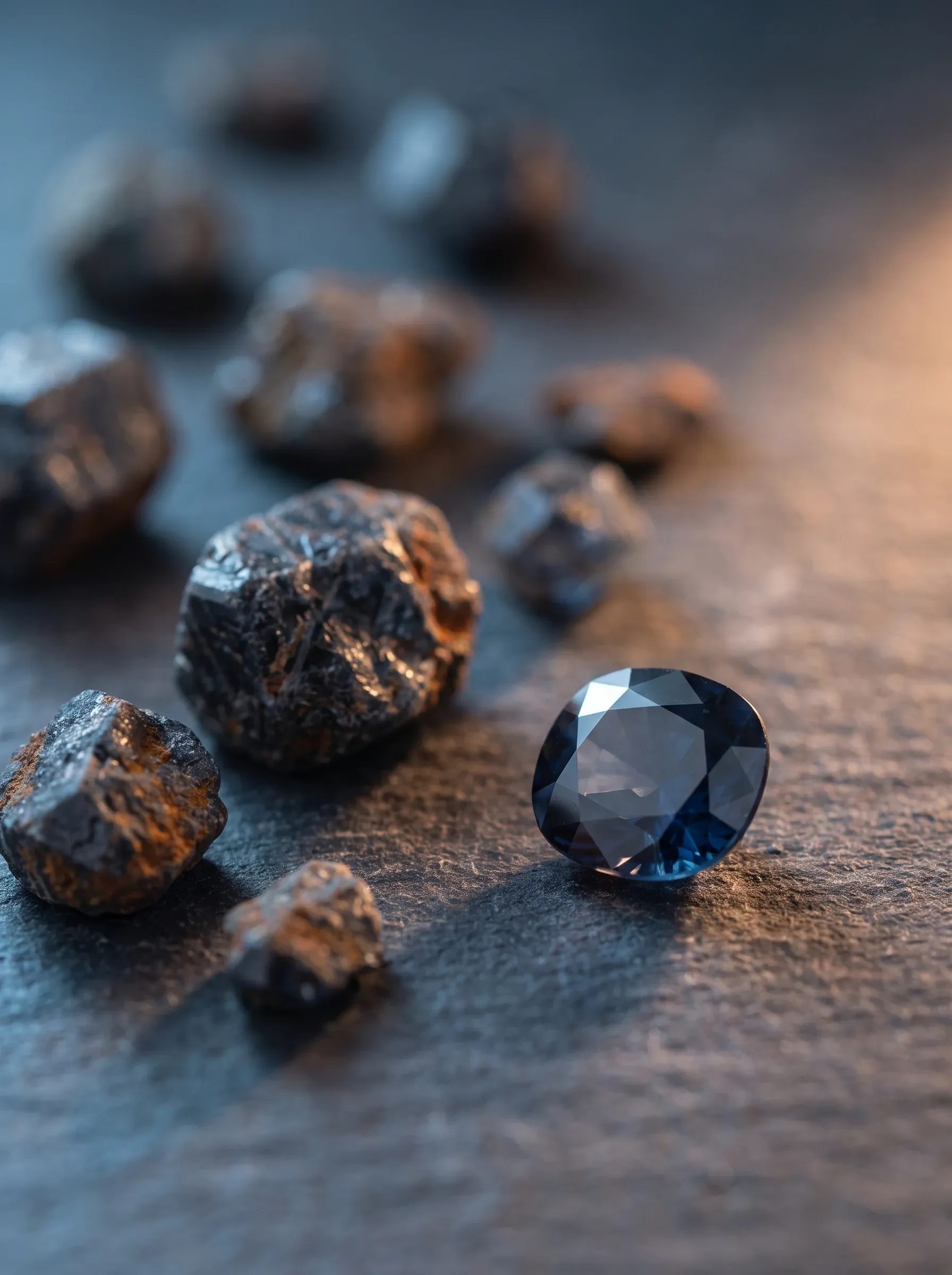
The Science Behind Moissanite
Chemical Composition: Silicon and Silicon Carbide Explained
Moissanite is composed of silicon carbide, written chemically as SiC. Diamonds, by contrast, are composed of pure carbon in a different crystal structure — the reason moissanite is not classed as a diamond. That single difference in composition explains why moissanite and diamond can look similar at a glance yet behave differently in light.
Silicon carbide gives moissanite a strong mix of properties valued in a gemstone:
- High hardness for scratch resistance
- Strong brilliance and fire for visible sparkle
- Good toughness for everyday jewelry wear
- Heat resistance that helps during routine jewelry repair and cleaning
Lab moissanite is made by growing silicon carbide crystals under tightly controlled conditions. The process starts with purified raw materials, then uses very high temperatures to create crystals large enough to cut into gemstones. After growth, each stone is cut, polished, and checked for clarity, color, and overall finish.
Gem Cutting Techniques and Their Impact on Engagement Jewelry
Cut matters just as much as origin. A moissanite gemstone can be fashioned into round, oval, cushion, emerald, and other popular shapes, and the cut directly affects how the stone returns light to your eye.
In engagement jewelry, round cuts usually emphasize brilliance most strongly, while elongated cuts such as oval and emerald can make the stone appear larger across the finger. Precise faceting also helps control the balance between white sparkle and rainbow fire, which is especially important because moissanite is naturally very lively in light.
If you are choosing a moissanite engagement ring, focus on more than size alone. The cut, the setting style, and the number of accent stones all influence how the finished jewelry looks and how much it costs.
History and Discovery of Moissanite
The Discovery: From Rare Mineral to Sought-After Gemstone
Henri Moissan discovered the mineral in 1893 while studying tiny crystals from a meteor crater in Arizona. A report in Nature dated February 16, 1893, documented his early work with minute crystals tied to the material later named moissanite.
The stone was named after Moissan roughly a decade later, which is also where its slightly awkward pronunciation comes from. He went on to receive the 1906 Nobel Prize in Chemistry, and his work helped secure his place in the history of mineral science. What he found was not diamond, even though the crystals initially resembled it. The material was naturally occurring silicon carbide.
That discovery gave moissanite its origin story: a rare mineral found in material linked to a meteorite impact rather than a conventional gemstone deposit.
Milestones in Moissanite’s Evolution and Creation
For many years, silicon carbide had more industrial than jewelry use. Early synthetic material existed, but it was not initially attractive enough for fine gemstone applications. The shift came when producers developed methods to create high-quality crystals suitable for cutting and polishing.
A major commercial milestone arrived in the mid-1990s, when a North Carolina company founded in Research Triangle Park introduced lab-grown moissanite to the jewelry market. That changed moissanite from a scientific rarity into a viable fine-jewelry stone.
Another important turning point came later, when key patents expired. After that, manufacturers in China began producing moissanite as well, which expanded supply and helped the stone become more widely available across the global jewelry market.
Moissanite vs. Diamonds: A Comparative Analysis
Natural Origins and Formation Differences Between Moissanite and Diamonds
Moissanite and diamonds differ at the most basic level: composition and origin. Moissanite is silicon carbide. Diamond is crystallized carbon. Natural moissanite is found in meteorites and rare geological environments, while natural diamonds form deep within the Earth under different pressure and temperature conditions.
Lab-created moissanite is made in a laboratory from silicon carbide. Lab-grown diamonds are also made in a laboratory, but they remain diamonds because their composition is still carbon. That distinction matters if you want to know exactly what stone you are buying rather than just how it looks.
| Criterion | Moissanite | Diamond |
|---|---|---|
| Composition | Silicon carbide | Pure carbon |
| Natural origin | Meteorites and rare geological environments | Deep-earth formation |
| Common jewelry supply | Mostly lab created | Natural and lab grown |
| Hardness | About 9.25 Mohs | 10 Mohs |
| Visual character | Strong brilliance and rainbow fire | Classic diamond sparkle |
| Price positioning | Generally lower than diamonds | Generally higher |
Price is one of the biggest practical differences. A moissanite center stone typically costs a small fraction of what a natural diamond of similar face-up size commands, though real-world pricing depends heavily on size, cut, setting, and retailer. The broader point holds: moissanite is chosen partly because it offers a high-end look at a far lower cost.
Jewelry Applications: Engagement Trends and Aesthetic Appeal
For engagement jewelry, moissanite appeals to buyers who want maximum sparkle, durability, and a more accessible price point. It works well in solitaire rings, halo settings, three-stone rings, wedding bands, and earrings.
Diamond still holds stronger traditional status for many buyers, but moissanite has built its own identity. You are not just choosing a cheaper diamond look. You are choosing a different gemstone with a brighter, more fiery visual style.
If you prefer crisp white sparkle with less rainbow flash, diamond may suit your taste better. If you want bold brilliance and value size-for-budget, moissanite is often the stronger fit.
The Role of Moissanite in Modern Jewelry
Trends and Market Impact in Contemporary Jewelry Design
Moissanite has moved well beyond being a backup option. It now influences mainstream jewelry design because it gives designers freedom to work with larger center stones, more detailed settings, and a wider range of cuts without pushing the final price as high as diamond jewelry.
That shift has been especially visible in engagement rings. Buyers increasingly want a stone that fits personal values as well as personal style, and moissanite answers both concerns with durability, strong visual performance, and a non-mined primary supply chain.
Its rise also changed consumer expectations. More shoppers now understand the difference between natural rarity and lab creation, and they are comfortable choosing a created gemstone when the material itself is real and the quality is reliable.
Comparing Moissanite to Lab Grown Diamonds and Other Stones
Moissanite sits in a distinct category. It is not a diamond, and it is not simply another generic diamond simulant. Compared with lab grown diamonds, moissanite differs in composition, optical behavior, and price position. Compared with cubic zirconia, it offers much better hardness, durability, and long-term wear.
If you are choosing among popular center-stone options, this framework helps:
- Choose moissanite if you want high brilliance, strong durability, and a lower price than diamond.
- Choose a lab grown diamond if you want diamond composition with laboratory origin.
- Choose a natural diamond if geological origin and traditional market status matter most to you.
That makes moissanite especially compelling for buyers who care more about performance and appearance than about owning a carbon-based diamond specifically.
The Future of Moissanite: Sustainability and Innovation
Environmental and Ethical Considerations in Moissanite Production
Modern moissanite is closely tied to sustainability discussions because it avoids the large-scale mining required for most natural gemstone supply. Lab production reduces land disruption and gives buyers a conflict-free option for fine jewelry.
That does not mean every purchase decision is identical in environmental impact, but the overall case is clear: lab-created moissanite exists largely because natural moissanite is too rare to support a fine-jewelry market at scale. For many buyers, that makes it an easier ethical choice than mined stones.
There is also a consumer-protection angle. When you buy moissanite, verify what the seller is actually offering and look for recognized grading or certification practices such as GIA or IGI documentation when available. Clear disclosure matters, especially when comparing moissanite with diamonds or lab grown diamonds.
Advancements in Production Methods and Gemstone Quality Improvements
Production quality has improved dramatically since the earliest synthetic silicon carbide materials. Better crystal growth, more consistent color control, and more refined cutting standards have made modern moissanite suitable for high-end engagement jewelry rather than only industrial use.
Growth itself takes time. High-quality lab-grown moissanite crystals can require two to three months for a batch, and the process depends on stable high-temperature conditions. Once the rough is produced, the stone still has to be cut and polished well to perform like a premium gem.
The next stage of moissanite’s future is not about proving it belongs in jewelry. That question is already settled. The focus now is better consistency, more sophisticated cuts, and finer control over the appearance buyers want in modern gemstone design.
Frequently Asked Questions
Is moissanite natural or lab created?
Both exist. Moissanite is a natural mineral form of silicon carbide, but nearly all moissanite used in jewelry today is lab created because natural moissanite is extremely rare and usually microscopic.
Was moissanite really found in a meteor crater?
Yes. Henri Moissan identified tiny crystals in 1893 while studying material from a meteor crater in Arizona, which is why moissanite is strongly associated with a meteorite origin story.
What is moissanite made of?
Moissanite is made of silicon carbide, a compound of silicon and carbon. That composition gives the gemstone its hardness, brilliance, and heat resistance.
Is moissanite a diamond?
No. Moissanite and diamond are different stones. Moissanite is silicon carbide, while diamond is pure carbon crystallized in a different structure.
Why is natural moissanite so rare?
Natural moissanite forms under unusual extreme conditions and is most often found only in tiny particles in meteorites or rare geological environments. Jewelry-sized natural crystals are exceptionally difficult to find.
Is lab-created moissanite a real gemstone?
Yes. Lab-created moissanite is a real gemstone with the same chemical composition as natural moissanite. The difference is how the crystal originated, not what the stone is.
Is moissanite good for engagement rings?
Yes. Moissanite is a strong choice for engagement rings because it ranks about 9.25 on the Mohs scale, resists everyday wear well, and delivers intense sparkle.
How can you tell moissanite from diamond?
The most noticeable visual difference is that moissanite shows stronger rainbow fire than diamond. Composition is the definitive difference: moissanite is silicon carbide, and diamond is carbon.